







American Forests is aiming to assist with at least 100 cities to make progress on Tree Equity by 2030. Photo by Thomas Koenig/Big Pineapple Productions

The oldest national nonprofit conservation organization in the U.S American Forests has launched the Houston Tree Equity Score Analyzer, which was developed through local nonprofit Trees For Houston and local stakeholders from local government, environmental groups and the public health sector, and supported by Google’s philanthropic arm Google.org with a $450,000 grant.

To mark the launch, Trees For Houston and American Forest celebrated the partnership and worked to plant 50 trees at Shadydale Elementary in Northeast Houston on December 6.

“This marks a significant milestone for Houston's urban forestry efforts,” says Texas State Representative Senfronia Thompson at the December 6 event. “This effort goes beyond simply planting trees—it’s about creating the foundation for a greener, more inclusive future for our community. By uniting diverse resources and partners, including American Forests, Google.org and Trees For Houston, we’re showcasing a powerful dedication to enhancing the environmental well-being and quality of life in our urban areas.”

How the analyzer works is it provides auto-generated data on the impact of tree cover alongside demographic data, land use, poverty and other socioeconomic factors to assist with guide planning and investments to grow tree cover. The Houston Tree Equity Analyzer found that Shadydale Elementary has just 9 percent tree canopy coverage, which falls short of the 30 percent canopy goal for the area. The planting will increase the canopy by 6 percent according to a news release. According to American Forests, nearly 80 percent of urban neighborhoods in the United States have inadequate tree cover.

“The Tree Equity Score Analyzer enables communities to take a human-centered, data-driven approach to developing actionable tree planting and protection plans, ensuring they are focusing on areas that need them most, like Shadydale Elementary School,” said Vice President of GIS and Data Science at American Forests Chris David said in a news release.

American Forests is aiming to assist with at least 100 cities to make progress on Tree Equity by 2030. American Forests helped to unlock $1.5 billion, which was the nation’s largest federal investment in urban forestry in the Inflation Reduction Act of 2022.

“We look forward to working with our partners in Houston to continue to grow equitable tree cover in the community with data-driven approaches and action,” David says in a news release.
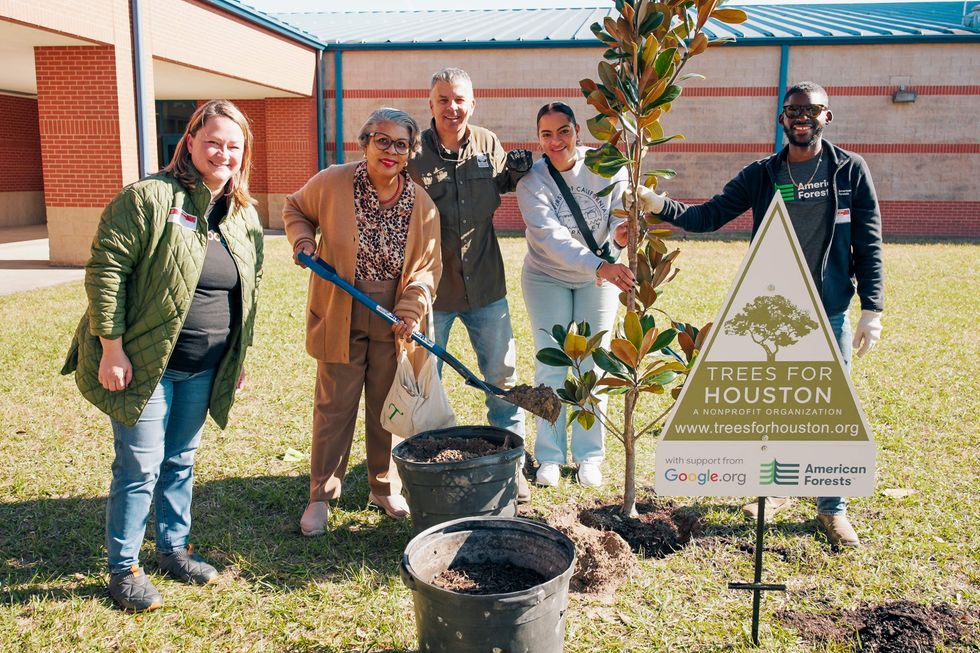
Photo by Thomas Koenig/Big Pineapple Productions

Ad Placement 300x100
Ad Placement 300x600

CultureMap Emails are Awesome

Houston AI energy forecasting company lands investment from Samsung Ventures

funding for forecasts

Amperon, a Houston-based AI-powered forecasting solutions company, has received an investment for an undisclosed amount from Samsung Ventures, the corporate venture arm of Samsung Group.

According to Amperon, the funding will be put toward the company's global growth and next-generation product development. Samsung Ventures invests in emerging businesses developing technologies for the AI, advanced devices and energy-related sectors.

“Samsung Ventures’ investment is a strong validation of our mission to transform the way energy is forecasted and traded,” Sean Kelly, CEO and co-founder of Amperon, said in a news release. “Samsung’s global footprint and leadership in semiconductors, data infrastructure, and AI acceleration make them a natural fit as we expand Amperon’s reach into energy-intensive sectors like data centers. Their track record of scaling next-generation technologies aligns perfectly with our vision to build a more intelligent, resilient, and data-driven energy system.”

Amperon was founded in 2018. Its AI models combine real-time weather, consumption and market data for energy retailers, utilities and independent power producers.

Last year, the company launched its weather-informed grid demand Mid-Term Forecast (MTF), which provides users with data on electricity demand up to seven months in advance. It also secured strategic investments from Acario, the corporate venture capital and innovation division of Tokyo Gas, as well as National Grid Partners, the venture investment and innovation arm of National Grid (NYSE: NGG).

After expanding into Europe in 2024, the company has continued to see international growth, and currently operates in the U.S., Canada, Mexico, Australia, Europe and the Middle East.

“Amperon has demonstrated strong technical capabilities and global traction in a rapidly evolving energy landscape,” a spokesperson for Samsung Ventures added in the release. “Their ability to forecast and model real-time energy data at global scale positions them as a key enabler of smarter energy systems and climate resilience. We are pleased to invest in a company developing technologies that support a more sustainable and digitized world.”

Solar surpasses coal to become ERCOT’s third-largest power source in 2025

by the numbers

Solar barely eclipsed coal to become the third biggest source of energy generated for the Electric Reliability Council of Texas (ERCOT) in 2025, according to new data.

In 2024, solar represented 10 percent of energy supplied to the ERCOT electric grid. Last year, that number climbed to 14 percent. During the same period, coal’s share remained at 13 percent.

From the largest to smallest share, here’s the breakdown of other ERCOT energy sources in 2025 compared with 2024:

  • Combined-cycle gas: 33 percent, down from 35 percent in 2024
  • Wind: 23 percent, down from 24 percent in 2024
  • Natural gas: 8 percent, down from 9 percent in 2024
  • Nuclear: 8 percent, unchanged from 2024
  • Other sources: 1 percent, unchanged from 2024

Combined, solar and wind accounted for 37 percent of ERCOT energy sources.

Looking ahead, solar promises to reign as the star of the ERCOT show:

  • An ERCOT report released in December 2024 said solar is on track to continue outpacing other energy sources in terms of growth of installed generating capacity, followed by battery energy storage.
  • In December, ERCOT reported that more than 11,100 megawatts of new generating capacity had been added to its grid since the previous winter. One megawatt of electricity serves about 250 homes in peak-demand periods. Battery energy storage made up 47 percent of the new capacity, with solar in second place at 40 percent.

The mix of ERCOT’s energy is critical to Texas’ growing need for electricity, as ERCOT manages about 90 percent of the electric load for the state, including the Houston metro area. Data centers, AI and population growth are driving heightened demand for electricity.

In the first nine months of 2025, Texas added a nation-leading 7.4 gigawatts of solar capacity, according to a report from data and analytics firm Wood Mackenzie and the Solar Energy Industries Association.

“Remarkable growth in Texas, Indiana, Utah and other states ... shows just how decisively the market is moving toward solar,” says Abigail Ross Hopper, president and CEO of the solar association.