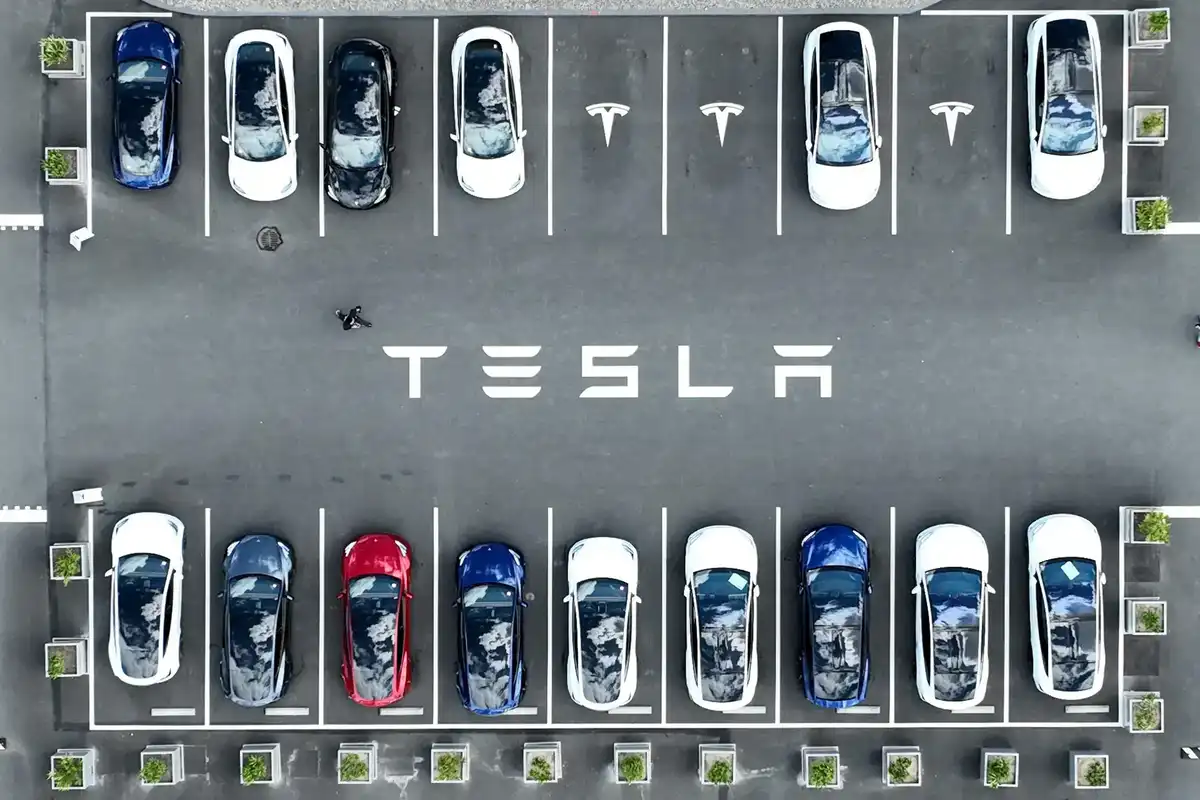
Wood Mackenzie predicts EVs will account for 20 percent of the U.S. personal and commercial vehicle fleet in 2040. Photo via Unsplash

The rise of electric vehicles could spell trouble for Houston’s oil and gas sector, a new report suggests. But the oil and gas industry stands to benefit from potential sluggishness in U.S. adoption of EVs.

If worldwide EV adoption rises as expected, global oil demand could fall by five million barrels per day by 2040, accelerating the closure of about 40 oil refineries, says the report, published by energy research and consulting firm Wood Mackenzie. The firm’s North American hub is in Houston.

Those closures might spell trouble for refinery operators with a sizable Houston-area presence, including BP, ExxonMobil, Marathon, Saudi Aramco, and Valero. In 2025, the five companies collectively earned roughly $33 billion from downstream operations, including refineries. One caveat: Each company assigns a different definition to “downstream.”

Refineries in Organization for Economic Co-operation and Development (OECD) countries, including the U.S. but excluding Middle Eastern heavyweights, “are most at risk due to their high energy costs and carbon prices,” the Wood Mackenzie report says.

On the flip side, an abundant U.S. oil supply means American drivers have less of an incentive to switch from traditional cars to electric vehicles, despite stubbornly high fuel prices, according to the report.

Wood Mackenzie predicts EVs will account for 20 percent of the U.S. personal and commercial vehicle fleet in 2040, up from three percent in 2025. That compares with a global forecast of 25 percent in 2040, up from 4 percent last year.

Another U.S. roadblock to EV adoption cited in the report: the country’s relative lack of advanced battery manufacturing.

“Without advanced battery technologies, the U.S. auto sector is at risk of ceding its home market to non-Chinese EVs and falling behind competitors internationally,” the report says.

Furthermore, according to the report, Chinese investment in EV manufacturing in the U.S. probably will remain a no-go and tariffs on Chinese EV imports likely won’t be lifted, even if Democrats resurrected EV incentives following a White House win in 2028.

“Competition among EV manufacturers in international markets will only intensify,” the report notes. “Companies that can offer competitive products in high-growth markets will be best positioned for long-term success.”

Ad Placement 300x100
Ad Placement 300x600

CultureMap Emails are Awesome

Houston clean energy leader to receive posthumous Trailblazer Legacy Award

lasting legacy

Every year, the Houston Innovation Awards, presented by EnergyCapital's sister site InnovationMap, honor one Houstonian with the Trailblazer Award, whose impact is felt throughout the city's innovation and business ecosystem.

This year, the Trailblazer Legacy Award will be given posthumously to Don Kendall Jr., who died in September while on a trip to the Republic of the Congo with the Jane Goodall Institute, one of the many organizations he was deeply involved with.

Kendall's obituary puts it simply: "Don’s truest passions were conservation and his family." Many saw those passions play out in his career, particularly in the role he played in shaping Houston's clean energy sector.

Kendall served as general partner of New Climate Ventures, a Houston-based early-stage venture capital firm that invests in next-gen energy, materials and fuel technologies and startups. The firm's portfolio includes Houston-based clean energy companies like Solidec, Syzygy Plasmonics and Rheom Materials.

Kendall was also founding managing director and CEO of Kenmont Capital LP. He ran a $500 million distressed debt and credit-based hedge fund focused on the energy, power and transportation sectors and one of the top-performing private equity funds under the Kenmont umbrella.

He served on the board of Talos Energy, American Midstream Partners, Syzygy Plasmonics, Tangent Energy, Stream Energy and others. Notably, he served as Chair of the Special Committee of the SolarCity board during its acquisition by Tesla in 2016. According to his obituary, Kendall negotiated with "Elon Musk in the middle of the night on a rickety pier in Indonesia after eluding a poisonous snake."

Outside of the clean energy space, Kendall also served on the boards of the Jane Goodall Institute, Earthwatch International and Ecological Defense Group. He also served as vice chair of the Houston Zoo Inc. and chair of its Conservation Committee.

Kendall was selected by our esteemed panel of judges to receive the 2026 Trailblazer Legacy Award. The panel includes carbon removal entrepreneur and CEO of Houston-based Mars Materials Aaron Fitzgerald.

Fitzgerald shares the profound impact Kendall had on his career and those of many others.

"Honoring Don with the Trailblazer Legacy Award is a fitting tribute to a leader whose impact spanned civic work with the Houston Zoo, wildlife conservation, and the growth of our startup ecosystem," Fitzgerald says. "He paired a keen eye for potential with the relentless drive to unlock it. For Mars Materials, his early backing carried us through a critical valley when we needed belief the most, and his presence as a personal mentor is profoundly missed."

Don was an avid traveler, cyclist and collector. He is survived by his wife of 50 years, Diane S. Kendall. A celebration of life will be held early in 2027.

---

This article originally appeared on our sister site, InnovationMap.

Katy’s TerraFlow acquires Houston battery tech startup FlowCellutions

m&a activity

Katy-based TerraFlow Energy, an energy storage and infrastructure company, has acquired Houston-based battery technology startup FlowCellutions. Financial terms weren’t disclosed.

FlowCellutions still operates under its established name, but with the tagline “A TerraFlow Energy Company.” Becca Segel, founder and CEO of FlowCellutions, now runs the business as its president.

FlowCellutions specializes in electrochemical sensing, diagnostics, analytics, and testing that offer insights into battery chemistry, charging capabilities, and system performance.

“FlowCellutions has always been focused on developing better ways to understand what is happening inside a flow battery and using that information to improve how these systems perform,” Segal said in a press release. “Joining TerraFlow gives us the opportunity to apply that work at a much larger scale while continuing to build the capabilities and expertise that make FlowCellutions unique.”

The FlowCellutions platform supports data centers and other heavy users of power. It’s designed to help reduce operating costs, prevent failures and costly downtime, and extend battery lifetime from about seven years to more than 30 years.

Segel founded the company in 2022. A member of Greentown Labs, the company raised more than $2 million in non-dilutive funding and received $1.5 million in National Science Foundation funding earlier this year.

FlowCellutions is one of five finalists in the Energy Transition Business category of InnovationMap’s 2026 Houston Innovation Awards.

“FlowCellutions brings a depth of scientific and technical expertise that fits naturally with where TerraFlow is going,” Jon Parrella, CEO of TerraFlow, said in the release.

“As we move from developing these systems to deploying them at commercial scale, understanding performance at a deeper level matters,” he said. “Bringing FlowCellutions into TerraFlow strengthens that capability and gives both teams more opportunity to advance the technology.”

TerraFlow, founded in 2024, develops long-duration energy storage and power infrastructure for data centers, industrial facilities, utilities and other large power consumers.