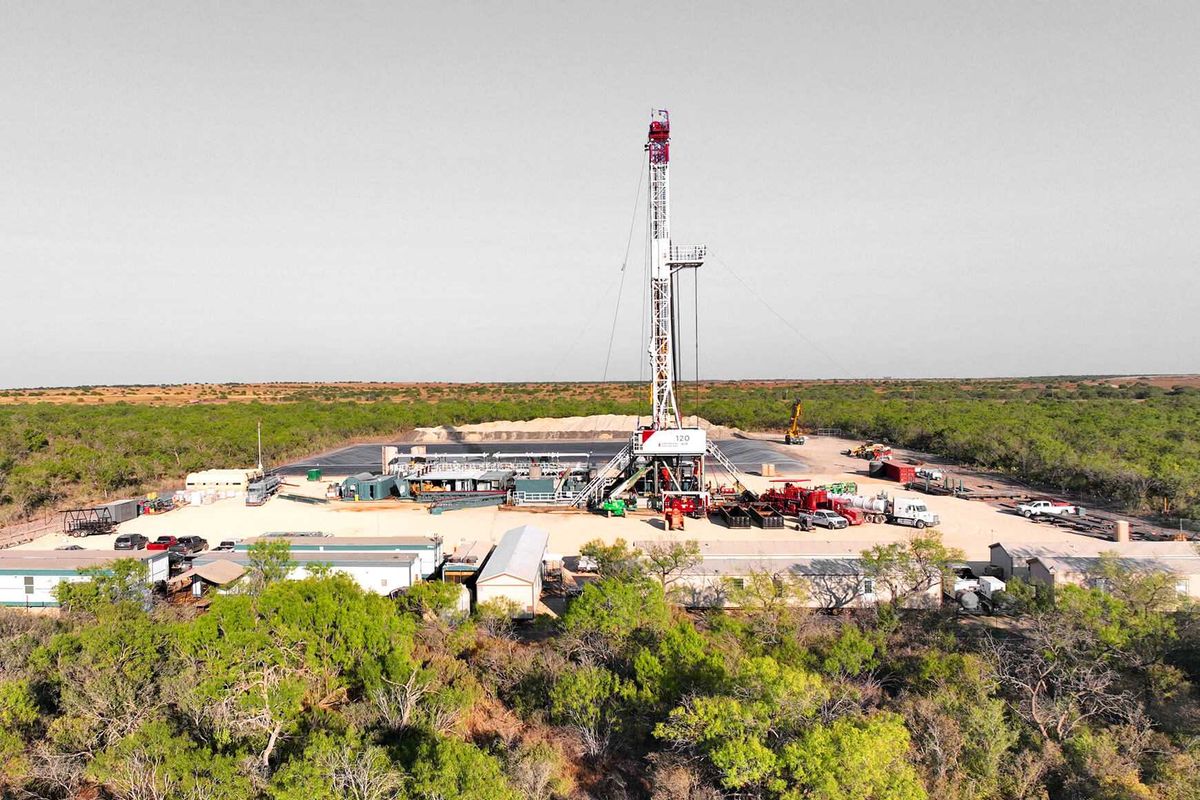
Rice's Baker Institute and UH's Energy Transition Institute have partnered to develop real-world solutions for plastic recycling. Photo courtesy UH

Institutes at two Houston universities are joining forces to help position the city as a global leader in plastics recycling innovation.

The Center for Energy Studies (CES) at Rice University’s Baker Institute for Public Policy and the University of Houston’s Energy Transition Institute (UH-ETI) have announced a strategic partnership that aims to develop real-world solutions for plastic recycling.

The universities will kick off the new initiative with the Annual Sustainability Summit: Innovations and Collaborations in Circularity & Supply Chain Resilience event April 22 at the Baker Institute.

“Houston sits at the center of the global plastics and petrochemical value chain, which makes it uniquely positioned to lead in circular solutions,” Rachel Meidl, deputy director of CES, said in a news release. “This partnership is about moving beyond theory and bringing together data, policy and industry insight to accelerate technologies and frameworks that can scale.”

The partnership—which was made official during CERAWeek—will integrate policy, economics, science and engineering. The universities will work to “share data, insights, networks and connections to advance global work in protecting the environment, economy and society,” according to a news release from Rice.

Initially, the universities will focus on evaluating scalable advanced recycling pathways, developing policy frameworks to improve plastics circularity, analyzing emerging technology and using industry stakeholders for deployment.

Plastics circularity aligns with Rice and UH’s energy transition efforts to advance a circular economy. UH's ETI recently published a white paper that analyzes how the U.S. currently handles plastics recycling and advocates for a new approach. Ramanan Krishnamoorti, author of the paper and vice president of energy and innovation at UH, said the partnership with Rice’s Baker Institute could help bring some of the ideas outlined in the paper to reality.

“Our research has shown that a uniform approach may be the best way for the U.S. to tackle plastic waste,” Krishnamoort said in a news release. “By partnering with Rice’s Baker Institute for Public Policy, we will be better positioned to deliver real-world solutions that advance a circular plastics economy.”

Rachel Meidl has more than 27 years of experience in industry, government, policy, finance, international relations, and academia. Photo via rice.edu

National plastics-focused initiative names Houston expert to committee

new role

A Houston energy and sustainability expert has been named to a national committee that provides a forum for issues around national efforts to reduce plastic pollution.

Rachel Meidl, a fellow at Rice University’s Baker Institute for Public Policy, was appointed to the Roundtable on Plastics Committee established by the National Academies of Sciences, Engineering and Medicine.

"As a member of the The National Academies of Sciences, Engineering, and Medicine Roundtable on Plastics Committee, our science- and evidence-based work will cover all aspects of the plastics lifecycle and examine interventions in plastic production, waste management, environmental and health impacts, and data collection, management, and modeling," Meidl writes on LinkedIn. "The goal is to pave the way for a sustainable circular economy for plastics. I look forward to working on this important endeavor."

Meidl has more than 27 years of experience in industry, government, policy, finance, international relations, and academia. Her research focuses on sustainability, environmental justice, resiliency, circular economy, safety and environmental regulations of the treatment, storage, disposal and transportation of hazardous materials and wastes.

She also works with understanding environmental, economic and social impacts across energy and material supply chains. Previously, she was appointed deputy associate administrator of the Pipeline and Hazardous Materials Safety Administration in Washington, D.C.. There, she led the agency’s domestic and international strategy, policy and programs.

The roundtable is expected to be a way for federal agencies and experts in academia, industry and nongovernmental organizations to talk about future research initiatives. Activities will include aspects of the plastics lifecycle and potential interventions in plastic production and waste management; material and product design; environmental and health impacts and data collection, management and modeling. The National Academies will address the diversity and complexity of issues in reducing plastic waste by convening various sectors and experts to match each step in the lifecycle of the plastics.

Ad Placement 300x100
Ad Placement 300x600

CultureMap Emails are Awesome

Houston startup lands $1B from Blackstone and Halliburton, plans acquisition

power deal

Houston-based power generation startup VoltaGrid has nailed down a $1 billion equity investment from asset management heavyweight Blackstone and Houston-based oilfield services provider Halliburton.

The investment comes in two forms:

  • A $775 million primary capital raise
  • A $225 million secondary capital purchase from existing investors

VoltaGrid, founded in 2020, provides behind-the-meter mobile power generation equipment for data centers, microgrids and industrial customers.

Aside from the $1 billion investment, VoltaGrid has agreed to buy Propell Energy Technology, a VoltaGrid supplier, for an undisclosed amount. Propell offers a natural gas power generation platform for AI data centers. VoltaGrid plans to add two manufacturing plants at Propell’s facilities in Granbury, a Dallas-Fort Worth suburb.

The investment and acquisition deals are expected to close in mid-2026.

Funds managed by Blackstone Tactical Opportunities are contributing to the $1 billion investment. William Nicholson, managing director of Blackstone, called VoltaGrid “a highly differentiated platform addressing one of the most important infrastructure needs of the AI era: reliable, rapidly deployable power. This investment is a strong example of Tac Opps’ focus on providing flexible, scaled capital to exceptional entrepreneurs and businesses operating in Blackstone’s highest-conviction investment themes.”

Nathan Ough, founder and CEO of VoltaGrid, said in a release that the Blackstone investment “is a powerful endorsement of the platform we have built and the role VoltaGrid is playing in delivering the energy infrastructure of the AI era.”

Last October, VoltaGrid and Halliburton said they had forged a partnership to supply power for data centers around the world, with the Middle East picked as the initial target. Two months later, the companies said they had arranged the manufacturing of 400 megawatts of natural gas power systems that’ll be delivered in 2028 to support new data centers in the Eastern Hemisphere.

Jeff Miller, president and CEO of Halliburton, said his company’s investment in VoltaGrid “reflects our shared focus on long-term solutions for the world’s most demanding power environments, and advances VoltaGrid’s ability to deliver reliable, distributed power at scale.”

Report shows geoscientists earn largest salary premium in Texas

Career Day

A move to Texas bolsters earnings for some, and a new SmartAsset study has revealed the top professions where the median annual earnings in the Lone Star State exceed the national median.

The report, "When it Pays to Work in Texas — and When It Doesn’t," published in April, analyzed over 700 occupations to determine which have the biggest "Texas premium" — meaning jobs where the price-adjusted median annual pay in Texas most exceeds the national median for the same occupation — and which jobs have the biggest “Texas penalty,” where the statewide median annual pay falls furthest below the national median. Salaries were sourced from the U.S. Bureau of Labor Statistics (BLS) and adjusted for regional price parity.

According to the report's findings, geoscientists have the biggest "Texas premium" and make a $159,903 median annual salary. Texas' salary for geoscientists is 61 percent higher than the national median for the same position (after adjusting for regional price parity).

"Texas’s large petroleum industry helps explain why employers in the state retain so many geoscientists," the report's author wrote. "In fact, the Lone Star State is home to more geoscientists than any other state except California."

There are more than 3,600 geoscientists working in Texas, SmartAsset said.

These are the remaining top 10 occupations with the biggest "Texas premiums" (salaries are price-adjusted):

  • No. 2 – Commercial pilots: $167,727 median Texas earnings; 37 percent higher than the national median
  • No. 3 – Sailors: $67,614 median Texas earnings; 36 percent higher than the national median
  • No. 4 – Aircraft structure assemblers: $83,519 median Texas earnings; 35 percent higher than the national median
  • No. 5 – Ship captains: $108,905 median Texas earnings; 27 percent higher than the national median
  • No. 6 – Nursing instructors (postsecondary): $100,484 median Texas earnings; 26 percent higher than the national median
  • No. 7 – Tax preparers: $63,321 median Texas earnings; 25 percent higher than the national median
  • No. 8 – Chemists: $104,241 median Texas earnings; 24 percent higher than the national median
  • No. 9 – Health instructors (postsecondary): $128,680 median Texas earnings; 22 percent higher than the national median
  • No. 10 – Engineering instructors (postsecondary): $129,030 median Texas earnings; 22 percent higher than the national median
---

This article originally appeared on CultureMap.com.

Solar manufacturer expands Houston footprint with new 4-gigawatt factory

coming soon

Houston-based SEG Solar plans to open a new 4-gigawatt solar module manufacturing facility in Cypress.

The facility represents more than a $200 million investment and will raise SEG's total annual U.S. module production capacity to approximately 6 gigawatts, according to a new release. The expansion is part of SEG’s long-term goal of becoming one of the largest 100 percent U.S.-owned module manufacturers.

The new 500,000-square-foot facility will be located on Telge Road and is expected to create 800 new jobs, according to reports.

“This new facility marks an important milestone for SEG,” Timothy Johnson, VP of operations, said in the release. “It will further strengthen our U.S. manufacturing capabilities while supporting ongoing technology innovation. The plant is designed with the flexibility to integrate next-generation technologies, including (heterojunction solar technology) as the industry evolves.”

Commercial operations at the new facility are expected to commence in Q3 2026.

SEG is also developing a 5-gigawatt ingot and wafer manufacturing facility in Indonesia. Construction on the facility is expected to begin in Q2 2026.

In 2024, SEG Solar opened a new $60 million, 250,000-square-foot facility in Houston to house its production workshops, raw material warehouses, administrative offices, finished goods warehouses and supporting infrastructure. Read more here.