




Hertha Metals has broken ground on its new iron and steel “innovation complex." Photos courtesy Hertha Metals

Shortly after announcing a $133.65 million Series A funding round, Conroe-based Hertha Metals broke ground Oct. 8 on a $100 million factory that will produce steel-grade and magnet-grade high-purity iron.

Hertha’s Chalyx plant, located in Conroe, will manufacture a total of about 10,000 metric tons per year of magnet-grade and steel-grade high-purity iron. The factory will use Hertha’s single-step process to generate high-purity iron for rare-earth-magnet and steel manufacturers in the U.S.

Hertha says Chalyx will be the first U.S. commercial plant for production of magnet-grade high-purity iron.
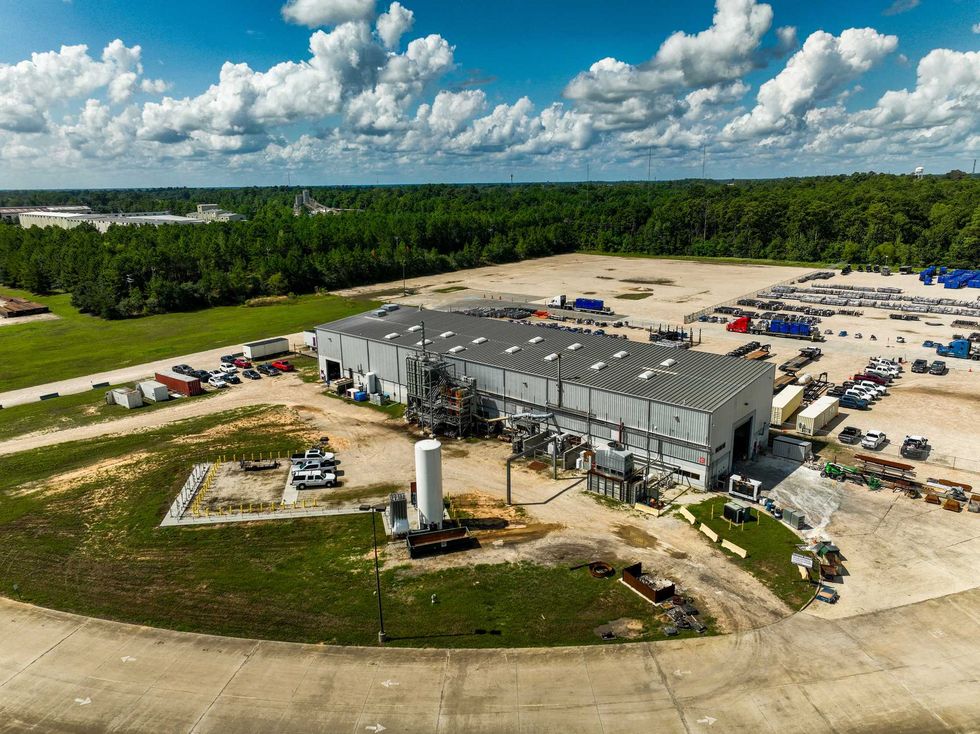
Chalyx is being built next to Hertha’s headquarters and its Pi100 pilot plant, which will remain in operation. Chalyx and Pi100 will form the first modern-day iron and steel “innovation complex” in the U.S., the company says.

“I founded Hertha Metals because I believed we could significantly improve how the world makes iron and steel from ore, and that an industry so fundamental to our future still had enormous room for invention,” Laureen Meroueh, founder and CEO of Hertha, said in a press release.

The 4-year-old startup says the Chalyx complex will lay the foundation for its first 500,000-ton-per-year steel mill.

Chalyx’s first priority is making high-purity iron for U.S. manufacturers of rare-earth magnets, Hertha says. These magnets are critical components for electric vehicles, data centers, wind turbines and defense systems.

China produces an estimated 94 percent of high-purity iron for rare-earth magnets, according to Hertha.
Aside from iron for rare-earth magnets, Chalyx will make iron and steel for pilot projects in the steel industry.

The plant is expected to come online in late 2027, with production of magnet-grade high-purity iron starting in early 2028.

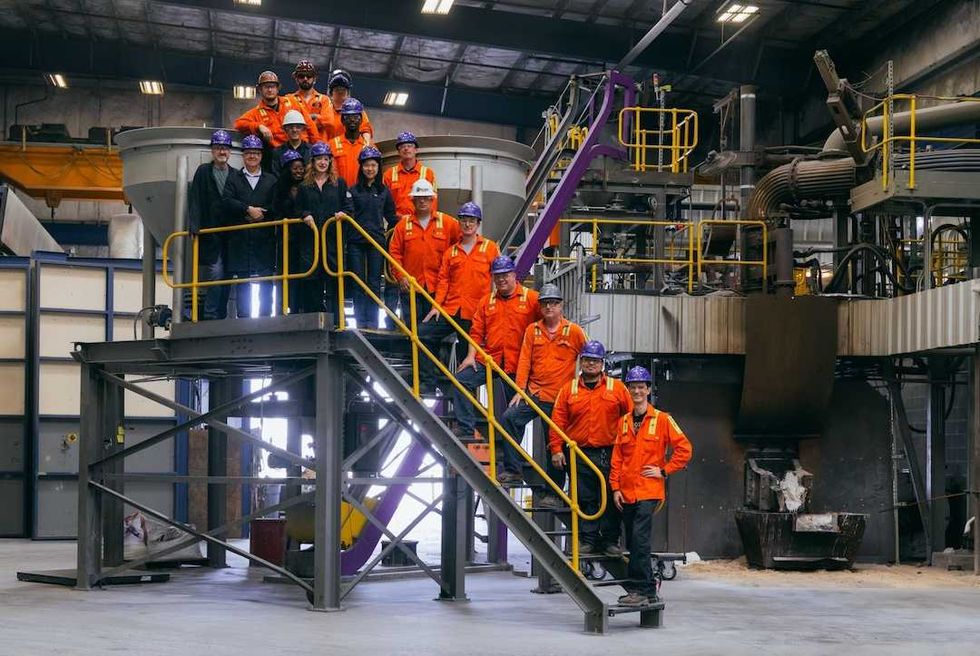
Today, Hertha employs 32 people, the company says. Once it’s fully operating, the Chalyx plant will employ about 50 people.

Just ahead of the groundbreaking, Hertha announced the $133.65 million Series A round, co-led by Khosla Ventures and Doerr Capital. The round included a $65 million equity investment from the Pentagon.

“Iron and steel have shaped human progress for thousands of years. And I believe there is still an enormous amount left to invent,” Meroueh said at the groundbreaking ceremony.

Ad Placement 300x100
Ad Placement 300x600

CultureMap Emails are Awesome

Tesla, Houston City College to receive millions for workforce training

texas talent

Gov. Greg Abbott announced $1.73 million in workforce training grants for the Houston and Rio Grande Valley regions late last month, with the bulk of the funding heading toward Houston.

The funding comes through the Skills Development Fund (SDF) grant program from the Texas Workforce Commission. The grants will help train 689 current and new workers in technology, manufacturing, technology, logistics and other fields in high demand.

Three grants totaling $1.56 million will go to Houston City College to develop training programs for 602 Houston-area workers.

The largest grant, totaling $782,998, will go toward training 261 employees for Tesla Inc. as welders, maintenance technicians, process technicians and other jobs. In addition to Tesla’s $200 million megafactory in Brookshire, Texas, the electric vehicle company is also considering building a $10.1 billion solar cell manufacturing facility in Fort Bend County called Project Sun City. The company recently expanded its self-driving Robotaxi service throughout 610 Loop and northwest Houston.

A second grant of $690,044 will go toward training 300 workers at Texas Tissue LLC and Karsten Management LLC as frontline supervisors, production line operators, design specialists and maintenance technicians. An allocation of $83,963 will go toward training 41 workers at Watchfire Signs LLC as production supervisors, operations specialists, industrial maintenance technicians, and more.

According to HCC, its Corporate Training and Development will coordinate the program in partnership with the college’s Advanced Manufacturing Center of Excellence Southwest and the Material Science Center of Excellence Welding Department.

“These grants demonstrate how state agencies, employers and Houston City College can work together to meet evolving workforce needs, strengthen Texas businesses and create meaningful opportunities for workers,” HCC Chancellor Margaret Ford Fisher said in a news release.

TWC granted an additional $169,087 to Workforce Solutions Lower Rio Grande Valley to train 87 workers at Denso Ten America Limited, Alps Logistics (USA) Inc., Index Fresh Inc. and Emerson Electric Co.

“When we align local training directly with the needs of expanding industries, we strengthen the regional economy,” TWC Chairman Joe Esparza said in the news release. “These Skills Development Fund grants empower Houston City College and Workforce Solutions Lower Rio Grande Valley to provide the specialized, high-demand training that employers need to succeed right here in Texas.”

Texas A&M wins $5.4M DOE grant for advanced nuclear fuel research

fresh funding

The U.S. Department of Energy has awarded Texas A&M Engineering Experiment Station (TEES) a $5.4 million grant to research ways to turn nuclear waste into fuel.

The goal of the project, “Turning Nuclear Waste into Fuel with a Thorium Molten Salt Reactor,” is to develop innovative reactor fuel technology that could help transform long-lived nuclear waste into a valuable energy resource while advancing the future of nuclear power, according to Texas A&M.

Lin Shao, a Texas A&M professor of nuclear engineering, will lead the project and unite researchers from TEES, Savannah River National Laboratory and Abilene, Texas-based nuclear power company Natura Resources. The team will use experimental testing, fuel preparation, reactor design and computational modeling in their work.

“Texas A&M Engineering is honored to receive this support from the Department of Energy to advance groundbreaking nuclear energy technologies,” Robert H. Bishop, vice chancellor and dean of Texas A&M Engineering and director of TEES, said in a news release. “This research aligns directly with our mission to solve the nation’s most pressing engineering challenges through innovation and collaboration. We have an opportunity to develop solutions that reduce nuclear waste, improve energy reliability and help maintain American leadership in advanced nuclear technologies.”

Texas A&M’s award is part of the DOE's Advanced Research Projects Agency-Energy (ARPA-E) $50 million advancement for next-generation nuclear fuels through the High-performance Optimized Recycled Nuclear Isotopes for Gen IV reactors (HORNIG) program. Texas A&M was one of eight projects selected as part of the ARPA-E efforts.

“America’s energy future depends on bold innovation and strong partnerships between the federal government, national laboratories, universities and industry,” U.S. Deputy Secretary of Energy James P. Danly said when he awarded the grant on campus Oct. 29. “This project demonstrates how we can address long-term nuclear waste challenges while advancing technologies that strengthen our nation’s energy security. The Department of Energy is proud to support research that has the potential to unlock new value from existing nuclear materials and accelerate the deployment of advanced reactor systems.”

Zero-emission electric air taxi network to land in Texas in 2027

Electric Travel

San Jose, California-based aerospace company Archer Aviation is bringing its air-taxi system to the “Texas triangle” of Houston, Austin and Dallas-Fort Worth.

Currently, the planned zero-emission electric air taxi networks will use Archer’s Midnight air taxi to “turn 60- to 90-minute drives to major airports, business districts and major destinations into 10- to 20-minute flights,” the company said in a news release. Archer plans to begin flights in the Texas triangle next year.

The Midnight air taxi is an all-electric vertical takeoff and landing (eVTOL) aircraft. It can carry four passengers and a pilot and is designed for consecutive flights of about 20 miles.

Archer cites the Texas triangle as one of the busiest and fastest-growing “megaregions” in the country due to its proximity to coastal regions, major airports, and a number of business districts.

Archer Chief Commercial Officer Nikhil Goel described the air taxi experience to CW Houston as “100 times quieter than a helicopter for the price of an Uber Black.” He added that the air taxis are a combination of a helicopter, a small airplane and a drone.

In Houston, Archer’s air taxi network will aim to connect George Bush Intercontinental, William P. Hobby and Sugar Land Regional Airport with downtown destinations, including the Thompson Hotel helipad, and Galveston.

In Austin, it plans to link the city's Austin-Bergstrom International Airport and Austin Executive Airport with the F1 Circuit Helipad at the Circuit of the Americas. Archer debuted its Midnight aircraft at the F1 Prix in the Fan Zone and the F1 Paddock at Austin’s COTA.

The Dallas-Fort Worth network is slated to include Dallas-Fort Worth International Airport, Dallas Love Field, Addison Airport, Arlington Municipal Airport, Fort Worth Meacham International Airport and Perot Field Fort Worth Alliance Airport, plus major business hubs like Frisco Station.

“Texas is setting the bar for America’s leadership in the next generation of aviation,” Adam Goldstein, founder and CEO of Archer Aviation, said in the release. “Our planned networks will make the benefits of electric air taxis real for Texans — trading hours in traffic for minutes in the air, while connecting the biggest airports, business districts and sporting hubs in ways that America’s largest megaregion needs to grow.”

Archer is working with state and local partners to develop charging infrastructure and plans to pursue Texas operations through the White House’s eVTOL Integration Pilot Program, according to the release. It recently completed its "No Roads" flight tour, which included multiple flights over the San Francisco Bay, and flew to seven cities over three days.

---

This article first appeared on InnovationMap.com.