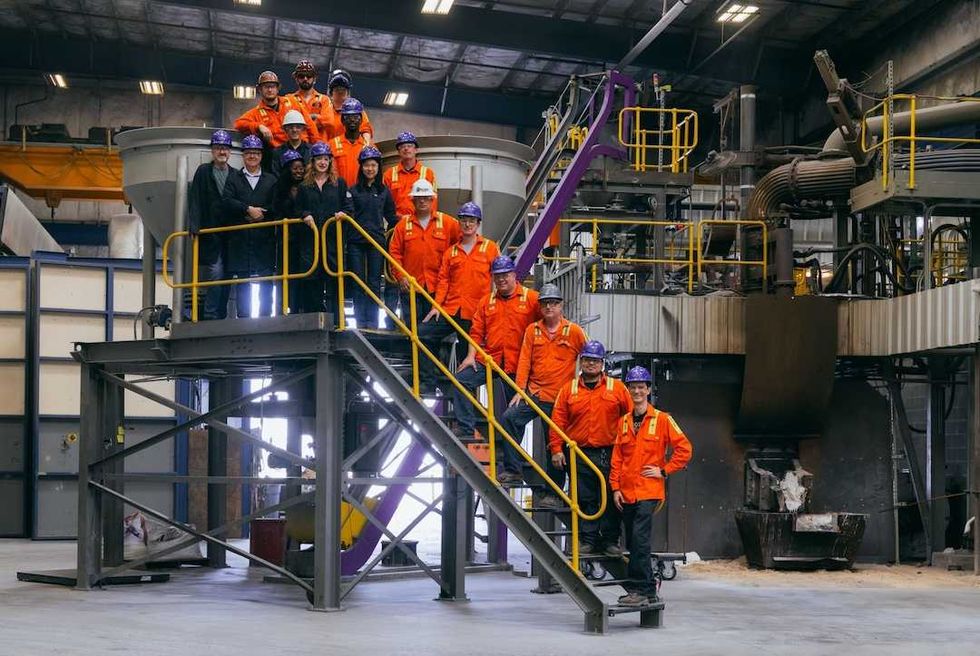
Asking ChatGPT what all was made from petroleum produced surprising results - the answer: everything. Photo by Sanket Mishra/Unsplash

I sat down to have a conversation with ChatGPT from OpenAI about energy by-products; specifically, everyday items we use that contain some form of petrochemicals. My first prompt was rather broad, so I wasn’t surprised to get back a rather broad answer highlighting product categories instead of specific examples. Plastics, synthetic fibers, cleaning products, personal care products, medicines, paints & coatings, and adhesives were all succinctly summarized, but I wanted to dive deeper.

Given that AI has an almost limitless reach, I asked for a comprehensive list of all the products we use in everyday life that are made from petrochemicals. Turns out, ChatGPT has some healthy boundaries, so it pushed back, only offering a slightly more detailed list of the categories produced from the first prompt.

Not to be deterred, I asked for additional examples. I didn’t want to continue getting spoon-fed 10 items at a time, so I asked for 200. Less than comprehensive, more than the crumbs I was getting.

In entertaining fashion, ChatGPT told me compiling a list of 200 items might be challenging, but that it could offer up 100. The brazen negotiation made me smile.

I complimented the list and nudged a bit, encouraging ChatGPT it could come up with another 100 items if it tried. Much like a teenager wishes to stave off further questioning from a nosy parent, ChatGPT proffered up a second response of 100 items–almost half of which were simply things before which it added the qualifier “synthetic.” Salty.

As my intention is not to bore you, but rather enhance the knowledge of our readers by understanding how pervasive petrochemical products are in our everyday life, I settled on a more direct inquiry with a capped demand prompt: “What would you say are the 10 most surprising things in common everyday use that contain petrochemical products?”

Most of the answers featured wax-based products, like lotions, crayons, and lipstick–not necessarily earth-shattering realizations given my familiarity with cosmetics as petroleum by-products. I was pleasantly surprised to learn that chewing gum, with its synthetic rubber base enabling theoretically endless chewing, is derived from petroleum. I was also surprised to learn that many artificial sweeteners, like saccharin and aspartame, are made from petrochemicals. Huh.

There was one item on the list, however, that helped me see how truly pervasive the energy industry is, and not just for petrochemicals. Tucked in nonchalantly at #6 was Deodorant. My brain jumped immediately to the waxy base of a solid sweat deterrent, but my eyes got a curveball. ChatGPT writes, “Many deodorants contain aluminum, which is often derived from bauxite, a mineral that is usually mined from the earth using petroleum-powered machinery.” Now that was an answer I wasn’t expecting.

While my initial inference stood true – the smooth glide of a buttery solid antiperspirant is without a doubt derived from petrochemicals (not to mention the plastic packaging surrounding it), I wasn’t expecting ChatGPT to rope in the oft petroleum-fueled tools used to make said product. If that’s true, then nearly every item on the planet is derived from petroleum. Or at the very least, some source of energy. Regardless of whether the machinery used runs on gasoline, electricity, or wind power, literally almost everything that is produced on this earth is related to the energy industry.

Even if it’s hand-made, it’s technically still energy-adjacent, assuming we all bathe regularly with soap, yet another on the list of commonly used items derived from petroleum by-products. It’s certainly directly powering some manual activities, for those busting stress and bad breath with gum, or drinking a diet soda to power through. No pun intended.

I share this amusing tale simply to clarify the ubiquitous nature of energy in all parts of the modern world. As we look toward the #futureofenergy, we must be cognizant of its universal reach. It’s not necessarily realistic to switch from one source of energy to another overnight, but we do have a responsibility to seek cleaner, healthier, more efficient sources of energy while sustaining the life to which we have all grown accustomed.

Much like ChatGPT thought she couldn’t come up with 200 items derived from petroleum products, many think Houston will be unable to drive the Energy Transition, given our extensive petroleum focus. But like so many fellow Houstonians before us, we love a good challenge.

Just keep prompting us, and we’ll eventually unlock infinite potential for the #futureofenergy. It’s a limitless time to be in Houston, absorbing wisdom the city so willingly wants to share with the growing ecosystem of innovators. Just ask the growing number of almost 5,000 Energy-related firms in Houston. We’re just getting started.

------

Lindsey Ferrell is a contributing writer to EnergyCapitalHTX and founder of Guerrella & Co.
Ad Placement 300x100
Ad Placement 300x600

CultureMap Emails are Awesome

Investors close partial acquisition of Phillips 66 subsidiary with growing EV network

M&A activity

Energy Equation Partners, a London-based investment firm focused on clean energy companies, and New York-based Stonepeak have completed the acquisition of a 65 percent interest in JET Tankstellen Deutschland GmbH, a subsidiary of Houston oil and gas giant Phillips 66.

JET is one of the largest and most popular fuel retailers in Germany and Austria with a rapidly growing EV charging network, according to a news release. It also operates approximately 970 service stations, convenience stores and car washes.

“We are delighted to complete this acquisition and to partner with Stonepeak and Phillips 66 to take JET to the next level,” Javed Ahmed, managing partner of Energy Equation Partners, said in a news release. “This investment reflects EEP’s commitment to investing in established players in the energy sector who have the potential to make a meaningful impact on the energy transition, and we are excited to work alongside the entire JET team, including its dedicated service station operators, to realize this vision.”

The deal values JET at approximately $2.8 billion. Phillips 66 will retain a 35 percent non-operated interest in JET and received about $1.6 billion in pre-tax proceeds.

“Under Phillips 66’s ownership, JET has grown into one of the largest fuel retailers in Germany and Austria," Anthony Borreca, senior managing director and co-head of energy at Stonepeak, added in a news release. "We are excited to join forces with them, as well as Javed and the EEP team, who have long-standing experience investing in and operating retail fuel distribution and logistics globally, to support the next phase of JET’s growth.”

6 must-attend Houston energy events in December 2025

Event Guide

Editor's note: The year is coming to a close, but there are still exciting energy events to attend in Houston this month. Mark your calendar now for pitch days, seminars, networking, and Reuters Energy LIVE 2025.

Dec. 4 — Resiliency & Adaptation Sector Pitch Day

Join innovators, industry leaders, investors, and policymakers as they explore breakthrough climate and energy technologies at Greentown Labs' latest installment of its Sector Pitch Day series, focused on resiliency and adaptation. Hear from Adrian Trömel, Chief Innovation Officer at Rice University; Eric Willman, Executive Director of the Rice WaTER Institute; pitches from 10 Greentown startups; and more.

This event is Thursday, Dec. 4, from 1-3:30 p.m. at the Ion. The Ion Holiday Block Party follows. Register here.

Dec. 8 — Pumps & Pipes Annual Event 2025

The annual gathering brings together cross-industry leaders in aerospace, energy and medicine for engaging discussions and networking opportunities. Connor Grennan, Chief AI Architect at the NYU Stern School of Business, will present this year's keynote address, "Practical Strategies to Increase Productivity." Other sessions will feature leaders from Cena Research Institute, NASA Ames Research Center, ExxonMobil, Southwest Airlines, and more.

This event is Monday, Dec. 8, from 8 a.m.-5 p.m., at TMC Helix Park. Register here.

Dec. 9 — Energy in Action Seminar

The Energy Transition Institute hosts a monthly Energy in Action Seminar focused on the digitization of the global energy transition. This month's topic is "Exploring AI’s Impact on the Fuels & Petrochemicals Industry," featuring speaker Leo Chiang, Senior Director of Corporate Technology at The Lubrizol Corporation. The event includes a one-hour talk followed by an hour of networking.

This event is Dec. 9 from 4-6 pm at the University of Houston.

Dec. 9-10 — Energy LIVE 2025

Energy LIVE is Reuters Events' flagship conference and expo that brings the full energy ecosystem together under one roof in Houston to solve the industry's most urgent commercial and operational challenges. The event will feature 3,000-plus senior executives across three strategic stages, a showcase of 75-plus exhibitors, and six strategic content pillars.

This event is Dec. 9-10 at NRG Park. Register here.

Dec. 11-12 — Fundamentals of The Texas ERCOT Electric Power Market

This two-day seminar provides a comprehensive overview of the structure, function, and current status of the Texas ERCOT ISO. Attendees will gain an understanding of the dynamic Texas wholesale and retail competitive markets, and learn how these markets interface with ERCOT ISO energy auctions and ISO operations. This two-day event will also address the rapidly expanding new market opportunities in Texas renewables, distributed generation, demand response, and demand side management, and more.

This event is Dec. 11-12 at the Courtyard Marriott Houston near the Galleria. Register here.

Dec. 9-11 — AST Conference & Trade Show

The 18th Annual National Aboveground Storage Tank (AST) Conference & Trade Show is the premier event for professionals in storage tank and terminal operations. Join industry leaders and experts for a three-day conference providing regulatory updates, technical insights, hands-on learning, and networking opportunities.

This event is Dec. 9-12 at The Woodlands Waterway Marriott. Register here.

Houston scientists develop 'recharge-to-recycle' reactor for lithium-ion batteries

reduce, recharge, recycle

Engineers at Rice University have developed a cleaner, innovative process to turn end-of-life lithium-ion battery waste into new lithium feedstock.

The findings, recently published in the journal Joule, demonstrate how the team’s new “recharge-to-recycle” reactor recharges the battery’s waste cathode materials to coax out lithium ions into water. The team was then able to form high-purity lithium hydroxide, which was clean enough to feed directly back into battery manufacturing.

The study has major implications for the electric vehicle sector, which significantly contributes to the waste stream from end-of-life battery packs. Additionally, lithium tends to be expensive to mine and refine, and current recycling methods are energy- and chemical-intensive.

“Directly producing high-purity lithium hydroxide shortens the path back into new batteries,” Haotian Wang, associate professor of chemical and biomolecular engineering, co-corresponding author of the study and co-founder of Solidec, said in a news release. “That means fewer processing steps, lower waste and a more resilient supply chain.”

Sibani Lisa Biswal, chair of Rice’s Department of Chemical and Biomolecular Engineering and the William M. McCardell Professor in Chemical Engineering, also served as co-corresponding author on the study.

“We asked a basic question: If charging a battery pulls lithium out of a cathode, why not use that same reaction to recycle?” Biswal added in the release. “By pairing that chemistry with a compact electrochemical reactor, we can separate lithium cleanly and produce the exact salt manufacturers want.”

The new process also showed scalability, according to Rice. The engineers scaled the device to 20 square centimeters, then ran a 1,000-hour stability test and processed 57 grams of industrial black mass supplied by industry partner Houston-based TotalEnergies. The results produced lithium hydroxide that was more than 99 percent pure. It also maintained an average lithium recovery rate of nearly 90 percent over the 1,000-hour test, showing its durability. The process also worked across multiple battery chemistries, including lithium iron phosphate, lithium manganese oxide and nickel-manganese-cobalt variants.

Looking ahead, the team plans to scale the process and consider ways it can sustain high efficiency for greater lithium hydroxide concentrations.

“We’ve made lithium extraction cleaner and simpler,” Biswal added in the release. “Now we see the next bottleneck clearly. Tackle concentration, and you unlock even better sustainability.