




Houston energy leader Katie Mehnert shared her key takeaways from Houston Energy and Climate Week 2026 with Energy Capital. Photo courtesy

While hundreds of thousands descend on New York for Climate Week, Houston offered a different proposition: come where the work is being built. And last week Houston proved that it’s solving for more energy and fewer emissions; reliability and affordability; speed and durability. We are solving for the “&.”

That equation sharpened last week. On Sept. 14, the Environmental Protection Agency announced it had repealed most 2024 federal carbon-pollution standards for power plants and proposed rescinding remaining greenhouse-gas requirements. Policy matters, but it can pivot. The need to build does not.

HECW is a proving ground, not another conference stop. As I wrote in the Houston Chronicle, Mayor Sylvester Turner planted the seed by insisting we bring people together across the city and industry to drive Houston’s energy future. He knew false choices have no place here: oil and gas and clean technology; prosperity and stewardship; industry and lower emissions.

ECW joined the Climate Week Network this year, connecting Houston to a growing community of more than 500,000 people across 22-plus cities. We now have a seat at the global table—and a responsibility to use it well, building with other cities and the wider clean-energy-solutions world rather than merely talking at them.

The capital is already moving. Since 2017, Houston Energy Transition Initiative member companies have invested more than $95 billion in low-carbon infrastructure, technologies, and research and development. This is where the transition is financed, engineered, tested and operated. But the work requires more than capital. It requires capital allocators who understand the difference between a promising idea and a project that can scale, hire and endure.

Last week was Houston’s show and tell. At ARTECHOUSE, The &Bassador Reception & Awards brought art, technology, culture, philanthropy and energy together. Then the week went beyond downtown.

Sugar Land Town Square became the launchpad for the Metro Innovation Tour & Market: a place for an ecosystem conversation about smart cities, clean energy, equitable access and next-generation mobility before participants boarded three tour routes across greater Houston. It was also the starting point for the Bay City South Innovation Tour to Erthos Project Bravo in Matagorda County, where small groups saw Earth Mount solar modules being installed in real time. The conversation did not end at a panel. It went to the project site.
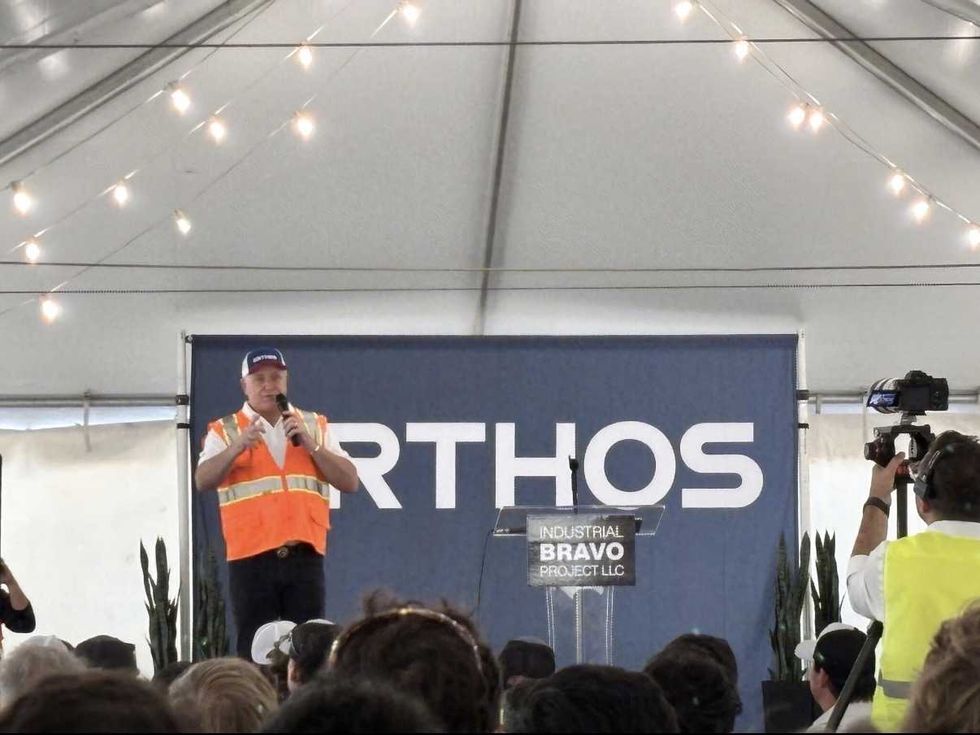
The HTX Tech Tours included a visit to the Erthos Project Bravo in Matagorda County. Photo courtesy

Approximately 100 startups from around the world pitched at Rice Alliance, Greentown Labs and Halliburton Labs events. At Astros Night at Daikin Park, builders, backers, and believers traded conference rooms for the diamond, creating an experience, not just another event. That is how this work becomes civic fabric.

Activation also means making the energy story felt, not merely explained. AY Young brought the Battery Tour for live performances. It was a reminder that the “Power of &” is not confined to a boardroom or a laboratory. Art and technology, culture and commerce, a new generation and established industry can share the same stage—and help more people see themselves in the work ahead.

Perhaps no activation made the “Power of &” more immediate and real than the Houston, We Have Solutions open mic night. At Creatopia’s Innovation Studio, people took the mic—or simply listened—to share what they were building, the problem they could not stop thinking about, and the connection they hoped to make. It put founders, artists, community builders, researchers and future-makers in one room. That is collaboration in real time: different kinds of expertise meeting before anyone knows exactly what the solution will be.

FOX26 helped carry that story beyond the rooms we convened, hosting Erthos COO Jessica Knight, Mars Materials co-founder Aaron Fitzgerald, and investors Taylor Chapman and Juliana Garaizar to discuss building and backing the future in Houston. Our region should be proud—not as self-congratulation, but because the world is beginning to experience energy and climate solutions firsthand.

This was also a week to give back. Allies in Energy awarded $27,500 to nine organizations advancing energy and climate literacy, civil dialogue, workforce pathways and community action. NRG Energy’s Brighter Communities provided a founding gift to expand the week and fund local grants. It took partners, hosts, sponsors, volunteers, funders and community organizations. That is the “Power of &”: collaboration that leaves a stronger community behind.

The “Power of &” cannot stop at Houston’s city limits. Louisiana’s participation—through its support of the Digital Delta Symposium & Expo—made clear that Houston’s builder ecosystem is regional by necessity. Gulf Coast infrastructure, supply chains, talent, and industrial decisions do not recognize state lines. Neither should our collaboration. If we are serious about building more energy with fewer emissions, we must align capital, resources and opportunity across the entire Gulf Coast.

That same commitment to practical collaboration means listening, learning and adjusting. A builder’s mindset does not protect a plan simply because it came first; it improves the conditions for the work to succeed. That is why Houston Energy and Climate Week will move to April 4–10, 2027—better weather, more time and space for connection, and a stronger city-wide experience for the people building what comes next.

But the real test begins now. Can we keep widening the circle? Can we continue to turn research into projects, pilots into infrastructure, capital into good jobs and climate ambition into results that families and communities can see? Can we make every new solution stronger by bringing in the people who must finance it, build it, operate it, live beside it and benefit from it?

That is the work ahead. Turner understood that Houston does not move forward by asking who wins the argument. It moves forward by asking who is ready to solve the problem. His legacy—and the promise of the “&”—is an invitation to choose collaboration over division, action over performance and possibility over false choices.

The future does not need another city to talk about it. It needs Houston to keep building it. And it will only be built if we keep choosing the "&."

---

Katie Mehnert is the CEO of The Bee Suite, and a recent partner to The Builder’s Movement.

Ad Placement 300x100
Ad Placement 300x600

CultureMap Emails are Awesome

Fervo Energy adds transmission capacity at Cape Station geothermal project

geothermal expansion

Houston-based geothermal power company Fervo Energy has expanded its deal with Longroad Energy for transmission of electricity generated by Fervo’s Utah project.

Fervo added 105 megawatts to its existing 400-megawatt transmission deal with Longroad Energy, a Boston company that develops solar, wind and battery storage projects. The updated agreement will enable Fervo to deliver 505 megawatts of power from its marquee Cape Station geothermal project in Beaver County, Utah.

Dawn Owens, senior vice president of commercial markets at Fervo, said in a release that the new agreement brings another “105 megawatts of long-term, reliable capacity to the grid.”

Subject to regulatory approvals, the new agreement is expected to take effect in 2028.

“Longroad has worked alongside Fervo since its first efforts in Beaver County, and we’re excited to collaborate again,” Charles Spiliotis, chief development officer at Longroad, added in the release. “Providing transmission service for this next phase helps deliver clean, around-the-clock power to the grid.”

Cape Station recently began delivering carbon-free power. Capacity is on track to reach 100 megawatts in early 2027. The project’s second phase is targeted for completion in 2028. It will add 400 megawatts of capacity and is currently under construction.

Cape Station is adjacent to the U.S. Department of Energy’s Frontier Observatory for Research in Geothermal Energy and near the Blundell geothermal power plant.

Earlier this month, Tim Latimer, Fervo’s co-founder, chair, president and CEO, told Wall Street analysts the company had a $11.9 billion backlog of orders in the third quarter, up from $7.2 billion in the previous quarter.

Fervo signed the largest purchase agreement in its history in September with Google. The tech giant agreed to purchase 396 megawatts of geothermal power from Fervo with an option for Google to expand capacity to 1 gigawatt by June 2030. Financial terms weren’t disclosed.

Regulators OK Dow’s Gulf Coast nuclear reactor project

going nuclear

The federal government has given preliminary approval for construction of four nuclear reactors at a Dow site on the Texas Gulf Coast.

The U.S. Nuclear Regulatory Commission (NRC) recently signed off on a permit for Dow and Maryland-based nuclear reactor developer X-energy to build Long Mott Generating Station at Dow’s Seadrift complex. The complex is near Port Lavaca and about 140 miles southwest of Houston.

The NRC issued the permit but hasn’t yet authorized construction to start. The commission said it’s the first construction permit issued for a high-temperature gas-cooled nuclear reactor in nearly 60 years.

Edward Stones, vice president of Dow’s energy and climate business, said the permit approval represents “another important milestone” for Long Mott. It’s expected to be the first-ever advanced nuclear project at a North American industrial site.

Construction at Long Mott could begin before 2030.

Dow’s Seadrift complex manufactures chemicals and plastics. The roughly 4,700-acre site employs more than 1,200 people. Union Carbide, a Dow subsidiary, operates the parent company’s second-largest facility in Texas.

Long Mott will supply zero-carbon electricity and high-temperature steam at Seadrift, replacing current energy- and steam-generating methods. Dow and X-energy are developing the project with support from the U.S. Department of Energy’s Advanced Reactor Demonstration Program.

Mike Goff, principal deputy assistant secretary for nuclear energy, said the NRC’s approval “demonstrates meaningful progress toward deploying advanced reactors that can deliver reliable power and industrial heat, strengthen American energy leadership and expand the role of nuclear energy in meeting our nation’s growing energy demands.”

Plans call for four small X-energy modular reactors to operate at Long Mott. Each reactor would be capable of producing 80 megawatts of electricity or 200 megawatts of thermal energy. Initial delivery of energy could happen as soon as the early 2030s.

“Advanced nuclear has attractive advantages over other sources of clean power, including a compact footprint, competitive cost, and enhanced power and steam reliability,” said Jim Fitterling, executive chair of Dow.

Woodlands startup Mavria raises $130M to mass-produce AI data centers

seed funding

The Woodlands-based Mavria, which mass-produces factory-built modular AI data centers, just emerged from stealth mode with $130 million in funding at a $1 billion valuation.

Mavria raised the money in pre-seed and seed rounds led by Paradigm, an investment firm that concentrates on early-stage startups developing “pioneer” technology. Participants in the funding rounds include AMP PBC, Critical Frontier, Dream Ventures and Liquid 2 Ventures, co-founded by former NFL quarterback Joe Montana.

The company’s inaugural product, Terrain, is a prefabricated data center designed for AI labs, cloud computing providers and data center developers. Mavria says its platform avoids ground-up construction, delivering infrastructure more quickly and at a lower cost.

Mavria tells the Wall Street Journal that the first Terrain unit is being built at a Houston-area factory. The 5-megawatt Terrain system features power distribution, direct liquid cooling, controls and server racks.

“America sets the pace at the intelligence frontier. But the race is moving from the lab into the physical world,” Adam Blake, co-founder and CEO of Mavria, wrote in a blog post.

“Intelligence needs data centers. Data centers need power. Power needs factories, equipment, supply chains, and skilled workers, but much of that infrastructure is still built one custom project at a time, on timelines measured in years.”

Blake and Mavria’s two other co-founders, Nick Poradek and Seth Cohen, most recently worked at the U.S. Department of Energy. There, they focused on reforming the nuclear power sector.

From start to finish, it can take roughly three to six years to build a data center at an estimated cost of $10 million to $37 million per megawatt. Based on those figures, a 100-megawatt data center might cost as much as $3.7 billion.

Here are brief bios of Blake, Poradek and Cohen, who co-founded Mavria in May.

Adam Blake

Blake most recently was a senior advisor to U.S. Energy Secretary Chris Wright. He is co-founder and former CEO of Zego, a provider of energy management technology for property managers. Zego spun out from Brightergy, a commercial solar company. Blake is founder and former CEO of Brightergy.

Nick Poradek

Poradek, chief operating officer at Mavria, was also an advisor to the U.S. energy secretary. He is founder and former CEO of Spring-based Edera Energy, co-founder of The Woodlands-based craft-ice brand Clarity Ice, and founder and former CEO of The Woodlands-based Edera Capital. Poradek sold Edera Energy, a manufacturer of oilfield equipment, to Liberty Energy, a fracking company. Wright is Liberty’s founder and former chairman and CEO.

Seth Cohen

Cohen, chief strategy officer and chief legal officer at Mavria, was head of nuclear law and policy at the Department of Energy. He is also a former NASA advisor and a former attorney at Kirkland & Ellis.

“We believe in rapidly deploying infrastructure as a product, rather than custom-building every project,” Blake said. “We’re bringing together engineering, manufacturing, supply chains and capital so that every project makes us better at delivering the next.”

---

This article originally appeared on our sister site, InnovationMap.