







Shell partners with UK-based co. for hydrogen electrolyzer pilot

ultra-efficient electrolyzer

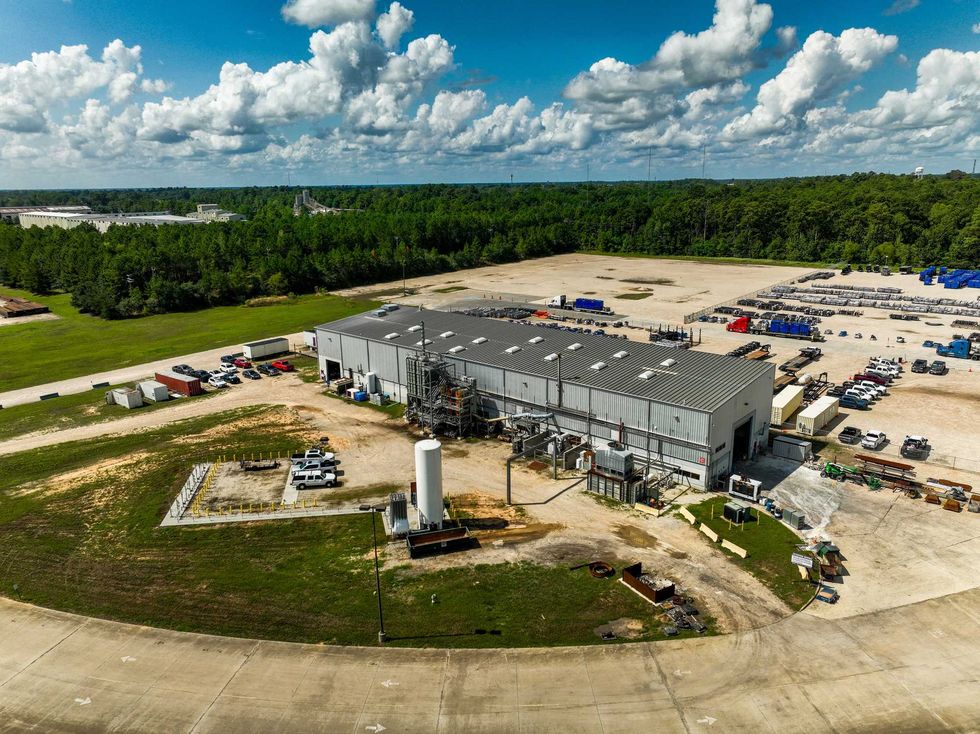
Supercritical Solutions' electrolyzer aims to deliver high-efficiency renewable hydrogen at a lower cost for the industrial hydrogen market. Photo courtesy Supercritical Solutions.

Shell Global Solutions International, a subsidiary of Shell, which maintains its U.S. headquarters in Houston, has signed a collaboration agreement with London-based Supercritical Solutions to advance Supercritical’s ultra-efficient hydrogen electrolyzer technology toward a field pilot demonstration.

In the deal, the companies will collaborate on a paid technology feasibility study that will support the evaluation and planning of the pilot demonstration, according to a news release. Supercritical Solutions’ technology aims to deliver high-efficiency renewable hydrogen at a lower cost for the industrial hydrogen market.

"Signing this collaboration agreement with Shell is a major milestone for Supercritical Solutions and an important step on our commercialisation journey,” Luke Tan, co-founder of Supercritical, said in the news release. “We are directly addressing the cost and complexity barriers facing the renewable hydrogen market. We are excited to move forward with a company like Shell, whose global leadership has been proven to accelerate innovative technologies to market.”

Supercritical’s hydrogen electrolyser technology can operate at high temperatures and pressures of up to 220 bar without the need for an external hydrogen compressor, rare-earth materials or easily degradable membranes. The technology removes the typical compression step in the process while delivering hydrogen at industry standards. It requires significantly less energy than many traditional electrolyzers and is more cost-efficient.

This recent investment builds on an ongoing relationship between Shell and Supercritical. Supercritical was founded in 2020 and was runner-up in Shell’s New Energy Challenge, which helps startups and scaleups develop sustainable technologies, in 2021. Shell Ventures then invested in Supercritical’s Series A funding round in 2024 with Toyota Ventures.
Ad Placement 300x100
Ad Placement 300x600

CultureMap Emails are Awesome

Texas claims No. 1 spot on new energy resilience report

A new report by mineral group Texas Royalty Brokers ranks Texas as the No. 1 most energy-resilient state.

The study focused on four main sources of electricity in hydroelectric dams, natural gas plants, nuclear reactors and petroleum facilities. Each state was given an Energy Resilience Score based on size and diversity of its power infrastructure, energy production and affordability for residents.

Texas earned a score of 71.3 on the report, outpacing much of the rest of the country. Pennsylvania came in at No. 2 with a score of 55.8, followed by New York (49.1) and California (48.4).

According to the report, Texas produces 11.7 percent of the country’s total energy, made possible by the state’s 141,000-megawatt power infrastructure—the largest in America.

Other key stats in the report for Texas included:

  • Per-capita consumption: 165,300 kWh per year
  • Per-capita expenditures: $5,130 annually
  • Total summer capacity: 141,200 megawatts

Despite recent failures in the ERCOT grid, including the 2021 power grid failure during Winter Storm Uri and continued power outages with climate events like 2024’s Hurricane Beryl that left 2.7 million without power, Texas still was able to land No. 1 on an energy resilience list. Texas has had the most weather-related power outages in the country in recent years, with 210 events from 2000 to 2023, according to an analysis by the nonprofit Climate Central. It's also the only state in the lower 48 with no major connections to neighboring states' power grids.

Still, the report argues that “(Texas’ infrastructure) is enough to provide energy to 140 million homes. In total, Texas operates 732 power facilities with over 3,000 generators spread across the state, so a single failure can’t knock out the entire grid here.”

The report acknowledges that a potential problem for Texas will be meeting the demands of AI data centers. Eric Winegar, managing partner at Texas Royalty Brokers, warns that these projects consume large amounts of energy and water.

According to another Texas Royalty Brokers report, Texas has 17 GPU cluster sites across the state, which is more than any other region in the United States. GPUs are specialized chips that run AI models and perform calculations.

"Energy resilience is especially important in the age of AI. The data centers that these technologies use are popping up across America, and they consume huge amounts of electricity. Some estimates even suggest that AI could account for 8% of total U.S. power consumption by 2030,” Winegar commented in the report. “We see that Texas is attracting most of these new facilities because it already has the infrastructure to support them. But we think the state needs to keep expanding capacity to meet growing demand."

Houston energy expert looks ahead to climate tech trends of 2026

Guest Column

There is no sugar‑coating it: 2025 was a rough year for many climate tech founders. Headlines focused on policy rollbacks and IRA uncertainty, while total climate tech venture and growth investment only inched up to about 40.5 billion dollars, an 8% rise that felt more like stabilization than the 2021–2022 boom. Deal count actually fell 18% and investor participation dropped 19%, with especially steep pullbacks in carbon and transportation, as capital concentrated in fewer, larger, “safer” bets. Growth-stage funding jumped 78% while early-stage seed rounds dropped 20%.

On top of that, tariff battles and shifting trade rules added real supply‑chain friction. In the first half of 2025, solar and wind were still 91% of new U.S. capacity additions, but interconnection delays, equipment uncertainty, and changing incentive structures meant many projects stalled or were repriced mid‑stream. Founders who had raised on 2021‑style valuations and policy optimism suddenly found themselves stuck in limbo, extending runway or shutting down.

The bright spots were teams positioned at the intersection of climate and the AI power surge. Power demand from data centers is now a primary driver of new climate‑aligned offtake, pulling capital toward firm, 24/7 resources. Geothermal developers like Fervo Energy, Sage Geosystems and XGS did well. Google’s enhanced‑geothermal deal in Nevada scales from a 3.5 MW pilot to about 115 MW under a clean transition tariff, nearly 30× growth in geothermal capacity enabled by a single corporate buyer. Meta and others are exploring similar pathways to secure round‑the‑clock low‑carbon power for hyperscale loads.

Beyond geothermal, nuclear is clearly back on the strategic menu. In 2024, Google announced the first U.S. corporate nuclear offtake, committing to purchase 500 MW from Kairos Power’s SMR fleet by 2035, a signal that big tech is willing to underwrite new firm‑power technologies when the decarbonization and reliability story is compelling. Meta just locked in 6.6GW of nuclear capacity through deals with Vistra, Oklo, and TerraPower.

Growth investors and corporates are increasingly clustering around platforms that can monetize long‑duration PPAs into data‑center demand rather than purely policy‑driven arbitrage.

Looking into 2026, the same trends will continue:

Solar and wind

Even with policy headwinds, solar and wind continue to dominate new capacity. In the first half of 2025 they made up about 90% of new U.S. electricity capacity. Over the 2025–2028 period, FERC’s ‘high‑probability’ pipeline points to on the order of 90–93 GW of new utility‑scale solar and roughly 20–23 GW of new wind, far outpacing other resources.

Storage and flexibility

Solar plus batteries is now the default build—solar and storage together account for about 81% of expected 2025 U.S. capacity additions, with storage deployments scaling alongside renewables to keep grids flexible. Thermal storage and other grid‑edge flexibility solutions are also attracting growing attention as ways to smooth volatile load.

EVs and transport

EV uptake continues to anchor long‑term battery demand; while transportation funding cooled in 2025, EV sales and charging build‑out are still major components of clean‑energy demand‑side investment

Buildings

Heat pumps, smart HVAC, and efficient water heating are now the dominant vectors for building‑sector decarbonization. Heating and cooling startups alone have raised billions since 2020, with nearly 700 million dollars going into HVAC‑focused companies in 2024, and that momentum carried into 2025.

Hydrogen

The green hydrogen narrative has faded, but analysts still see hydrogen as essential for steel, chemicals, and other hard‑to‑abate sectors, with large‑scale projects and offtake frameworks under development rather than headline hype.

CCS/CCUS

After years of skepticism, more large CCS projects are finally reaching FID and coming online, helped by a mix of tax credits and industrial demand, which makes CCS look more investable than it did in the pre‑IRA era.

So, yes, 2025 was a downer from the easy‑money, policy‑euphoria years. But the signal beneath the noise is clear: capital is rotating toward technologies with proven unit economics, real offtake (especially from AI‑driven power loads), and credible paths to scale—not away from climate altogether.

---

Nada Ahmed is the founding partner at Houston-based Energy Tech Nexus.

Houston startup advances methane tech, sets sights on growth capital

making milestones

Houston-based climatech startup Aquanta Vision achieved key milestones in 2025 for its enhanced methane-detection app and has its focus set on future funding.

Among the achievements was the completion of the National Science Foundation’s Advanced Sensing and Computation for Environmental Decision-making (ASCEND) Engine. The program, based in Colorado and Wyoming, awarded a total of $3 million in grants to support the commercialization of projects that tackle critical resilience challenges, such as water security, wildfire prediction and response, and methane emissions.

Aquanta Vision’s funding went toward commercializing its NETxTEN app, which automates leak detection to improve accuracy, speed and safety. The company estimates that methane leaks cost the U.S. energy industry billions of dollars each year, with 60 percent of leaks going undetected. Additionally, methane leaks account for around 10 percent of natural gas's contribution to climate change, according to MIT’s climate portal.

Throughout the months-long ASCEND program, Aquanta Vision moved from the final stages of testing into full commercial deployment of NETxTEN. The app can instantly identify leaks via its physics-based algorithms and raw video output of optical gas imaging cameras. It does not require companies to purchase new hardware, requires no human intervention and is universally compatible with all optical gas imaging (OGI) cameras. During over 12,000 test runs, 100 percent of leaks were detected by NETxTEN’s system, according to the company.

The app is geared toward end-users in the oil and gas industry who use OGI cameras to perform regular leak detection inspections and emissions monitoring. Aquanta Vision is in the process of acquiring new clients for the app and plans to scale commercialization between now and 2028, Babur Ozden, the company’s founder and CEO, tells Energy Capital.

“In the next 16 months, (our goal is to) gain a number of key customers as major accounts and OEM partners as distribution channels, establish benefits and stickiness of our product and generate growing, recurring revenues for ourselves and our partners,” he says.

The company also received an investment for an undisclosed amount from Marathon Petroleum Corp. late last year. The funding complemented follow-on investments from Ecosphere Ventures and Odyssey Energy Advisors.

Ozden says the funds will go toward the extension of its runway through the end of 2026. It will also help Aquanta Vision grow its team.

Ozden and Marcus Martinez, a product systems engineer, founded Aquanta Vision in 2023 and have been running it as a two-person operation. The company brought on four interns last year, but is looking to add more staff.

Ozden says the company also plans to raise a seed round in 2027 “to catapult us to a rapid growth phase in 2028-29.”