




Houston energy leader Katie Mehnert shared her key takeaways from Houston Energy and Climate Week 2026 with Energy Capital. Photo courtesy

While hundreds of thousands descend on New York for Climate Week, Houston offered a different proposition: come where the work is being built. And last week Houston proved that it’s solving for more energy and fewer emissions; reliability and affordability; speed and durability. We are solving for the “&.”

That equation sharpened last week. On Sept. 14, the Environmental Protection Agency announced it had repealed most 2024 federal carbon-pollution standards for power plants and proposed rescinding remaining greenhouse-gas requirements. Policy matters, but it can pivot. The need to build does not.

HECW is a proving ground, not another conference stop. As I wrote in the Houston Chronicle, Mayor Sylvester Turner planted the seed by insisting we bring people together across the city and industry to drive Houston’s energy future. He knew false choices have no place here: oil and gas and clean technology; prosperity and stewardship; industry and lower emissions.

ECW joined the Climate Week Network this year, connecting Houston to a growing community of more than 500,000 people across 22-plus cities. We now have a seat at the global table—and a responsibility to use it well, building with other cities and the wider clean-energy-solutions world rather than merely talking at them.

The capital is already moving. Since 2017, Houston Energy Transition Initiative member companies have invested more than $95 billion in low-carbon infrastructure, technologies, and research and development. This is where the transition is financed, engineered, tested and operated. But the work requires more than capital. It requires capital allocators who understand the difference between a promising idea and a project that can scale, hire and endure.

Last week was Houston’s show and tell. At ARTECHOUSE, The &Bassador Reception & Awards brought art, technology, culture, philanthropy and energy together. Then the week went beyond downtown.

Sugar Land Town Square became the launchpad for the Metro Innovation Tour & Market: a place for an ecosystem conversation about smart cities, clean energy, equitable access and next-generation mobility before participants boarded three tour routes across greater Houston. It was also the starting point for the Bay City South Innovation Tour to Erthos Project Bravo in Matagorda County, where small groups saw Earth Mount solar modules being installed in real time. The conversation did not end at a panel. It went to the project site.
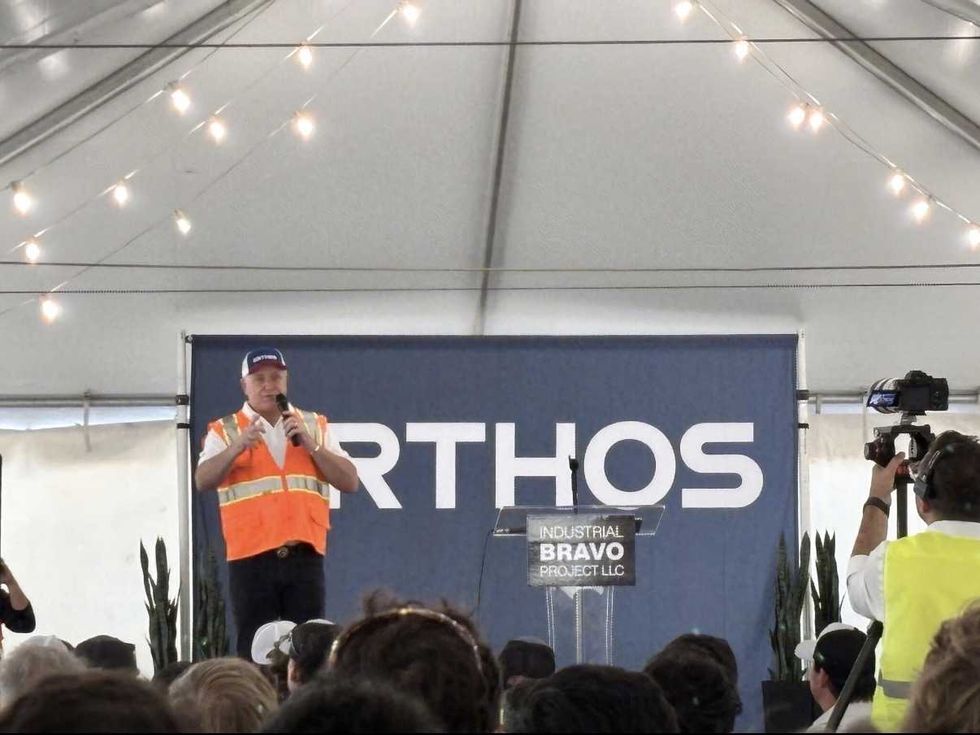
The HTX Tech Tours included a visit to the Erthos Project Bravo in Matagorda County. Photo courtesy

Approximately 100 startups from around the world pitched at Rice Alliance, Greentown Labs and Halliburton Labs events. At Astros Night at Daikin Park, builders, backers, and believers traded conference rooms for the diamond, creating an experience, not just another event. That is how this work becomes civic fabric.

Activation also means making the energy story felt, not merely explained. AY Young brought the Battery Tour for live performances. It was a reminder that the “Power of &” is not confined to a boardroom or a laboratory. Art and technology, culture and commerce, a new generation and established industry can share the same stage—and help more people see themselves in the work ahead.

Perhaps no activation made the “Power of &” more immediate and real than the Houston, We Have Solutions open mic night. At Creatopia’s Innovation Studio, people took the mic—or simply listened—to share what they were building, the problem they could not stop thinking about, and the connection they hoped to make. It put founders, artists, community builders, researchers and future-makers in one room. That is collaboration in real time: different kinds of expertise meeting before anyone knows exactly what the solution will be.

FOX26 helped carry that story beyond the rooms we convened, hosting Erthos COO Jessica Knight, Mars Materials co-founder Aaron Fitzgerald, and investors Taylor Chapman and Juliana Garaizar to discuss building and backing the future in Houston. Our region should be proud—not as self-congratulation, but because the world is beginning to experience energy and climate solutions firsthand.

This was also a week to give back. Allies in Energy awarded $27,500 to nine organizations advancing energy and climate literacy, civil dialogue, workforce pathways and community action. NRG Energy’s Brighter Communities provided a founding gift to expand the week and fund local grants. It took partners, hosts, sponsors, volunteers, funders and community organizations. That is the “Power of &”: collaboration that leaves a stronger community behind.

The “Power of &” cannot stop at Houston’s city limits. Louisiana’s participation—through its support of the Digital Delta Symposium & Expo—made clear that Houston’s builder ecosystem is regional by necessity. Gulf Coast infrastructure, supply chains, talent, and industrial decisions do not recognize state lines. Neither should our collaboration. If we are serious about building more energy with fewer emissions, we must align capital, resources and opportunity across the entire Gulf Coast.

That same commitment to practical collaboration means listening, learning and adjusting. A builder’s mindset does not protect a plan simply because it came first; it improves the conditions for the work to succeed. That is why Houston Energy and Climate Week will move to April 4–10, 2027—better weather, more time and space for connection, and a stronger city-wide experience for the people building what comes next.

But the real test begins now. Can we keep widening the circle? Can we continue to turn research into projects, pilots into infrastructure, capital into good jobs and climate ambition into results that families and communities can see? Can we make every new solution stronger by bringing in the people who must finance it, build it, operate it, live beside it and benefit from it?

That is the work ahead. Turner understood that Houston does not move forward by asking who wins the argument. It moves forward by asking who is ready to solve the problem. His legacy—and the promise of the “&”—is an invitation to choose collaboration over division, action over performance and possibility over false choices.

The future does not need another city to talk about it. It needs Houston to keep building it. And it will only be built if we keep choosing the "&."

---

Katie Mehnert is the CEO of The Bee Suite, and a recent partner to The Builder’s Movement.

Tim Latimer and Sean Maher are some of the headliners for this fall's major clean energy events. Photos courtesy

Houston clean energy events announce keynote speakers from Fervo, Phillips 66

where to be

Two Houston energy institutions will host their signature events this September and have named industry leaders as their keynote speakers.

The Rice Alliance Energy Tech Venture Forum and Greentown Lab's Climatetech Summit kick off Sept. 16. The events are part of Houston Energy and Climate Startup Week and Houston Energy and Climate Week.

The two-day Energy Tech Venture Forum will bring together climatech startups and professionals from around the world to hear pitches, participate in one-on-one office hours and connect with energy innovators.

Sean Maher, chief economist at Phillips 66, will open the forum with a keynote address on the macroeconomic forces shaping the energy industry. Maher also serves as vice president of investor relations at Phillips 66. He previously launched Third Gear Investments, a Houston-based energy investment firm.

Ira Ehrenpreis, founder and managing partner of DBL Partner, which manages more than $1 billion of capital and invests in companies driving social change, will present the keynote on the second day of the forum, Sept. 17. Ehrenpreis is a board member of Tesla and an investor of SpaceX. He will share insights on commercializing breakthrough technologies and what investors are looking for in today's energy innovations.

Applications for the Energy Tech Venture Forum close July 17. Register for the event here.

Fresh off a landmark IPO, Tim Latimer, co-founder and CEO of Houston-based Fervo Energy, will present the keynote at Greentown's Climatetech Summit. Latimer was recently named one of Fast Company's 2026 Visionaries of the Year.

He will be joined by Houston-based SCF Partners' David Baldwin, who will moderate the discussion. The conversation will focus on the timing of Fervo's IPO, what Latimer would have done differently at the early stages of the business, and why the company chose Houston as its headquarters.

The Climatetech Summit will bring together philanthropists, executives and innovators in the energy transition space. Greentown member startups will also present their pitches at the event. Learn more and secure tickets here.

Ad Placement 300x100
Ad Placement 300x600

CultureMap Emails are Awesome

Regulators OK Dow’s Gulf Coast nuclear reactor project

going nuclear

The federal government has given preliminary approval for construction of four nuclear reactors at a Dow site on the Texas Gulf Coast.

The U.S. Nuclear Regulatory Commission (NRC) recently signed off on a permit for Dow and Maryland-based nuclear reactor developer X-energy to build Long Mott Generating Station at Dow’s Seadrift complex. The complex is near Port Lavaca and about 140 miles southwest of Houston.

The NRC issued the permit but hasn’t yet authorized construction to start. The commission said it’s the first construction permit issued for a high-temperature gas-cooled nuclear reactor in nearly 60 years.

Edward Stones, vice president of Dow’s energy and climate business, said the permit approval represents “another important milestone” for Long Mott. It’s expected to be the first-ever advanced nuclear project at a North American industrial site.

Construction at Long Mott could begin before 2030.

Dow’s Seadrift complex manufactures chemicals and plastics. The roughly 4,700-acre site employs more than 1,200 people. Union Carbide, a Dow subsidiary, operates the parent company’s second-largest facility in Texas.

Long Mott will supply zero-carbon electricity and high-temperature steam at Seadrift, replacing current energy- and steam-generating methods. Dow and X-energy are developing the project with support from the U.S. Department of Energy’s Advanced Reactor Demonstration Program.

Mike Goff, principal deputy assistant secretary for nuclear energy, said the NRC’s approval “demonstrates meaningful progress toward deploying advanced reactors that can deliver reliable power and industrial heat, strengthen American energy leadership and expand the role of nuclear energy in meeting our nation’s growing energy demands.”

Plans call for four small X-energy modular reactors to operate at Long Mott. Each reactor would be capable of producing 80 megawatts of electricity or 200 megawatts of thermal energy. Initial delivery of energy could happen as soon as the early 2030s.

“Advanced nuclear has attractive advantages over other sources of clean power, including a compact footprint, competitive cost, and enhanced power and steam reliability,” said Jim Fitterling, executive chair of Dow.

Woodlands startup Mavria raises $130M to mass-produce AI data centers

seed funding

The Woodlands-based Mavria, which mass-produces factory-built modular AI data centers, just emerged from stealth mode with $130 million in funding at a $1 billion valuation.

Mavria raised the money in pre-seed and seed rounds led by Paradigm, an investment firm that concentrates on early-stage startups developing “pioneer” technology. Participants in the funding rounds include AMP PBC, Critical Frontier, Dream Ventures and Liquid 2 Ventures, co-founded by former NFL quarterback Joe Montana.

The company’s inaugural product, Terrain, is a prefabricated data center designed for AI labs, cloud computing providers and data center developers. Mavria says its platform avoids ground-up construction, delivering infrastructure more quickly and at a lower cost.

Mavria tells the Wall Street Journal that the first Terrain unit is being built at a Houston-area factory. The 5-megawatt Terrain system features power distribution, direct liquid cooling, controls and server racks.

“America sets the pace at the intelligence frontier. But the race is moving from the lab into the physical world,” Adam Blake, co-founder and CEO of Mavria, wrote in a blog post.

“Intelligence needs data centers. Data centers need power. Power needs factories, equipment, supply chains, and skilled workers, but much of that infrastructure is still built one custom project at a time, on timelines measured in years.”

Blake and Mavria’s two other co-founders, Nick Poradek and Seth Cohen, most recently worked at the U.S. Department of Energy. There, they focused on reforming the nuclear power sector.

From start to finish, it can take roughly three to six years to build a data center at an estimated cost of $10 million to $37 million per megawatt. Based on those figures, a 100-megawatt data center might cost as much as $3.7 billion.

Here are brief bios of Blake, Poradek and Cohen, who co-founded Mavria in May.

Adam Blake

Blake most recently was a senior advisor to U.S. Energy Secretary Chris Wright. He is co-founder and former CEO of Zego, a provider of energy management technology for property managers. Zego spun out from Brightergy, a commercial solar company. Blake is founder and former CEO of Brightergy.

Nick Poradek

Poradek, chief operating officer at Mavria, was also an advisor to the U.S. energy secretary. He is founder and former CEO of Spring-based Edera Energy, co-founder of The Woodlands-based craft-ice brand Clarity Ice, and founder and former CEO of The Woodlands-based Edera Capital. Poradek sold Edera Energy, a manufacturer of oilfield equipment, to Liberty Energy, a fracking company. Wright is Liberty’s founder and former chairman and CEO.

Seth Cohen

Cohen, chief strategy officer and chief legal officer at Mavria, was head of nuclear law and policy at the Department of Energy. He is also a former NASA advisor and a former attorney at Kirkland & Ellis.

“We believe in rapidly deploying infrastructure as a product, rather than custom-building every project,” Blake said. “We’re bringing together engineering, manufacturing, supply chains and capital so that every project makes us better at delivering the next.”

---

This article originally appeared on our sister site, InnovationMap.

Houston geothermal company lands 50 MW power deal with Google

power purchase

Houston-based geothermal company Quaise Energy has secured a major power purchase agreement from Google.

The companies announced this week that the tech giant would purchase 50 megawatts of superhot geothermal power from Quaise's flagship Project Obsidian geothermal project in Central Oregon starting in 2030. The power will support Google's existing data center campuses in the Dalles region of Oregon, according to a news release.

“We started Quaise to make the Earth's most abundant energy source universally accessible — and this agreement marks a critical next step, not just for Quaise but for the entire clean energy sector," Carlos Araque, CEO and president of Quaise, said in the release. “Together with Google, we are building the commercial foundation for superhot geothermal and cementing the United States as the global leader in geothermal power.”

Google operates three data center campuses in Central Oregon, which have achieved 83 percent carbon-free energy, according to the company. Google says the new partnership with Quaise supports its clean energy efforts.

“Google data centers are long-term investments in the communities we call home,” Lucia Tian, head of advanced energy technologies at Google, added in the release. “This collaboration with Quaise on superhot geothermal will help fuel local economic growth while helping to build a more robust and affordable energy future for Oregon.”

Quaise's Project Obsidian is slated to come online in 2030. Phase I will generate 50 megawatts of geothermal power, with the total capacity planned to reach 1 gigawatt by Phase III. The company says Phase II of the project will be the first to use millimeter wave drilling, which can "plug into existing drilling rigs to economically reach superhot geothermal conditions."

Quaise closed its Series B fundraising round at $180 million in August after inking a $35 million investment from Houston-based Nabors Industries. It previously held a "first close" of the round at $134 million, led by San Francisco-based investment firm Prelude Ventures.

The company announced in March that it was aiming to raise $200 million for Project Obsidian through $100 million in Series B funding, plus an additional $100 million from grants, debt and project-level finance.

Meanwhile, Google struck a giant geothermal deal with Fervo Energy, another Houston-based geothermal leader, in September. Google agreed to purchase 396 megawatts of geothermal power from Fervo with an option for Google to expand capacity to 1 gigawatt by June 2030. The deal represents the largest purchase agreement in Fervo's history.

Financial terms were not disclosed for Google's deal with Quaise or Fervo.