


Hertha Metals has broken ground on its new iron and steel “innovation complex." Photos courtesy Hertha Metals

Shortly after announcing a $133.65 million Series A funding round, Conroe-based Hertha Metals broke ground Oct. 8 on a $100 million factory that will produce steel-grade and magnet-grade high-purity iron.

Hertha’s Chalyx plant, located in Conroe, will manufacture a total of about 10,000 metric tons per year of magnet-grade and steel-grade high-purity iron. The factory will use Hertha’s single-step process to generate high-purity iron for rare-earth-magnet and steel manufacturers in the U.S.

Hertha says Chalyx will be the first U.S. commercial plant for production of magnet-grade high-purity iron.
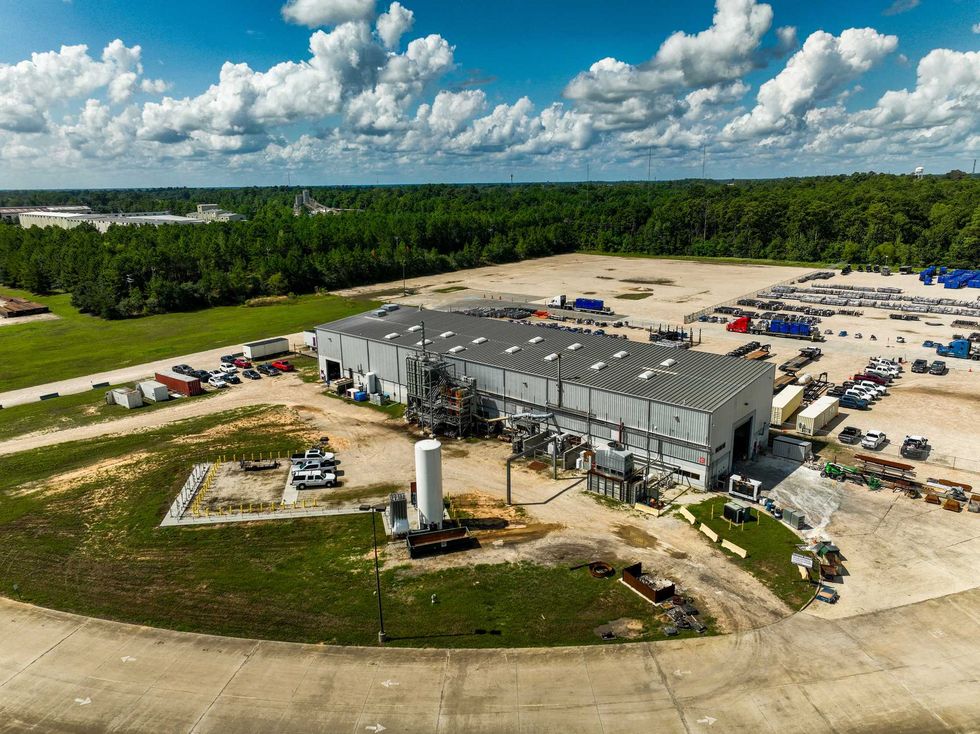
Chalyx is being built next to Hertha’s headquarters and its Pi100 pilot plant, which will remain in operation. Chalyx and Pi100 will form the first modern-day iron and steel “innovation complex” in the U.S., the company says.

“I founded Hertha Metals because I believed we could significantly improve how the world makes iron and steel from ore, and that an industry so fundamental to our future still had enormous room for invention,” Laureen Meroueh, founder and CEO of Hertha, said in a press release.

The 4-year-old startup says the Chalyx complex will lay the foundation for its first 500,000-ton-per-year steel mill.

Chalyx’s first priority is making high-purity iron for U.S. manufacturers of rare-earth magnets, Hertha says. These magnets are critical components for electric vehicles, data centers, wind turbines and defense systems.

China produces an estimated 94 percent of high-purity iron for rare-earth magnets, according to Hertha.
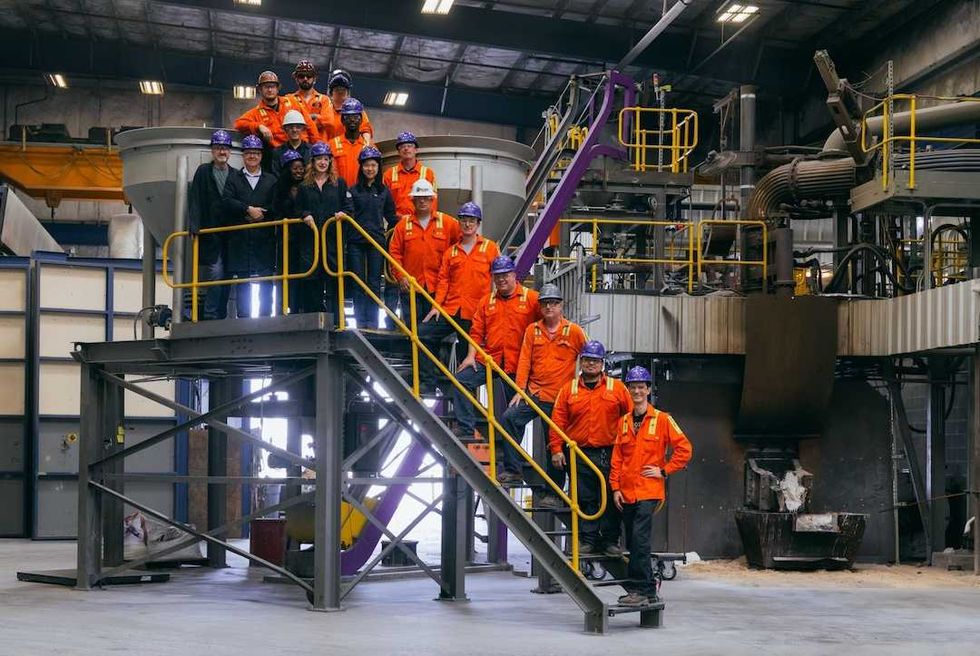
Aside from iron for rare-earth magnets, Chalyx will make iron and steel for pilot projects in the steel industry.

The plant is expected to come online in late 2027, with production of magnet-grade high-purity iron starting in early 2028.

Today, Hertha employs 32 people, the company says. Once it’s fully operating, the Chalyx plant will employ about 50 people.

Just ahead of the groundbreaking, Hertha announced the $133.65 million Series A round, co-led by Khosla Ventures and Doerr Capital. The round included a $65 million equity investment from the Pentagon.

“Iron and steel have shaped human progress for thousands of years. And I believe there is still an enormous amount left to invent,” Meroueh said at the groundbreaking ceremony.

The funding will support the construction of the Hertha Chalyx plant. Photo courtesy Hertha Metals

Hertha Metals raises $133M Series A round, plans high-purity iron plant

cleaner steel

Conroe-based Hertha Metals has closed a $133.65 million Series A round that includes a $65 million equity investment from the Pentagon. The startup uses a one-step process to convert iron into molten steel or high-purity iron.

Khosla Ventures and Doerr Capital co-led the round, with participation from CEV, Pear Ventures, Gates Frontier, Niterra SUISO no MORI Fund, Toyota Ventures, and Siemens Financial Services.

The federal investment came from the U.S. Department of Defense’s Industrial Base Analysis and Sustainment program. The program aims to strengthen and modernize the U.S. Defense Industrial Base, a network that researches, designs, builds, and maintains military weapons, equipment, technology, and services.

The Series A funding will finance construction of Hertha Chalyx, a plant that will be capable of producing 10,000 metric tons of steel-grade and magnet-grade high-purity iron.

Hertha says Chalyx will provide U.S.-made material for manufacturers of rare-earth magnets. Today, China controls more than 90 percent of the global manufacturing of rare-earth magnets.

Rare-earth magnets can be found in fighter jets, smart bombs, submarines, satellites, drones and other military hardware. These magnets are also key components in electric vehicle motors, wind turbines, computer hard drives, smartphones, headphones, cordless tools and an array of other products.

“Every electric vehicle, aerospace platform, radar system, and data center depends on domestic iron and magnet feedstock suppliers,” Laureen Meroueh, founder and CEO of Hertha, said in a press release.

“Hertha Chalyx closes that gap,” she added. “We are building the supply chain this country needs, and we are doing it by providing a domestic cost-competitive option for manufacturers while unlocking safer and cleaner production.”

Hertha says Chalyx, alongside its Pi100 pilot project, will be the first modern-day “iron and steel innovation complex.” The startup expects to break ground on Chalyx this year.

Since its founding in 2022, Hertha has raised more than $150 million from investors.

This spring, Hertha led the manufacturing category on Fast Company’s list of the World’s Most Innovative Companies of 2026.

Ad Placement 300x100
Ad Placement 300x600

CultureMap Emails are Awesome

Houston’s Fervo Energy amasses $12B backlog of orders

q3 results

Houston-based geothermal power company Fervo Energy saw a 65 percent spike in purchase orders during the third quarter.

During Fervo’s third-quarter earnings call, Tim Latimer, co-founder, chair, president and CEO, said the company had a $11.9 billion backlog of orders, up from $7.2 billion in the previous quarter.

Those numbers didn’t translate to robust financial results in the third quarter, though. It closed the quarter with an operating loss of $43 million on revenue of just $116,000.

Beyond the billions of dollars in signed purchase agreements, Fervo is in talks with prospective customers in the utility, industrial data-center sectors, Latimer said. About half the potential customers are in the data-center sector, 35 percent in the utility sector and 15 percent in the industrial sector.

Latimer said the broad-based demand reflected by the backlog and the discussions with potential customers reinforces the critical need for reliable, readily available power.

“Our approach to power delivery will continue to blend front-of-the-meter and behind-the-meter development,” he said. “Grid-connected assets remain the foundation, though behind-the-meter gives customers a faster path to power when transmission time lines lag their need.”

Front-of-the-meter refers to power plants, utility-scale solar and wind farms, large grid batteries, and transmission and distribution infrastructure. Behind-the-meter assets sit on the customer side of the meter, such as backup generators and EV chargers at homes, businesses, factories and other everyday places.

The order backlog isn’t Fervo’s only recent milestone. In late September, the company’s Cape Station geothermal plant in Utah started delivering its first utility-scale geothermal power to the grid. The plant is producing about 33 megawatts of power.

Earlier in September, Fervo signed a 15-year deal to supply about 396 megawatts of power for Google data centers. The power will be delivered in four 99-megawatt batches. The company filed its $1.89 billion IPO this spring.

3 Houston incubators supporting hard tech, energy transition, and beyond

Meet The Finalists

It takes a village to launch a business. That's where Houston's network of incubators and accelerators can step in, providing the resources, mentorship and community needed to push a fledgling company forward.

As part of InnovationMap's 2026 Houston Innovation Awards, the Incubator/Accelerator of the Year category honors a local organization that is championing and fueling the growth of Houston startups.

Three incubators and accelerators have been named finalists for the 2026 award. They support startups ranging from hard tech companies to food and youth concepts.

Read more about these organizations below. The 2026 winners will be announced on InnovationMap.com in mid-November.

Activate

Hard tech incubator Activate supports scientists in "the outset of their entrepreneurial journey." The Houston hub was introduced in 2024, and joins others in Boston, New York, and Berkley, California—where Activate is headquartered. It named its third Houston cohort this summer.

The two-year program graduated its first class of Houston fellows in 2026 and saw its first alumni IPO from Houston-based Fervo Energy, which previously participated in a Berkley cohort. Nationally, it has supported 346 fellows and 276 companies since 2015. Those companies have raised more than $6 billion in follow-on funding, according to Activate. In Houston, it has supported Houston startups like energy transition leaders Solidec and FlowCellutions. Activate Houston is led by managing director Jeremy Pitts, who co-founded Greentown Labs in Boston. It is based out of the Ion.

Impact Hub Houston

Impact Hub Houston supports early-stage ventures at various stages of development through innovative programs that address pressing societal issues. The nonprofit organization supports social impact startups through mentorship, connections and training opportunities.

There are more than 110 Impact Hubs globally with members spanning 72 countries. Launched in 2018, Impact Hub Houston says its membership tripled by the beginning of 2026. This year brought major milestones for the community, including the launch of its Ideas to Impact Accelerator, which supported 11 founders across the health, education, food systems, civic technology and workforce development sectors. It also received funding from more than 20 international Impact Hubs to develop SYNC, a collaboration platform that 25 Impact Hubs across five continents have committed to pilot. The organization has worked with local startups including Myoviva Health, The Change Lab and INNERVERSE Inc.

MarMo Innovation

Galveston-based business incubator MarMo Innovation is focused on removing barriers to entrepreneurship. It aims to provide affordable space, education, mentorship, market access, connections and real-world opportunities that help entrepreneurs move from idea to launch to sustainable growth. The "industry-agnostic" incubator was founded in 2022 and is led by Executive Director Erica Delgadillo.

This year, the organization moved from primarily serving as a coworking and community space into a more comprehensive entrepreneurial incubator by expanding its MarMo Market, MarMo Market Jr. and Lunch LineUp programs. A major focus for MarMo is food entrepreneurship. It is developing an Incubator Kitchen, which MarMo says will support programs like its Cottage to Commercial Bootcamp and Food Biz 101. The organization also expanded its board this year and says it is diversifying its revenue through memberships, events, markets, equipment and space rentals, sponsorships, grants and new entrepreneurial programming.

---

This article first appeared on InnovationMap.com.

Sage Geosystems taps Halliburton to advance Nevada geothermal project

power partnership

Houston-based Sage Geosystems has selected oil and gas powerhouse Halliburton to provide cementing and stimulation services at its enhanced geothermal project in Nevada known as Project Vector.

“Our technology and experience will support Sage as it advances its geopressured geothermal technology,” Shawn Skobel, vice president at Halliburton, said in a news release.

Halliburton will provide Sage with technical modeling, engineering design, and field execution support as part of its specialized cementing and stimulation services at Project Vector at Ormat Technologies' Blue Mountain geothermal power plant. Sage announced the location of the geothermal project in September.

At the time, Sage said it expected to begin drilling the first well at Project Vector this year, with the first electricity to be generated in 2027 and full-scale production to start in 2028.

The project will use Sage’s enhanced geothermal systems (EGS) method in a two-well system to convert geothermal heat into electricity. The project aims to help meet industrial and residential demand, especially as data centers strain energy grids.

Founded in 2020, Sage has raised $159 million across three funding rounds. Its technology aims to reach Earth’s natural heat source deep underground for more consistent power generation and utilizes engineered subsurface reservoirs to minimize water and energy losses and increase net power output. Through the process, Sage says it can enable reliable, 24/7 power generation.

“One of the keys to scaling next-generation geothermal is combining innovative subsurface technology with the proven capabilities and execution of the oil and gas industry,” Jason Peart, Chief Operating Officer of Sage Geosystems, added in the news release. “Halliburton brings decades of experience in well integrity and reservoir stimulation, two critical components of our development approach. By selecting an established industry leader, we are strengthening our ability to execute Project Vector and demonstrate that Sage’s technology can be replicated and deployed commercially across a broad range of geologies.”

Sage is building off prior success of its South Texas SMECI facility, which began operations in August. Project Vector supports Sage’s growing commercial pipeline, which includes a 150-megawatt geothermal power agreement with Meta.