Four Houston scientists have been awarded funding through the Department of Energy's Genesis Mission. Photos courtesy

The U.S. Department of Energy has named the nearly 300 projects selected under the Trump Administration's Genesis Mission, which aims to address some of the largest science and technology challenges in the country. The group features four projects from Houston universities and companies.

The initiative aims to unite government, industry, academia and philanthropy to lead to breakthroughs in energy, scientific discovery and national security, according to a release.

The selected projects feature 87 led by DOE and National Nuclear Security Administration (NNSA) National Laboratories, 168 led by universities, 19 led by companies and 4 led by nonprofit organizations—totalling 342 participating institutions.

“America has no shortage of bold ideas or talented scientists, and the response to the Genesis Mission proves that,” U.S. Secretary of Energy Chris Wright said in a news release. “The 278 projects selected today represent the very best of our nation’s scientific enterprise. The remarkable number of high-quality proposals we received demonstrates that America’s innovation pipeline is strong, and it points to even greater opportunities for future investment and continued expansion of the Genesis Mission portfolio.”

Twelve Texas-based projects were selected among the 278. The Houston projects and their researchers include:

Caroline Ajo-Franklin

Ajo-Franklin recieved a Phase I grant for her project "Predictive AI to Map Point Mutation Effects on Protein Function: Measurement and Biosynthesis of Isoprenoids." Ajo-Franklin is a professor of biosciences at Rice University, a CPRIT Scholar in Cancer Research and member of the Rice Synthetic Biology Institute. The project aims to accelerate the engineering of microbes that can produce isoprenoids, which are natural compounds that could replace petroleum-derived fuels, solvents and materials.

“This project creates a continuous feedback loop in which AI guides experiments and each experiment generates more detailed data to better hone the AI model,” Ajo-Franklin said in a news release. “In addition, it demonstrates the extraordinary star power Rice has recruited in protein engineering and synthetic biology.”

Anastasios Kyrillidis

Kyrillidis recived a Phase I grant for his project "Cracking the VQA Optimization Bottleneck: AI Methods for Quantum Chemistry and Materials." Kyrillidis is the Noah Harding Associate Professor of Computer Science at Rice and a member of the Ken Kennedy Institute. The project aims to develop AI tools to resolve bottlenecks in quantum computing for chemistry and materials research.

“Our goal is to replace fragile, hand-tuned optimization methods with intelligent systems that can learn from quantum computations while still operating within frameworks that provide strong mathematical guarantees,” Kyrillidis added in the release.

Myoungkyu Lee

Lee received a nearly $750,000 Phase I grant for his project "Physics-Informed AI Surrogates for Turbulent Forced Convection in Energy System." Lee is an assistant professor of mechanical aerospace engineering at the University of Houston. Lee will collaborate with researchers from Lawrence Livermore National Laboratory and University of Pennsylvania on the project and develop artificial intelligence to accelerate the design of materials for advanced nuclear fission and fusion reactors.

“The goal is to develop a tool that runs much faster than today’s most detailed simulations while keeping errors small,” Lee said in a news release. “If successful, the approach could support better heat-transfer predictions for molten-salt reactor design and provide a starting point for studying heat removal in fusion blankets. This is one contribution among many toward reliable, carbon-free energy.”

Amit Padhi

Padhi recieved a grant for his project "Probabilistic Inference of Subsurface Fracture Connectivity for Stimulation Control with Physics-Informed AI." Padhi is a scientific advisor for Halliburton.

The DOE first called for applications for the Genesis Mission in March. At the time, the DOE shared that it would grant approximately $293 million to the selected teams via Phase I awards, ranging from $500,000 to $750,000 for nine-month project periods, and Phase II awards, for $6 million to $15 million over a three-year project period.

Since then, however, the initiative has grown with 15 federal agencies now granting research awards and funding opportunities under the Genesis umbrella. The White House announced this week that it had secured more than $5 billion in federal commitments to expand the initiative.

Ad Placement 300x100
Ad Placement 300x600

CultureMap Emails are Awesome

Houston geothermal startup bumps Series B to $180M with Nabors investment

fresh funding

Houston-based geothermal startup Quaise Energy has closed its Series B fundraising round at $180 million after inking a significant investment from another local energy leader.

Quaise, which is developing a 50-megawatt superhot geothermal plant in Oregon, announced a "first close" of the round last month at $134 million, led by San Francisco-based investment firm Prelude Ventures. The $46 million bump has been fueled by a $35 million investment from Houston-based Nabors Industries.

The funding will go toward the continued development of the company's superhot geothermal plant, Project Obsidian, as well as the commercialization of Quaise's millimeter-wave drilling system, according to a news release.

“We are unlocking the most powerful clean energy source on Earth, and the Series B signals deep conviction across a wide range of investors,” Carlos Araque, Quaise CEO and president, said in the release. “Nabors is an invaluable partner as we move millimeter wave drilling to full commercial operations at Project Obsidian and beyond.”

Nabors, a repeat investor in Quaise, has also entered into a strategic framework agreement with Quaise. Under the agreement, Quaise will have access to a dedicated Nabors land rig and drilling platform. Nabors will also provide expertise in reservoir modeling, well design and drilling strategy.

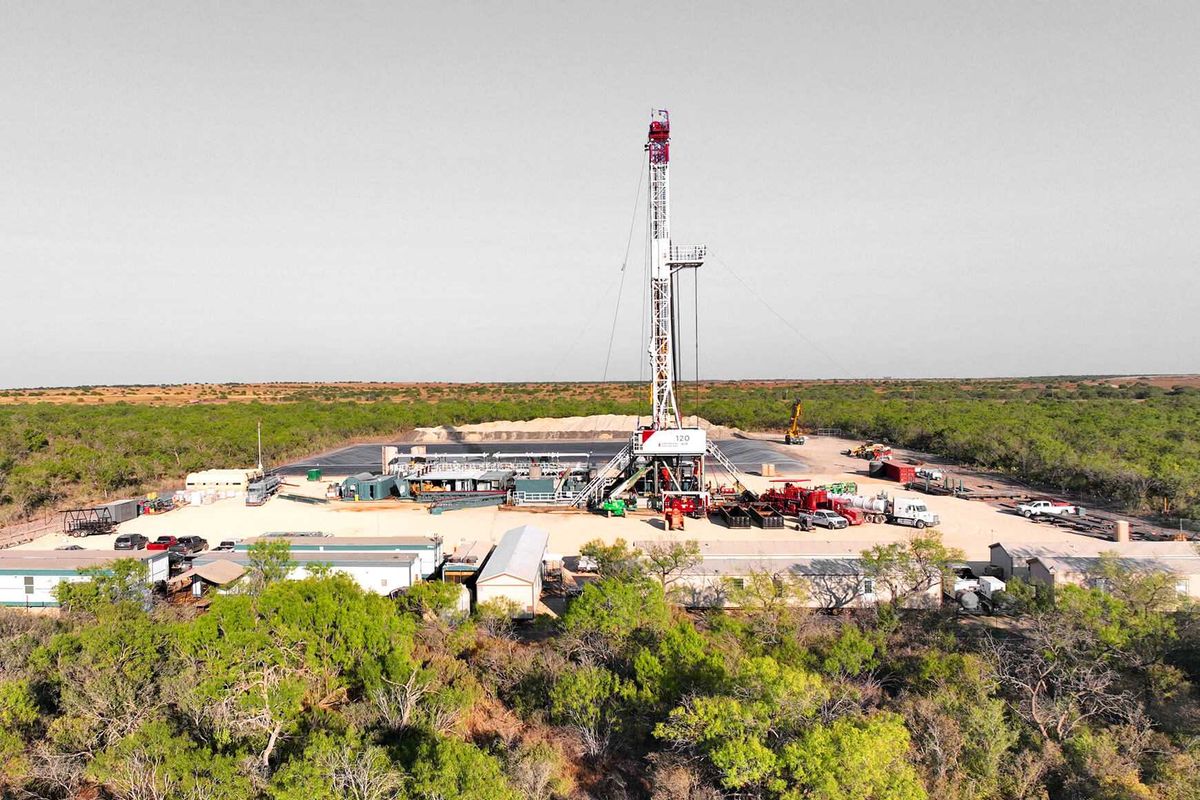
Last year, Quaise drilled to a depth of about 330 feet using its millimeter-wave technology at its field site in Central Texas. Canary Media previously reported that Quaise plans to drill to nearly 3,300 feet later this year and to deploy its millimeter-wave technology at its power plant in 2027. The plant is expected to deliver power to the Pacific Northwest in 2030.

Quaise and Nabors say the partnership will improve drilling performance, reduce costs and accelerate project timelines.

“Superhot geothermal has the potential to make clean energy ubiquitous. That is why we are excited about our close relationship with Quaise,” Anthony Petrello, president and CEO of Nabors, added in the release. “Quaise’s millimeter wave technology changes the equation entirely by reaching superhot rock at temperatures and depths that are inaccessible with conventional drilling, transforming geothermal from a location-dependent resource into a global energy solution. Combined with Nabors’ drilling expertise and infrastructure, we see a path to gigawatt-scale geothermal power that no other company can offer today.”

Quaise reports that with the latest funding, it has now raised $280 million. It raised $21 million in a Series A1 financing round in 2024 and a $52 million Series A in 2022.

The company announced in March that it was aiming to raise $200 million for Project Obsidian through $100 million in Series B funding, plus an additional $100 million from grants, debt and project-level finance.

Houston's KBR tapped to provide tech for first SAF plant in Kazakhstan

clean deals

Houston-based engineering and technology firm KBR Inc. has been tapped to provide technology for Kazakhstan's first sustainable aviation fuel (SAF) production plant.

KazMunayGas-Aero LLP (KMG-Aero), a subsidiary of Kazakhstan’s national oil and gas company KazMunayGas, and KazFoodProducts awarded the contract to KBR for the project. The plant will use the alcohol-to-jet (AtJ) process for producing aviation fuel and aims to support President Kassym-Jomart Kemeluly Tokayev’s goal of boosting Kazakhstan's profile as a global aviation player, according to a news release from KBR.

"We are honored to support KMG-Aero and KFP in advancing the national commitment to reduce greenhouse gas emissions, recognizing the pivotal role of aviation decarbonization in achieving these strategic objectives,” Jay Ibrahim, president of KBR Sustainable Technology Solutions, said in the release.

KBR will provide its PureSAF technology and engineering design for the project. Invented and developed by Swedish Biofuels AB, the PureSAF tech will be used to convert alcohol-based feedstocks into SAF. The PureSAF Technology can process multiple feedstocks—like bioethanol, syngas, carbon dioxide and hydrogen—and convert them to SAF, diesel and gasoline, according to KBR.

"KBR’s PureSAF is a feed-flexible, bankable technology that is designed to deliver high SAF yields and supports the project across the full lifecycle,” Ibrahim added in the release. “We look forward to closely collaborating and supporting the successful execution of this landmark SAF project.”

Earlier this summer, KBR was also chosen to provide technology for what’s expected to be Asia's first commercial-scale ethanol-to-jet (SAF) plant. The plant has a planned production capacity of up to 100,000 tons of SAF per year.

In addition to the SAF projects, KBR also announced this month that it has been selected by ORNX Green Hydrogen to provide proprietary ammonia technologies for a low-cost green ammonia project in Morocco.

The commitments come as KBR shifts its focus solely toward sustainability technology and services. The company is in the process of spinning off its Mission Technology Solutions business, which KBR recently announced will be named Trinzic. The remaining company, "New KBR," will serve the ammonia and syngas, chemical and petrochemicals, clean refining and circular economy markets.

Army to build nuclear microreactors at 5 U.S. bases, including Texas

Nuclear News

The U.S. Army announced Wednesday that it plans to add nuclear microreactors at five military bases from New York to Texas as a reliable source of energy independent of the commercial electric grid.

The announcement comes as the Trump administration pushes hard to develop the next generation of nuclear power, including billions in loans for large nuclear reactors to meet skyrocketing power demand from data centers and a pilot program to boost advanced reactor designs and projects for military and civilian use. No nuclear microreactors are supplying power to the commercial electric grid in the United States today.

Five companies selected by the Army will be awarded up to $2.2 billion in total over five years to own, construct and operate the microreactors, if they hit set milestones along the way for their performance. The Army expects that more than 20 nuclear microreactors will be built and operated.

Army and industry officials say microreactors offer a resilient power source for critical infrastructure at military installations in case the grid fails. Reactors can run for years without refueling.

Army Secretary Dan Driscoll said the awards will accelerate the military’s ability “to deliver safe, reliable baseload power directly to our installations. We are building the energy resilience necessary to project combat power globally, without relying on potentially vulnerable external grids,” he said.

The grants are part of the Army's “Janus Program” launched last year to deliver next-generation nuclear energy. Officials hope to push nuclear development forward so that advanced reactor designs move beyond experiments and prototypes to provide power for years to come. This will be the “spear tip,” said Jeff Waksman, principal deputy assistant secretary of the Army for installations, energy and environment.

“That is the transition that we are trying to effect here,” he said on a call with reporters Wednesday. “These are not meant to be Army-specific designs.”

Critics of building more nuclear reactors say they’re too expensive and riskier than other energy sources. The Army program is using the military's “deep pockets to provide a hidden subsidy” to nuclear companies that can't find private-sector customers for their hypothetical and uneconomical reactors, said Alan J. Kuperman, associate professor at the Lyndon B. Johnson School of Public Affairs at the University of Texas at Austin and coordinator of the Nuclear Proliferation Prevention Project.

The reactors will be licensed by the Army, rather than the U.S. Nuclear Regulatory Commission, which licenses commercial nuclear reactors. Kuperman said it's “a dangerous scam on many levels.”

Waksman said these reactors will shut down safely in case of a failure, they're small and the Army wouldn't add them to installations without being certain they are safe. He said the Army is working on a deal with the Energy Department to remove radioactive waste, and there won't be any long-term storage on these installations.

The Army is working to align its regulatory processes as much as possible, Waksman said, so that companies won’t need major changes to their designs to be later licensed by the NRC. Along with federal funding, the Army expects billions of dollars in private capital investment.

Army leads the military’s adoption of nuclear energy

President Donald Trump signed executive orders in May 2025 to speed up the development of nuclear power. The Army was tasked with ensuring that an advanced reactor would start operating at a domestic military installation no later than Sept. 30, 2028. The Janus program is named for the ancient Roman god of transitions.

Officials know that delivering nuclear power to a military base will be a challenge, so they picked five companies in case one or more fail, Waksman said. The selected companies are: Antares Nuclear at Fort Bragg in North Carolina; BWXT at Fort Campbell in Kentucky; General Atomics Electromagnetic Systems at Fort Hood in Texas; Radiant Industries at Fort Benning in Georgia; and Westinghouse Government Services at Fort Drum in New York.

Senate Minority Leader Chuck Schumer asked the Army to select Fort Drum. The critical missions Fort Drum supports require secure power generation, the New York Democrat said.

The military installations will remain connected to the grid. The reactors would not completely power them. Each reactor will provide between 1 megawatt to 20 megawatts of power, depending on the company's design. Major bases use as much power as a small city. Antares and Radiant are planning to deliver their reactors in three-packs, Waksman said.

The Army now uses diesel as a primary backup for critical infrastructure. But in a conflict, Waksman said, the Army may not be able to move fossil fuels easily wherever it needs them.

“That makes nuclear energy just a natural game changer,” he said. “It makes sense for the Army to take the lead here.”

A reactor at Fort Belvoir in Virginia, completed in 1957, was the first nuclear power reactor to provide electricity to a commercial power grid in the United States for an extended period, according to the U.S. Army Corps of Engineers.

Companies say this will accelerate US nuclear development

California-based Antares reached a crucial milestone under the U.S. pilot program that could allow it to produce electricity at Idaho National Lab next year. The company said the Army's announcement extends its momentum. Westinghouse Government Services said it’s proud to support the Army’s efforts to strengthen energy security and innovate.

Tori Shivanandan, president and chief operating officer of California-based Radiant, said the Army’s $750 million award “shows confidence in Radiant’s product and ability to manufacture, deploy and safely operate nuclear microreactors for the American military.” The Janus program “will build a stronger and more resilient America,” she said.

General Atomics Electromagnetic Systems said its reactor is designed to operate in remote, off-grid and extreme environments for 40 years. It said it will draw on more than 70 years of nuclear expertise to provide safe, dependable and independent power for the military.

Rex Geveden, BWXT's president and chief executive officer, said, “As we commence work on the Janus program, we are delivering the nation’s most credible and reliable path to deployable nuclear power.”