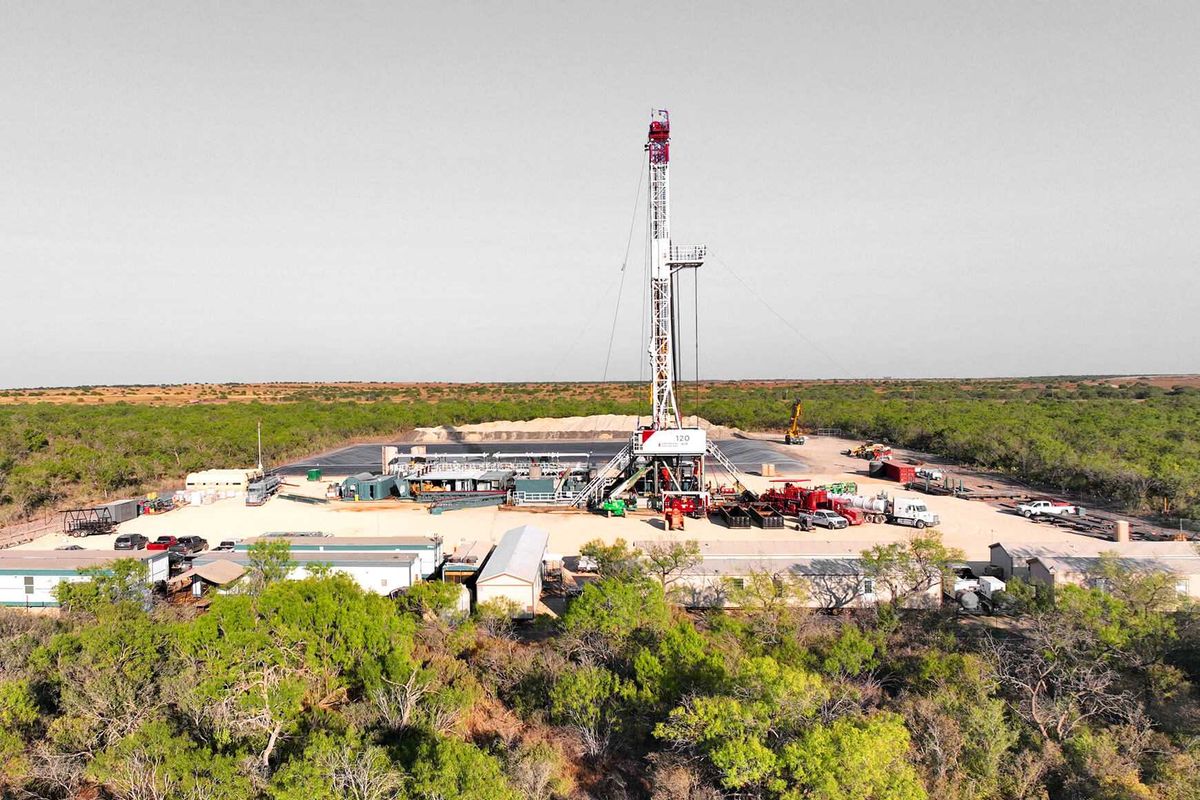
Houston-based energy companies have again held a sizable presence on the Fortune 500 ranking. Photo via Getty Images

Fourteen businesses with global or regional headquarters in the Houston area appear on Fortune’s new list of the world’s 500 biggest companies.

Oil and gas company Saudi Aramco, whose headquarters for the Americas is in Houston, leads the Houston-area pack. With annual revenue of $494.9 billion, it lands at No. 4 on the Fortune Global 500. Ahead of Saudi Aramco are U.S. retailers Walmart and Amazon, and Chinese electric company State Grid.

To put Saudi Aramco’s annual revenue in perspective, the total is slightly above the gross domestic product for the Philippines.

For the third year in a row, Saudi Aramco stands out as the most profitable member of the Fortune Global 500. The company racked up $121 billion in profit last year.

Overall, Saudi Aramco and 32 other petroleum refiners — many of them with a significant presence in the Houston area — made the Fortune Global 500.

“The Global 500 is the ultimate scorecard for business success. The aggregate revenue of the Fortune Global 500 in 2023 reached $41 trillion, a record level. That sum represents more than a third of global GDP — a sign of how much economic power is concentrated in these companies,” Scott DeCarlo, Fortune’s vice president of research, says in a news release.

Here’s the rundown of Fortune Global 500 companies with global or regional headquarters in the Houston area, including the ranking and annual revenue for each:

  • Saudi Aramco, No. 4, $494.9 billion, Americas headquarters in Houston
  • ExxonMobil, No. 12, $344.6 billion, global headquarters in Spring
  • Shell, No. 13, $323.2 billion; U.S. headquarters in Houston
  • TotalEnergies, No. 23, $218.9 billion, U.S. headquarters in Houston
  • BP, No. 25, $213 billion, U.S. headquarters in Houston
  • Chevron, No. 29, $200.9 billion, global headquarters relocating to Houston in 2024
  • Phillips 66, No. 52, $149.9 billion, global headquarters in Houston
  • Engie, No. 130, $89.3 billion, North American headquarters in Houston
  • Sysco, No. 163, $76.3 billion, global headquarters in Houston
  • ConocoPhillips, No. 235, $58.6 billion, global headquarters in Houston
  • Enterprise Products Partners, No. 303, $49.7 billion, global headquarters in Houston
  • Plains GP Holdings, No. 311, $48.7 billion, global headquarters in Houston
  • LyondellBasell, No. 368, $41.1 billion, global headquarters in Houston
  • SLB (formerly Schlumberger), No. 479, $33.1 billion, global headquarters in Houston

Fortune uses revenue figures for budget years ending on or before March 31, 2024, to rank the world’s largest companies.

Ad Placement 300x100
Ad Placement 300x600

CultureMap Emails are Awesome

Chevron CEO touts biofuels as part of its renewable energy efforts

Betting on biofuels

As Chevron Chairman and CEO Mike Wirth surveys the renewable energy landscape, he sees the most potential in biofuels.

At a recent WSJ CEO Council event, Wirth put a particular emphasis on biofuels—the most established form of renewable energy—among the mix of low-carbon energy sources. According to Biofuels International, Chevron operates nine biorefineries around the world.

Biofuels are made from fats and oils, such as canola oil, soybean oil and used cooking oil.

At Chevron’s renewable diesel plant in Geismar, Louisiana, a recent expansion boosted annual production by 278 percent — from 90 million gallons to 340 million gallons. To drive innovation in the low-carbon-fuels sector, Chevron opened a technology center this summer at its renewable energy campus in Ames, Iowa.

Across the board, Chevron has earmarked $8 billion to advance its low-carbon business by 2028.

In addition to biofuels, Chevron’s low-carbon strategy includes hydrogen, although Wirth said hydrogen “is proving to be very difficult” because “you’re fighting the laws of thermodynamics.”

Nonetheless, Chevron is heavily invested in the hydrogen market:

As for geothermal energy, Wirth said it shows “some real promise.” Chevron’s plans for this segment of the renewable energy industry include a 20-megawatt geothermal pilot project in Northern California, according to the California Community Choice Association. The project is part of an initiative that aims to eventually produce 600 megawatts of geothermal energy.

What about solar and wind power?

“We start with things where we have some reason to believe we can create shareholder value, where we’ve got skills and competency, so we didn’t go into wind or solar because we’re not a turbine manufacturer installing wind and solar,” he said in remarks reported by The Wall Street Journal.

In a September interview with The New York Times, Wirth touched on Chevron’s green energy capabilities.

“We are investing in new technologies, like hydrogen, carbon capture and storage, lithium and renewable fuels,” Wirth said. “They are growing fast but off a very small base. We need to do things that meet demand as it exists and then evolve as demand evolves.”

Houston robotics company partners with Marathon Petroleum to scale fleet

robot alliance

Houston- and Boston-based Square Robot Inc. has announced a partnership with downstream and midstream energy giant Marathon Petroleum Corp. (NYSE: MPC).

The partnership comes with an undisclosed amount of funding from Marathon, which Square Robot says will help "shape the design and development" of its submersible robotics platform and scale its fleet for nationwide tank inspections.

“Marathon’s partnership marks a major milestone in our mission to transform industrial tank inspection,” David Lamont, CEO of Square Robot, said in a news release. “They recognize the proven value of our robotic inspections—eliminating confined space entry, reducing the environmental impact, and delivering major cost efficiencies all while keeping tanks on-line and working. We’re excited to work together with such a great company to expand inspection capabilities and accelerate innovation across the industry.”

The company closed a $13 million series B last year. At the time of closing, Square Robot said it would put the funding toward international expansion in Europe and the Middle East.

Square Robot develops autonomous, submersible robots that are used for storage tank inspections and eliminate the need for humans to enter dangerous and toxic environments. Its newest tank inspection robot, known as the SR-3HT, became commercially available and certified to operate at a broader temperature range than previous models in the company's portfolio this fall.

The company was first founded in the Boston area in 2016 and launched its Houston office in 2019.