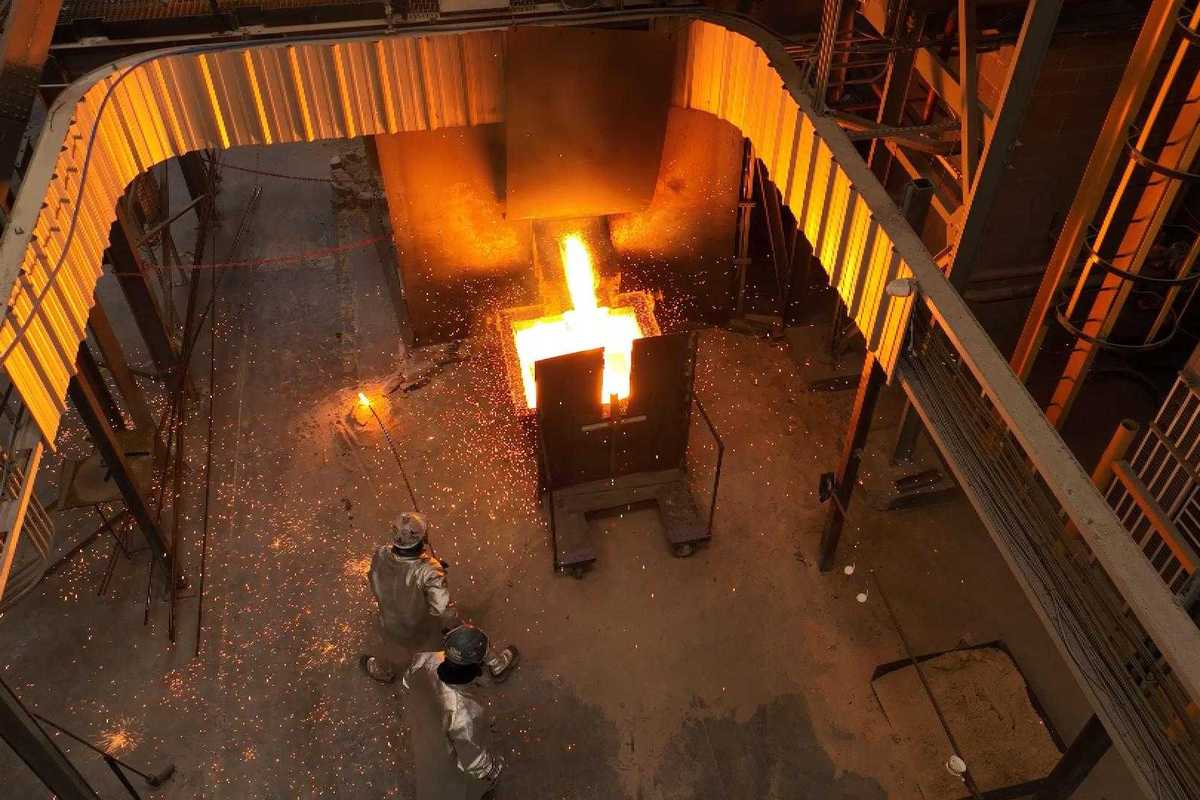
Conversations rarely focus on what keeps electricity moving: transmission infrastructure. Photo by REVTLProjects on Unsplash

Texas takes pride in running one of the most dynamic and deregulated energy markets in the world, but conversations about electricity rarely focus on what keeps it moving: transmission infrastructure.

As ERCOT projects unprecedented electricity demand growth and grid operators update their forecasts for 2026, it’s becoming increasingly clear that generation, whether renewable or fossil, is only part of the solution. Transmission buildout and sound governing policy now stand as the linchpin for reliability, cost containment, and long-term resilience in a grid under unprecedented stress.

At the heart of this urgency is one simple thing: demand. Over 2024 and 2025, ERCOT has been breaking records at a pace we haven’t seen before. From January through September of 2025 alone, electricity use jumped more than 5% over the year before, the fastest growth of any major U.S. grid. And it’s not slowing down.

The Energy Information Administration expects demand to climb another 14% in 2026, pushing total consumption to roughly 425 terawatt-hours in just the first nine months. That surge isn’t just about more people moving to Texas or running their homes differently; it’s being driven by massive industrial and technology loads that simply weren’t part of the equation ten years ago.

The most dramatic contributor to that rising demand is large-scale infrastructure such as data centers, cloud computing campuses, crypto mining facilities, and electrified industrial sectors. In the latest ERCOT planning update, more than 233 gigawatts of total “large load” interconnection requests were being tracked, an almost 300% jump over just a year earlier, with more than 70% of those requests tied to data centers.

Imagine hundreds of new power plants requesting to connect to the grid, all demanding uninterrupted power 24/7. That’s the scale of the transition Texas is facing, and it’s one of the major reasons transmission planning is no longer back-of-house policy talk but a central grid imperative.

Yet transmission is complicated, costly, and inherently long-lead. It takes three to six years to build new transmission infrastructure, compared with six to twelve months to add a new load or generation project.

This is where Texas will feel the most tension. Current infrastructure can add customers and power plants quickly, but the lines to connect them reliably take time, money, permitting, and political will.

To address these impending needs, ERCOT wrapped up its 2024 Regional Transmission Plan (RTP) at the end of last year, and the message was pretty clear: we’ve got work to do. The plan calls for 274 transmission projects and about 6,000 miles of new, rebuilt, or upgraded lines just to handle the growth coming our way and keep the lights on.

The plan also suggests upgrading to 765-kilovolt transmission lines, a big step beyond the standard 345-kV system. When you start talking about 765-kilovolt transmission lines, that’s a big leap from what Texas normally uses. Those lines are built to move a massive amount of power over long distances, but they’re expensive and complicated, so they’re only considered when planners expect demand to grow far beyond normal levels. Recommending them is a clear signal that incremental upgrades won’t be enough to keep up with where electricity demand is headed.

There’s a reason transmission is suddenly getting so much attention. ERCOT and just about every industry analyst watching Texas are projecting that electricity demand could climb as high as 218 gigawatts by 2031 if even a portion of the massive queue of large-load projects actually comes online. When you focus only on what’s likely to get built, the takeaway is the same: demand is going to stay well above anything we’ve seen before, driven largely by the steady expansion of data centers, cloud computing, and digital infrastructure across the state.

Ultimately, the decisions Texas makes on transmission investment and the policies that determine how those costs are allocated will shape whether 2026 and the years ahead bring greater stability or continued volatility to the grid. Thoughtful planning can support growth while protecting reliability and affordability, but falling short risks making volatility a lasting feature of Texas’s energy landscape.

Transmission Policy: The Other Half of the Equation

Infrastructure investment delivers results only when paired with policies that allow it to operate efficiently and at scale. Recognizing that markets alone won’t solve these challenges, Texas lawmakers and regulators have started creating guardrails.

For example, Senate Bill 6, now part of state law, aims to improve how large energy consumers are managed on the grid, including new rules for data center operations during emergencies and requirements around interconnection. Data centers may even be required to disconnect under extreme conditions to protect overall system reliability, a novel and necessary rule given their scale.

Similarly, House Bill 5066 changed how load forecasting occurs by requiring ERCOT to include utility-reported projections in its planning processes, ensuring transmission planning incorporates real-world expectations. These policy updates matter because grid planning isn’t just a technical checklist. It’s about making sure investment incentives, permitting decisions, and cost-sharing rules are aligned so Texas can grow its economy without putting unnecessary pressure on consumers.

Without thoughtful policy, we risk repeating past grid management mistakes. For example, if transmission projects are delayed or underfunded while new high-demand loads come online, we could see congestion worsen. If that happens, affordable electricity would be located farther from where it’s needed, limiting access to low-cost power for consumers and slowing overall economic growth. That’s especially critical in regions like Houston, where energy costs are already a hot topic for households and businesses alike.

A 2026 View: Strategy Over Shortage

As we look toward 2026, here are the transmission and policy trends that matter most:

  • Pipeline of Projects Must Stay on Track: ERCOT’s RTP is ambitious, and keeping those 274 projects, thousands of circuit miles, and next-generation 765-kV lines moving is crucial for reliability and cost containment.
  • Large Load Forecasting Must Be Nuanced: The explosion in large-load interconnection requests, whether or not every project materializes, signals demand pressure that transmission planners cannot ignore. Building lines ahead of realized demand is not wasteful planning; it’s insurance against cost and reliability breakdowns.
  • Policy Frameworks Must Evolve: Laws like SB 6 and HB 5066 are just the beginning. Texas needs transparent rules for cost allocation, interconnection standards, and emergency protocols that keep consumers protected while supporting innovation and economic growth.
  • Coordination Among Stakeholders Is Critical: Transmission doesn’t stop at one utility’s borders. Regional cooperation among utilities, ERCOT, and local stakeholders is essential to manage congestion and develop systemwide reliability solutions.

Here’s the bottom line: Generation gets the headlines, but transmission makes the grid work. Without a robust transmission buildout and thoughtful governance, even the most advanced generation mix that includes wind, solar, gas, and storage will struggle to deliver the reliability Texans expect at a price they can afford.

In 2026, Texas is not merely testing its grid’s capacity to produce power; it’s testing its ability to move that power where it’s needed most. How we rise to meet that challenge will define the next decade of energy in the Lone Star State.

———

Sam Luna is director at BKV Energy, where he oversees brand and go-to-market strategy, customer experience, marketing execution, and more.
Researchers from Rice University say their recent findings could revolutionize power grids, making energy transmission more efficient. Image via Getty Images.

Rice researchers' quantum breakthrough could pave the way for next-gen superconductors

new findings

A new study from researchers at Rice University, published in Nature Communications, could lead to future advances in superconductors with the potential to transform energy use.

The study revealed that electrons in strange metals, which exhibit unusual resistance to electricity and behave strangely at low temperatures, become more entangled at a specific tipping point, shedding new light on these materials.

A team led by Rice’s Qimiao Si, the Harry C. and Olga K. Wiess Professor of Physics and Astronomy, used quantum Fisher information (QFI), a concept from quantum metrology, to measure how electron interactions evolve under extreme conditions. The research team also included Rice’s Yuan Fang, Yiming Wang, Mounica Mahankali and Lei Chen along with Haoyu Hu of the Donostia International Physics Center and Silke Paschen of the Vienna University of Technology. Their work showed that the quantum phenomenon of electron entanglement peaks at a quantum critical point, which is the transition between two states of matter.

“Our findings reveal that strange metals exhibit a unique entanglement pattern, which offers a new lens to understand their exotic behavior,” Si said in a news release. “By leveraging quantum information theory, we are uncovering deep quantum correlations that were previously inaccessible.”

The researchers examined a theoretical framework known as the Kondo lattice, which explains how magnetic moments interact with surrounding electrons. At a critical transition point, these interactions intensify to the extent that the quasiparticles—key to understanding electrical behavior—disappear. Using QFI, the team traced this loss of quasiparticles to the growing entanglement of electron spins, which peaks precisely at the quantum critical point.

In terms of future use, the materials share a close connection with high-temperature superconductors, which have the potential to transmit electricity without energy loss, according to the researchers. By unblocking their properties, researchers believe this could revolutionize power grids and make energy transmission more efficient.

The team also found that quantum information tools can be applied to other “exotic materials” and quantum technologies.

“By integrating quantum information science with condensed matter physics, we are pivoting in a new direction in materials research,” Si said in the release.

Ad Placement 300x100
Ad Placement 300x600

CultureMap Emails are Awesome

Fervo taps into its hottest-ever geothermal reservoir

heat record

Things are heating up at Houston-based geothermal power company Fervo Energy.

Fervo recently drilled its hottest well so far at a new geothermal site in western Utah. Fewer than 11 days of drilling more than 11,000 feet deep at Project Blanford showed temperatures above 555 degrees Fahrenheit, which exceeds requirements for commercial viability. Fervo used proprietary AI-driven analytics for the test.

Hotter geothermal reservoirs produce more energy and improve what’s known as energy conversion efficiency, which is the ratio of useful energy output to total energy input.

“Fervo’s exploration strategy has always been underpinned by the seamless integration of cutting-edge data acquisition and advanced analytics,” Jack Norbeck, Fervo’s co-founder and chief technology officer, said in a news release. “This latest ultra-high temperature discovery highlights our team’s ability to detect and develop EGS sweet spots using AI-enhanced geophysical techniques.”

Fervo says an independent review confirms the site’s multigigawatt potential.

The company has increasingly tapped into hotter and hotter geothermal reservoirs, going from 365 degrees at Project Red to 400 degrees at Cape Station and now more than 555 degrees at Blanford.

The new site expands Fervo’s geologic footprint. The Blanford reservoir consists of sedimentary formations such as sandstones, claystones and carbonates, which can be drilled more easily and cost-effectively than more commonly targeted granite formations.

Fervo ranks among the top-funded startups in the Houston area. Since its founding in 2017, the company has raised about $1.5 billion. In January, Fervo filed for an IPO that would value the company at $2 billion to $3 billion, according to Axios Pro.

Texas claims No. 1 spot on new energy resilience report

A new report by mineral group Texas Royalty Brokers ranks Texas as the No. 1 most energy-resilient state.

The study focused on four main sources of electricity in hydroelectric dams, natural gas plants, nuclear reactors and petroleum facilities. Each state was given an Energy Resilience Score based on size and diversity of its power infrastructure, energy production and affordability for residents.

Texas earned a score of 71.3 on the report, outpacing much of the rest of the country. Pennsylvania came in at No. 2 with a score of 55.8, followed by New York (49.1) and California (48.4).

According to the report, Texas produces 11.7 percent of the country’s total energy, made possible by the state’s 141,000-megawatt power infrastructure—the largest in America.

Other key stats in the report for Texas included:

  • Per-capita consumption: 165,300 kWh per year
  • Per-capita expenditures: $5,130 annually
  • Total summer capacity: 141,200 megawatts

Despite recent failures in the ERCOT grid, including the 2021 power grid failure during Winter Storm Uri and continued power outages with climate events like 2024’s Hurricane Beryl that left 2.7 million without power, Texas still was able to land No. 1 on an energy resilience list. Texas has had the most weather-related power outages in the country in recent years, with 210 events from 2000 to 2023, according to an analysis by the nonprofit Climate Central. It's also the only state in the lower 48 with no major connections to neighboring states' power grids.

Still, the report argues that “(Texas’ infrastructure) is enough to provide energy to 140 million homes. In total, Texas operates 732 power facilities with over 3,000 generators spread across the state, so a single failure can’t knock out the entire grid here.”

The report acknowledges that a potential problem for Texas will be meeting the demands of AI data centers. Eric Winegar, managing partner at Texas Royalty Brokers, warns that these projects consume large amounts of energy and water.

According to another Texas Royalty Brokers report, Texas has 17 GPU cluster sites across the state, which is more than any other region in the United States. GPUs are specialized chips that run AI models and perform calculations.

"Energy resilience is especially important in the age of AI. The data centers that these technologies use are popping up across America, and they consume huge amounts of electricity. Some estimates even suggest that AI could account for 8% of total U.S. power consumption by 2030,” Winegar commented in the report. “We see that Texas is attracting most of these new facilities because it already has the infrastructure to support them. But we think the state needs to keep expanding capacity to meet growing demand."