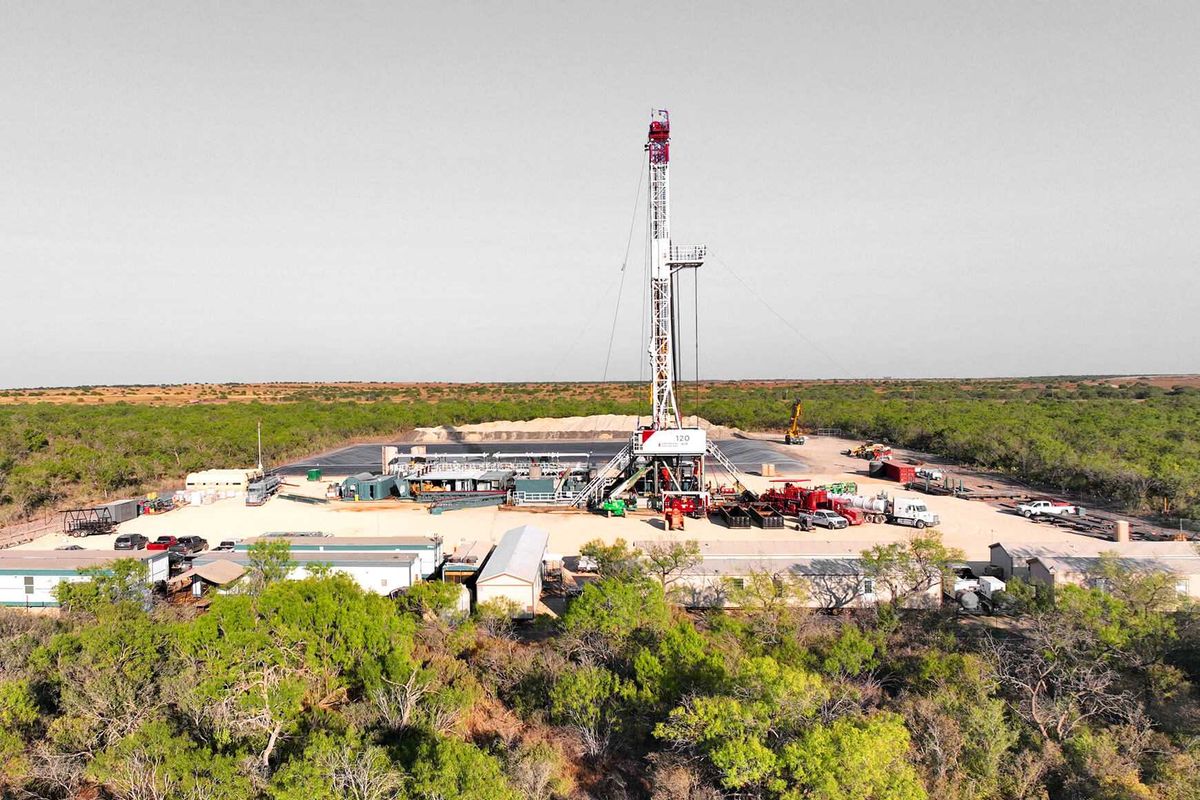
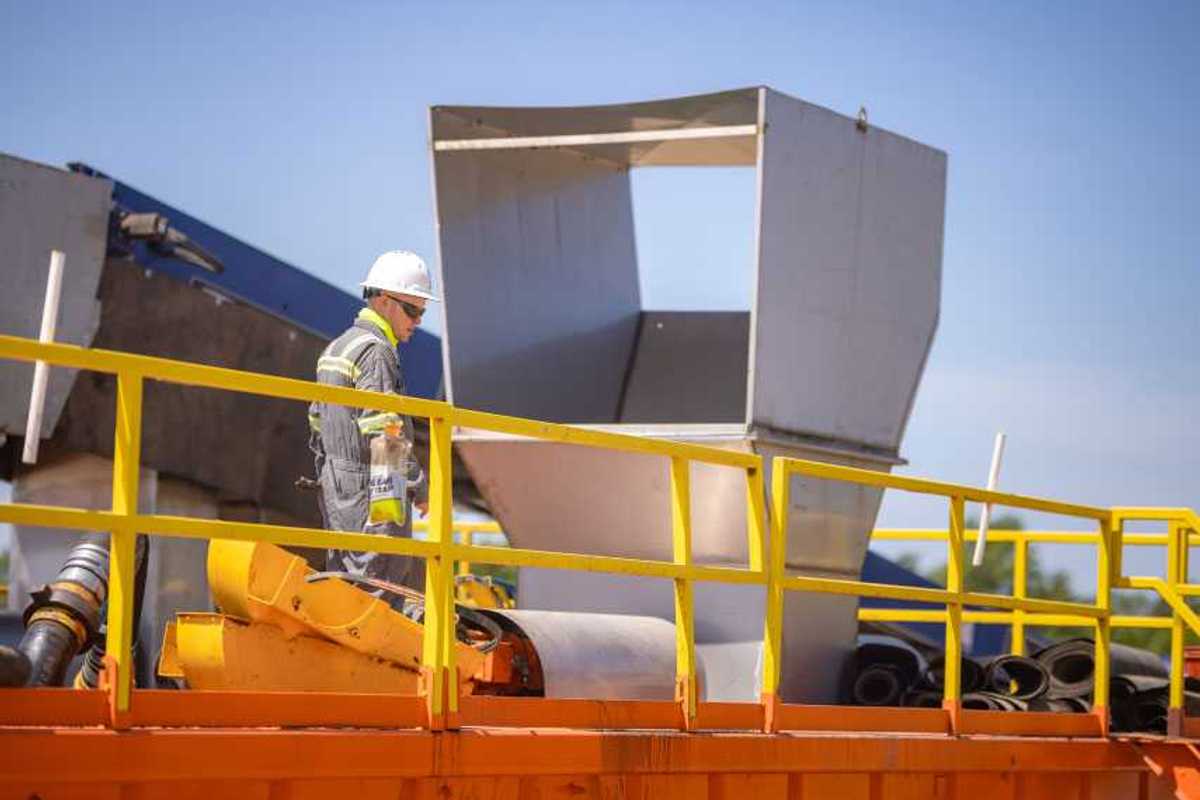
The Dune Express in West Texas. Courtesy of Atlas Energy

It's longer than the width of Rhode Island, snakes across the oil fields of the southwest U.S. and crawls at 10 mph – too slow for a truck and too long for a train.

It's a new sight: the longest conveyer belt in America.

Atlas Energy Solutions, a Texas-based oil field company, has installed a 42-mile long conveyer belt to transport millions of tons of sand for hydraulic fracturing. The belt the company named “The Dune Express” runs from tiny Kermit, Texas, and across state borders into Lea County, New Mexico. Tall and lanky with lids that resemble solar modules, the steel structure could almost be mistaken for a roller coaster.

In remote West Texas, there are few people to marvel at the unusual machine in Kermit, a city with a population of less than 6,000, where the sand is typically hauled by tractor-trailers. During fracking, liquid is pumped into the ground at a high pressure to create holes, or fractures, that release oil. The sand helps keep the holes open as water, oil and gas flow through it.

But moving the sand by truck is usually a long and potentially dangerous process, according to CEO John Turner. He said massive trucks moving sand and other industrial goods are a common site in the oil-rich Permian Basin and pose a danger to other drivers.

“Pretty early on, the delivery of sand via truck was not only inefficient, it was dangerous,” he said.

The conveyor belt, with a freight capacity of 13 tons, was designed to bypass and trudge alongside traffic.

Innovation isn't new to the oil and gas industry, nor is the idea to use a conveyor belt to move materials around. Another conveyer belt believed to be the world’s longest conveyor — at 61 miles long — carries phosphorous from a mine in Western Sahara on the northwest coast of Africa, according to NASA Earth Observatory.

When moving sand by truck became a nuisance, an unprecedented and risky investment opportunity arose: constructing a $400 million machine to streamline the production of hydraulic fracturing. The company went public in March 2023, in part, to help pay for the conveyor belt and completed its first delivery in January, Turner said.

The sand sits in a tray-shaped pan with a lid that can be taken off at any point, but most of it gets offloaded into silos near the Texas and New Mexico border. Along its miles-long journey, the sand is sold and sent to fracking companies who move it by truck for the remainder of the trip.

Keeping the rollers on the belt aligned and making sure it runs smoothly are the biggest maintenance obstacles, according to Turner. The rollers are equipped with chips that signal when it's about to fail and need to be replaced. This helps prevent wear and tear and keep the machine running consistently, Turner said.

The belt cuts through a large oil patch where environmentalists have long raised concerns about the industry disturbing local habitats, including those of the sagebrush lizard, which was listed as an endangered species last year by the U.S. Fish and Wildlife Service.

“In addition to that, we know that the sand will expedite further drilling nearby,” said Luke Metzger, executive director of Environment Texas. “We could see more drilling than we otherwise would, which means more air pollution, more spills than we otherwise would.”

The Dune Express currently runs for about 12 to 14 hours a day at roughly half capacity but the company expects to it to be rolling along at all hours later this year.

In New Mexico, Lea County Commissioner Brad Weber said he hopes the belt alleviates traffic on a parallel highway where car crashes are frequent.

“I believe it’s going to make a very positive impact here,” he said.
Ad Placement 300x100
Ad Placement 300x600

CultureMap Emails are Awesome

Houston geothermal company raises $97M Series B

fresh funding

Houston-based geothermal energy startup Sage Geosystems has closed its Series B fundraising round and plans to use the money to launch its first commercial next-generation geothermal power generation facility.

Ormat Technologies and Carbon Direct Capital co-led the $97 million round, according to a press release from Sage. Existing investors Exa, Nabors, alfa8, Arch Meredith, Abilene Partners, Cubit Capital and Ignis H2 Energy also participated, as well as new investors SiteGround Capital and The UC Berkeley Foundation’s Climate Solutions Fund.

The new geothermal power generation facility will be located at one of Ormat Technologies' existing power plants. The Nevada-based company has geothermal power projects in the U.S. and numerous other countries around the world. The facility will use Sage’s proprietary pressure geothermal technology, which extracts geothermal heat energy from hot dry rock, an abundant geothermal resource.

“Pressure geothermal is designed to be commercial, scalable and deployable almost anywhere,” Cindy Taff, CEO of Sage Geosystems, said in the news release. “This Series B allows us to prove that at commercial scale, reflecting strong conviction from partners who understand both the urgency of energy demand and the criticality of firm power.”

Sage reports that partnering with the Ormat facility will allow it to market and scale up its pressure geothermal technology at a faster rate.

“This investment builds on the strong foundation we’ve established through our commercial agreement and reinforces Ormat’s commitment to accelerating geothermal development,” Doron Blachar, CEO of Ormat Technologies, added in the release. “Sage’s technical expertise and innovative approach are well aligned with Ormat’s strategy to move faster from concept to commercialization. We’re pleased to take this natural next step in a partnership we believe strongly in.”

In 2024, Sage agreed to deliver up to 150 megawatts of new geothermal baseload power to Meta, the parent company of Facebook. At the time, the companies reported that the project's first phase would aim to be operating in 2027.

The company also raised a $17 million Series A, led by Chesapeake Energy Corp., in 2024.

Houston expert discusses the clean energy founder's paradox

Guest Column

Everyone tells you to move fast and break things. In clean energy, moving fast without structural integrity means breaking the only planet we’ve got. This is the founder's paradox: you are building a company in an industry where the stakes are existential, the timelines are glacial, and the capital requires patience.

The myth of the lone genius in a garage doesn’t really apply here. Clean energy startups aren’t just fighting competitors. They are fighting physics, policy, and decades of existing infrastructure. This isn’t an app. You’re building something physical that has to work in the real world. It has to be cheaper, more reliable, and clearly better than fossil fuels. Being “green” alone isn’t enough. Scale is what matters.

Your biggest risks aren’t competitors. They’re interconnection delays, permitting timelines, supply chain fragility, and whether your first customer is willing to underwrite something that hasn’t been done before.

That reality creates a brutal filter. Successful founders in this space need deep technical knowledge and the ability to execute. You need to understand engineering, navigate regulation, and think in terms of markets and risk. You’re not just selling a product. You’re selling a future where your solution becomes the obvious choice. That means connecting short-term financial returns with long-term system change.

The capital is there, but it’s smarter and more demanding. Investors today have PhDs in electrochemistry and grid dynamics. They’ve been burned by promises of miracle materials that never left the lab. They don't fund visions; they fund pathways to impact that can scale and make financial sense. Your roadmap must show not just a brilliant invention, but a clear, believable plan to drive costs down over time.

Capital in this sector isn’t impressed by ambition alone. It wants evidence that risk is being retired in the right order — even if that means slower growth early.

Here’s the upside. The difficulty of clean energy is also its strength. If you succeed, your advantage isn’t just in software or branding. It’s in hardware, supply chains, approvals, and years of hard work that others can’t easily copy. Your real competitors aren’t other startups. They’re inertia and the existing system. Winning here isn’t zero-sum. When one solution scales, it helps the entire market grow.

So, to the founder in the lab, or running field tests at a remote site: your pace will feel slow. The validation cycles are long. But you are building in the physical world. When you succeed, you don’t have an exit. You have a foundation. You don't just have customers; you have converts. And the product you ship doesn't just generate revenue; it creates a legacy.

If your timelines feel uncomfortable compared to software, that’s because you’re operating inside a system designed to resist change. And let’s not forget you are building actual physical products that interact with a complex world. Times are tough. Don’t give up. We need you.

---

Nada Ahmed is the founding partner at Houston-based Energy Tech Nexus.

Houston maritime startup raises $43M to electrify cargo vessels

A Houston-based maritime technology company that is working to reduce emissions in the cargo and shipping industry has raised VC funding and opened a new Houston headquarters.

Fleetzero announced that it closed a $43 million Series A financing round this month led by Obvious Ventures with participation from Maersk Growth, Breakthrough Energy Ventures, 8090 Industries, Y Combinator, Shorewind, Benson Capital and others. The funding will go toward expanding manufacturing of its Leviathan hybrid and electric marine propulsion system, according to a news release.

The technology is optimized for high-energy and zero-emission operation of large vessels. It uses EV technology but is built for maritime environments and can be used on new or existing ships with hybrid or all-electric functions, according to Fleetzero's website. The propulsion system was retrofitted and tested on Fleetzero’s test ship, the Pacific Joule, and has been deployed globally on commercial vessels.

Fleetzero is also developing unmanned cargo vessel technology.

"Fleetzero is making robotic ships a reality today. The team is moving us from dirty, dangerous, and expensive to clean, safe, and cost-effective. It's like watching the future today," Andrew Beebe, managing director at Obvious Ventures, said in the news release. "We backed the team because they are mariners and engineers, know the industry deeply, and are scaling with real ships and customers, not just renderings."

Fleetzero also announced that it has opened a new manufacturing and research and development facility, which will serve as the company's new headquarters. The facility features a marine robotics and autonomy lab, a marine propulsion R&D center and a production line with a capacity of 300 megawatt-hours per year. The company reports that it plans to increase production to three gigawatt-hours per year over the next five years.

"Houston has the people who know how to build and operate big hardware–ships, rigs, refineries and power systems," Mike Carter, co-founder and COO of Fleetzero, added in the release. "We're pairing that industrial DNA with modern batteries, autonomy, and software to bring back shipbuilding to the U.S."