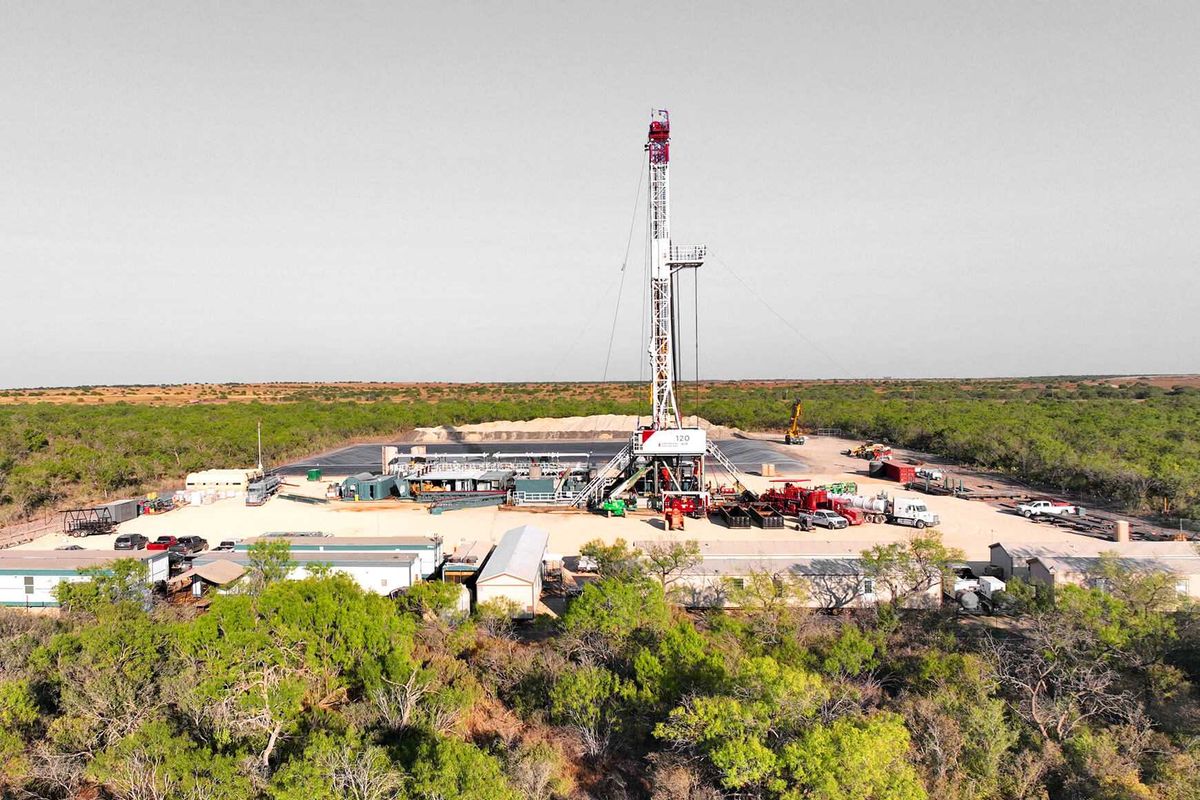
Fervo Energy has unlocked multigigawatt potential from a new geothermal energy site. Photo courtesy Fervo Energy.

Things are heating up at Houston-based geothermal power company Fervo Energy.

Fervo recently drilled its hottest well so far at a new geothermal site in western Utah. Fewer than 11 days of drilling more than 11,000 feet deep at Project Blanford showed temperatures above 555 degrees Fahrenheit, which exceeds requirements for commercial viability. Fervo used proprietary AI-driven analytics for the test.

Hotter geothermal reservoirs produce more energy and improve what’s known as energy conversion efficiency, which is the ratio of useful energy output to total energy input.

“Fervo’s exploration strategy has always been underpinned by the seamless integration of cutting-edge data acquisition and advanced analytics,” Jack Norbeck, Fervo’s co-founder and chief technology officer, said in a news release. “This latest ultra-high temperature discovery highlights our team’s ability to detect and develop EGS sweet spots using AI-enhanced geophysical techniques.”

Fervo says an independent review confirms the site’s multigigawatt potential.

The company has increasingly tapped into hotter and hotter geothermal reservoirs, going from 365 degrees at Project Red to 400 degrees at Cape Station and now more than 555 degrees at Blanford.

The new site expands Fervo’s geologic footprint. The Blanford reservoir consists of sedimentary formations such as sandstones, claystones and carbonates, which can be drilled more easily and cost-effectively than more commonly targeted granite formations.

Fervo ranks among the top-funded startups in the Houston area. Since its founding in 2017, the company has raised about $1.5 billion. In January, Fervo filed for an IPO that would value the company at $2 billion to $3 billion, according to Axios Pro.
Ad Placement 300x100
Ad Placement 300x600

CultureMap Emails are Awesome

6 Houston companies earn recognition on Time’s global greentech list 2026

green giants

Six Houston-area businesses appear on Time magazine’s 2026 list of the world’s top greentech companies, with a high-flying name leading the pack.

The highest-ranked local company is Houston-based geothermal power producer Fervo Energy, which claims the No. 4 spot—up from No. 14 last year.

In May, Fervo raised nearly $1.9 billion in its IPO, making it the biggest-ever IPO in the clean energy sector. The company’s valuation now exceeds $10 billion.

Founded in 2017, Fervo borrows methods from the oil and gas sector to drill wells that go down vertically into hot rock before turning horizontal, letting water circulate through them and produce electricity from the heat it absorbs. Cape Station in Utah, the company's first utility-scale project, is set to start delivering power to the grid later this year, with capacity expected to grow to 100 megawatts by 2027.

Co-founder and CEO Tim Latimer tells Fast Company, which named him a 2026 Visionary of the Year, that he launched his career as a drilling engineer for fossil fuels, “but quickly became obsessed with this idea that the drilling techniques we were using would actually be transformative for the world of geothermal as well.”

Fast Company notes the geothermal power generated by Cape Station will be available 24/7, unlike wind and solar power.

“When you start adding something to the grid mix that’s affordable and works around the clock,” Latimer says, “that’s going to be a huge asset to meeting our country’s energy needs.”

Time teamed up with data provider Statista to compile the second annual ranking of the 250 top greentech companies in the world. Companies on the list either develop or provide green technology, products, or services that help ease or reverse the environmental impacts of human activity.

Statista gathered and analyzed data from more than 8,300 companies to create the list, and they were scored in three categories: positive environmental impact, innovation, and financial strength. Fervo earned a score of 94.63 out of 100.

Joining Fervo on this year’s list are:

  • Houston-based Quaise Energy (No. 78), which specializes in terawatt-scale geothermal power
  • The Woodlands-based Plus Power (No. 112), which develops, owns and operates battery storage projects
  • Houston-based Utility Global (No. 167), which develops decarbonization technology
  • Houston-based 1PointFive (No. 217), an Occidental Petroleum subsidiary that offers large-scale carbon removal and storage.
  • Houston-based Sage Geosystems (No. 250), which produces commercial-scale geothermal power

Earlier this year, six Houston-area companies landed on Time's list of top greentech companies in America: Fervo (No. 1), Quaise Energy (No. 49), Plus Power (No. 71), Utility Global (No. 98), Solugen (No. 199) and Noodoe (No. 215).

Houston-based Syzygy lands global customer for first commercial SAF plant

clean fuel deal

Houston-based Syzygy Plasmonics has secured a major future customer for its sustainable aviation fuel.

Syzygy announced this week that it has entered into a capacity reservation agreement with World Fuel Services, a global fuel distribution and logistics company.

Through the deal, World Fuel has reserved a portion of Syzygy's SAF production for future plants slated for Central and South America. The clean fuel will be produced at Syzygy’s NovaSAF-1 facility in Uruguay, which is moving toward construction.

The NovaSAF-1 will be the world's first electrified facility to convert biogas into sustainable aviation fuel (SAF). The facility is expected to produce over 350,000 gallons of SAF annually, which would be considered “a breakthrough in cost-effective, scalable clean fuel,” according to Syzygy.

The facility is expected to produce SAF with at least an 80 percent reduction in carbon intensity compared to Jet A fuel and make its first deliveries in 2028.

"Following NovaSAF-1, this agreement reflects continued interest in scalable pathways for producing SAF from biogas," Trevor Best, CEO of Syzygy Plasmonics, said in a news release. "Our NovaSAF platform is designed to deliver cost-competitive fuel while supporting the aviation sector's evolving regulatory and sustainability requirements."

Syzygy will make a portion of future production capacity available to World Fuel from its planned facilities, subject to the development and completion of those projects, according to the deal.

"We continue to evaluate supply opportunities that support increased access to lower carbon fuels in aviation, in line with emerging regulatory requirements and customer demand," Michael Ranger, senior vice president of supply EMEAA at World Fuel, added in the release. "Arrangements such as this are part of our ongoing efforts across the supply chain.”

Syzygy also secured an offtake agreement with Singapore-based commodity company Trafigura from NovaSAF-1 earlier this year.

Texas Gov. Abbott seeks data center crackdown as state grapples with growing power demand

growing pains

Just seven months ago, Gov. Greg Abbott trumpeted Google’s $40 billion plan to add three data center campuses in Texas. Now, amid growing public outcry over such projects, Abbott is pushing for a regulatory crackdown on data centers in the Lone Star State.

Abbott recently sent a letter to leaders of the Public Utility Commission of Texas (PUC) and the Electric Reliability Council of Texas (ERCOT) proposing stricter oversight of the state’s data centers. Texas is home to more than 400 data centers, with many more on the way, and is poised to become the world’s largest data center market.

Among other things, Abbott wants to:

  • Ensure residential electric bills go down — not up — as data centers connect to ERCOT’s grid, which supplies power for about 90 percent of Texans.
  • Require data centers to cover the costs of upgrades to deliver electricity to the power-hungry facilities.
  • Repeal sales tax exemptions and other “outdated or unnecessary” financial incentives for data centers.
  • Institute “best practices,” such as property setbacks and noise-reduction technology, to ease the impact of data centers on nearby residents.
  • Demand that all new data centers, which use a tremendous amount of water, be built with water-efficient technology.
  • Require large data centers to generate annual reports on their use of electricity and water.

Abbott has set a July 17 deadline for the PUC and ERCOT to address his recommendations.

“As Texas continues to welcome innovation and investment, we must ensure that growth strengthens our people and their quality of life without placing undue burdens on Texans and local communities,” Abbott wrote.

Abbott’s call for tighter control of data centers has elicited both praise and skepticism.

In a social media post on X, Texas House Speaker Dustin Burrows, a Lubbock Republican, thanked Abbott for seeking “accountability and reform” in the state’s data center industry. Burrows has made data centers one of his priority issues for the 2027 state legislative session.

State oil and gas regulator Wayne Christian, a member of the Texas Railroad Commission, weighed in with similarly positive comments about Abbott’s directive. He says an outright ban on data centers isn’t the answer to residents’ complaints about new facilities.

“The Texas way is not to answer innovation with government overreach or fear-driven bans,” Christian, whose agency wasn’t cited in Abbott’s letter, said in a statement posted on X. “Our job is to protect prosperity, safeguard taxpayers and ensure the infrastructure that powers our economy remains strong and reliable.”

Gina Hinojosa, an Austin Democrat who’s challenging Abbott in this November’s gubernatorial race, took issue with the governor’s edict on data centers.

“Greg Abbott is changing his tune on data centers because he knows his policies are unpopular,” Hinojosa, a state representative, wrote on X. “Nobody believes the arsonist is gonna be the one to put out the fire.”

Abbott’s call for stepped-up regulation of data centers echoes many of the concerns expressed by the state chapter of the Sierra Club, an environmental nonprofit.

“The growth of data centers reflects a broader transformation taking place across Texas,” the Sierra Club says on its website. “The state is becoming a hub for the technologies that will shape the future economy, from artificial intelligence to advanced computing and cloud services. At the same time, Texans deserve transparency about how these projects affect the communities where they are built.”