







UH is developing a wide range of robotics programming for the energy industry. Photo courtesy of University of Houston

Over the past 14 months, UH Energy at the University of Houston has developed a unique robotics training program for the energy industry.

UH Subsea Systems Institute and SPRINT Robotics teamed up to make the robotics-focused curriculum “Robotics in Energy,” which debuted in May. The two-day course offered hands-on training experience with innovative robotics technologies and attracted professionals from the oil and gas industry like participants from Chevron, and renewable energy sectors made up the 40 companies that were involved. The first day focused on topics like impact on business, safety and reliability, and risk analysis all within the spectrum of the energy industry. The second day of the course included a site tour at Sonardyne with instructor-led demonstrations of robotics technologies.

Wenyu Zuo, SSI coordinator of the robotics curriculum tells the University that he believes this will “address a critical workforce challenge.”

“The robotics program will help workforce development to give them robotic knowledge to help them to use robots to improve the quality, and in the future, the demand for remote operations- this is very important for current energy companies,” Zuo says.
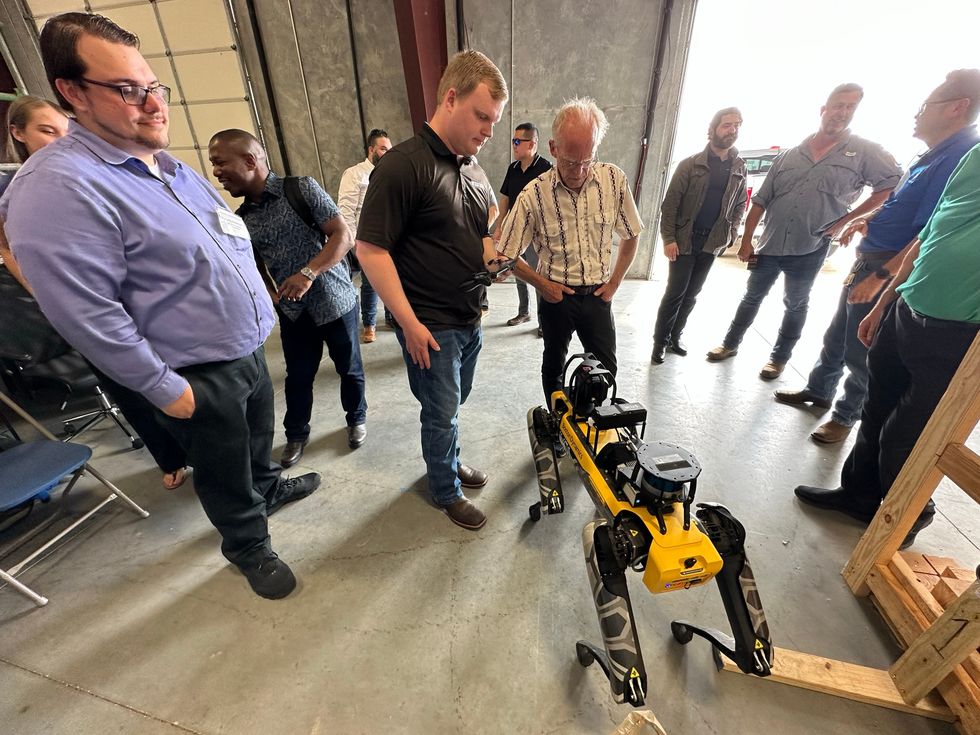
The unique programming will prepare and upskill a workforce where robotics have a seat at the table. Photo via uh.edu

The Robotics in Energy class is the first of four modules in the robotics curriculum. The next courses are Robotics Foundation, Automation and Autonomy, and AI & the Vision for Integration, and are expected to be offered sometime later in 2023. Robotics Foundation will be a fundamentals of robotics course, Automation and Autonomy will aim to go in-depth on automation and robotics, and AI & the Vision for Integration,will look to “enhance integrity within energy operations” according to the official course descriptions.

While renewable energies and other energy innovations are being more accepted into the discourse among the industry, the UH Subsea Systems Institute saw an opening to integrate robotics as a new innovation for companies to consider.

“We are upscaling…we see the energy industry from an innovation perspective as very invested in certain things, but not very invested in this automation and robotics space, so it is quite needy “ says John Allen, adviser to the program who previously has experience as an executive at General Electric and Automation Machinery Manufacturing along with various other energy organizations.

When labor-intensive work conditions offshore provide some risk to the humans doing the job, robotics may work in the environment to get people out of “harm's way” and “automate” the work according to Allen.

For now, the workforce is the audience that they are targeting to help companies catch up with the technology, which the course hopes to evolve with.

“In the future, as the technology is developing , and robotics is rapidly developing technology, we want to keep it (the program) evolving year-by-year,” Zuo says on how Robotics in Energy may look going forward.

Ad Placement 300x100
Ad Placement 300x600

CultureMap Emails are Awesome

SLB and NVIDIA expand partnership to scale AI across energy sector

AI partnership

Houston-based energy technology company SLB has expanded its 18-year tech collaboration with chipmaker NVIDIA to include the development of an “AI factory for energy.”

Through their partnership, SLB and NVIDIA will create AI infrastructure and models built around SLB’s existing digital platforms to help energy companies scale AI for data and operations.

In addition to the development of the “AI factory,” SLB will:

  • Provide modular design services to enhance NVIDIA’s blueprint for building, launching and operating gigawatt-scale AI data centers. In this case, modular design involves manufacturing data center components off-site.
  • Use NVIDIA’s AI infrastructure to improve the processing of large datasets and AI models across SLB’s digital platforms.

Energy companies generate vast amounts of operational data, which can slow down and silo decision-making, SLB says. By combining NVIDIA’s Omniverse libraries and its Nemotron open models with SLB’s digital and AI platforms, the companies aim to more rapidly transform data into actionable insights.

Omniverse libraries are sets of prebuilt 3D elements, such as objects, surfaces and interactive features, that make it easier to construct detailed virtual spaces without having to design everything manually. They’re commonly used for building immersive environments, digital replicas of real-world systems and simulation scenarios.

Nemotron open models are AI models that are freely available to download and modify. Instead of relying on a hosted service, you can run them on your own infrastructure and tailor them to fit specific needs.

Vladimir Troy, vice president of AI infrastructure at NVIDIA, says the energy sector is at the forefront of AI driving a “new industrial revolution.”

“The winners in AI will be companies with the best data, the deepest domain expertise, and the ability to scale,” Demos Pafitis, SLB’s chief technology officer, added. “By collaborating with NVIDIA to advance modular data center construction and harness our domain expertise and digital platforms, we’re enabling the energy industry to deploy AI at scale and transform operational data into smarter decisions.”

Oxy CEO Vicki Hollub to retire, Reuters reports

retirement plans

Vicki Hollub, CEO of Houston-based Occidental (Oxy), is set to retire this year, Reuters first reported Thursday.

Hollub has held the top leadership position at Oxy since 2016 and has been with the oil and gas giant for more than 40 years. Before being named CEO, she served as chief operating officer and senior executive vice president at the company. She led strategic acquisitions of Anadarko Petroleum in 2019 and CrownRock in 2024, and was the first woman selected to lead a major U.S. oil and gas company.

Reuters reports that a firm date for her retirement has not been set. Richard Jackson, who currently serves as Oxy's COO, is expected to replace Hollub in the CEO role.

Oxy is leading a number of energy transition projects.

It's subsidiary 1PointFive is developing a $1.3 billion direct air capture (DAC) project in the Midland-Odessa area that is slated to be the largest facility of its kind in the world. Known as STRATOS, it's designed to capture up to 500,000 metric tons of CO2 per year.

The company shared recently that Phase 1 of the project is expected to go online in Q2, with Phase 2 ramping up through the remainder of 2026.

“We are immensely proud of the achievements to date and the exceptional record of safety performance as we advance towards commercial startup,” Hollub said of Stratos last year.

“We believe that carbon capture and DAC, in particular, will be instrumental in shaping the future energy landscape,” she added.

Oxy was one of the first to set ambitious net-zero goals. In a 2020 interview during CERAWeek, Hollub outlined Oxy's future as a “carbon management company.”

“Ultimately, I don’t know how many years from now, Occidental becomes a carbon management company, and our oil and gas would be a support business unit for the management of that carbon. We would be not only using [CO2] in oil reservoirs [but] capturing it for sequestration as well,” Hollub said.

Oxy opened its Oxy Innovation Center in the Ion last year, focused on advancing low-carbon technology. It also operates Oxy Low Carbon Ventures, which focuses DAC, carbon sequestration and low-carbon fuels through businesses like 1PointFive, TerraLithium and others.