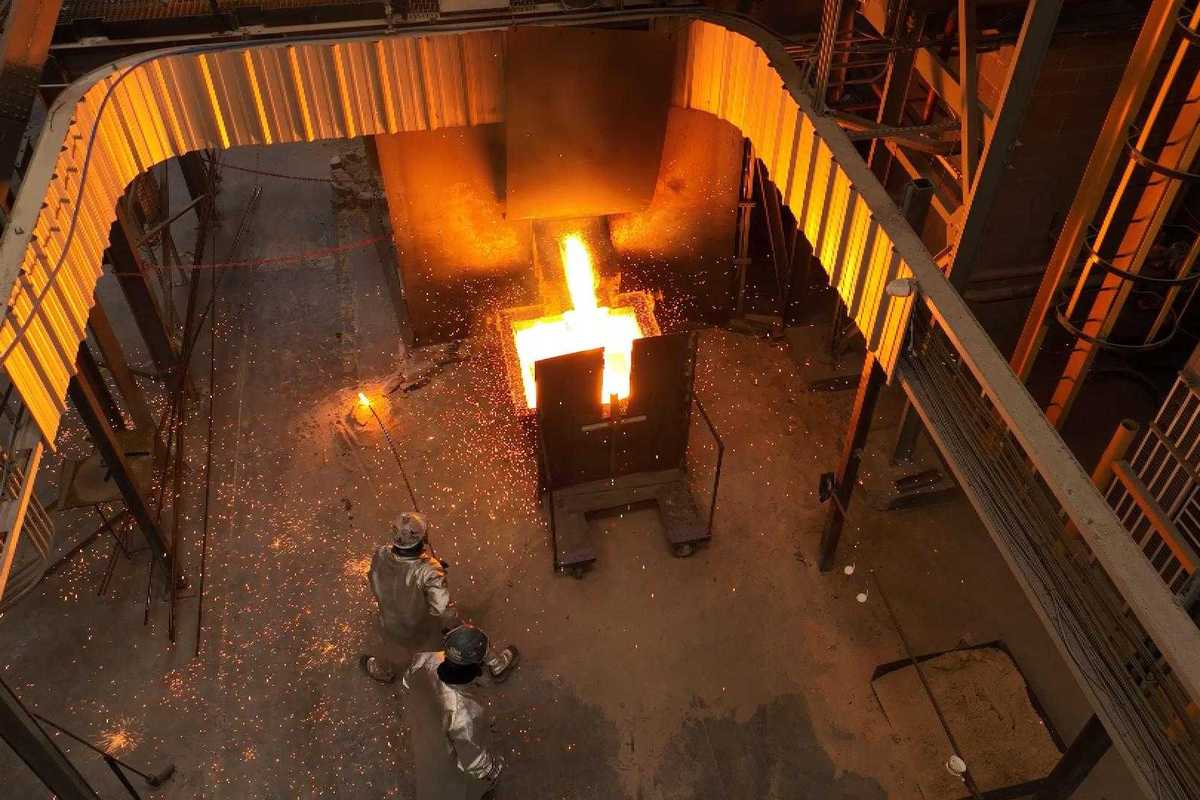
ERCOT plans to build a “super highway” of new transmission lines to boost grid reliability. Photo via Getty Images

The Electric Reliability Council of Texas, which manages the electric grid for 90 percent of Texans, is undertaking a $9.4 billion project to improve the reliability and efficiency of statewide power distribution. The initiative comes as ERCOT copes with escalating demand for electricity from data centers and cryptocurrency-mining facilities.

The project, approved Dec. 9 by ERCOT’s board, will involve building a 1,109-mile “super highway” of new 765-kilovolt transmission lines. One kilovolt equals 1,000 volts of electricity.

According to the Hoodline Dallas news site, the $9.4 billion project represents the five- to six-year first phase of ERCOT’s Strategic Transmission Expansion Plan (STEP). Hoodline says the plan, whose price tag is nearly $33 billion, calls for 2,468 miles of new 765-kilovolt power lines.

STEP will enable ERCOT to “move power longer distances with fewer losses,” Hoodline reports.

Upgrading the ERCOT grid is a key priority amid continued population growth in Texas, along with the state’s explosion of new data centers and cryptocurrency-mining facilities.

ERCOT says about 11,000 megawatts of new power generation capacity have been added to the ERCOT grid since last winter.

But in a report released ahead of the December board meeting, ERCOT says it received 225 requests this year from large power users to connect to its grid — a 270 percent uptick in the number of megawatts being sought by mega-users since last December. Nearly three-fourths (73 percent) of the requests came from data centers.

Allan Schurr, chief commercial officer of Houston-based Enchanted Rock, a provider of products and services for microgrids and onsite power generation, tells Energy Capital that the quickly expanding data center industry is putting “unprecedented pressure” on ERCOT’s grid.

“While the state has added new generation and transmission capacity, lengthy interconnection timelines and grid-planning limitations mean that supply and transmission are not keeping pace with this rapid expansion,” Schurr says. “This impacts both reliability and affordability.”

For families in Texas, this could result in higher energy bills, he says. Meanwhile, critical facilities like hospitals and grocery stores face a heightened challenge of preventing power outages during extreme weather or at other times when the ERCOT grid is taxed.

“I expect this trend to continue as AI and high-density computing grow, driving higher peak demand and greater grid variability — made even more complex by more renewables, extreme weather and other large energy users, like manufacturers,” Schurr says.

According to the Pew Research Center, data centers accounted for 4 percent of U.S. electricity use in 2024, and power demand from data centers is expected to more than double by 2030. Data centers that support the AI boom make up much of the rising demand.

In September, RBN Energy reported more than 10 massive data-center campuses had been announced in Texas, with dozens more planned. The Lone Star State is already home to roughly 400 data centers.

“Texas easily ranks among the nation’s top states for existing data centers, with only Virginia edging it out in both data-center count and associated power demand,” says RBN Energy.

Ad Placement 300x100
Ad Placement 300x600

CultureMap Emails are Awesome

Blackstone clears major step in acquisition of TXNM Energy

power deal

A settlement has been reached in a regulatory dispute over Blackstone Infrastructure’s pending acquisition of TXNM Energy, the parent company of Texas-New Mexico Power Co. , which provides electricity in the Houston area. The settlement still must be approved by the Public Utility Commission of Texas.

Aside from Public Utility Commission staffers, participants in the settlement include TXNM Energy, Texas cities served by Texas-New Mexico Power, the Texas Office of Public Utility Counsel, Texas Industrial Energy Consumers, Walmart and the Texas Energy Association for Marketers.

Texas-New Mexico Power, based in the Dallas-Fort Worth suburb of Lewisville, supplies electricity to more than 280,000 homes and businesses in Texas. Ten cities are in Texas-New Mexico Power’s Houston-area service territory:

  • Alvin
  • Angleton
  • Brazoria
  • Dickinson
  • Friendswood
  • La Marque
  • League City
  • Sweeny
  • Texas City
  • West Columbia

Under the terms of the settlement, Texas-New Mexico Power must:

  • Provide a $45.5 million rate credit to customers over 48 months, once the deal closes
  • Maintain a seven-member board of directors, including three unaffiliated directors as well as the company’s president and CEO
  • Embrace “robust” financial safeguards
  • Keep its headquarters within the utility’s Texas service territory
  • Avoid involuntary layoffs, as well as reductions of wages or benefits related to for-cause terminations or performance issues

The settlement also calls for Texas-New Mexico Power to retain its $4.2 billion five-year capital spending plan through 2029. The plan will help Texas-New Mexico Power cope with rising demand; peak demand increased about 66 percent from 2020 to 2024.

Citing the capital spending plan in testimony submitted to the Public Utility Commission, Sebastian Sherman, senior managing director of Blackstone Infrastructure, said Texas-New Mexico Power “needs the right support to modernize infrastructure, to strengthen the grid against wildfire and other risks, and to meet surging electricity demand in Texas.”

Blackstone Infrastructure, which has more than $64 billion in assets under management, agreed in August to buy TXNM Energy in a $11.5 billion deal.

Neal Walker, president of Texas-New Mexico Power, says the deal will help his company maintain a reliable, resilient grid, and offer “the financial resources necessary to thrive in this rapidly changing energy environment and meet the unprecedented future growth anticipated across Texas.”

Constellation and Calpine's $26B clean energy megadeal clears final regulatory hurdle

big deal

Baltimore-based nuclear power company Constellation Energy Corp. received final regulatory clearance this month to acquire Houston-based Calpine Corp. for a net purchase price of $26.6 billion.

The acquisition has the potential to create America’s “largest clean energy provider,” the companies reported when the deal was first announced in January.

The Department of Justice approved the acquisition contingent on Calpine divesting several assets, including one in the Houston area.

The company agreed to divest the Jack Fusco Energy Center natural gas-fired combined cycle facility in Richmond, Texas; four generating assets in the Mid-Atlantic region; and other natural gas plants in Pennsylvania and Corpus Christi, Texas.

The Federal Energy Regulatory Commission, the Public Utility Commission of Texas and the New York Public Service Commission previously approved the deal. The companies can move toward closing the acquisition once the court finalizes the stipulation and order.

"We are very pleased to reach a settlement that allows us to bring together two magnificent companies to create a new Constellation with unprecedented scale, talent and capability to better serve our customers and communities while building the foundation for America’s next great era of growth and innovation," Joe Dominguez, president and CEO of Constellation, said in a news release. "We thank the Department for its professionalism and tireless work reviewing this transaction through these many months. It’s now time for us to complete the transaction, welcome our new colleagues from Calpine, and together begin our journey to light the way to a brilliant tomorrow for all."

Andrew Novotny, CEO of Calpine, will continue to lead the Calpine business and Constellation's fleet of natural gas, hydro, solar and wind generation, according to the company. He will report to Dominguez and also serve as senior executive vice president of Constellation Power Operations.

Constellation is considered one of the top clean energy producers in the U.S. Earlier this month, the company was approved to receive a $1 billion loan from the Department of Energy's Energy Dominance Financing Program to restart its 835-megawatt nuclear reactor in Pennsylvania known as Crane Clean Energy Center.

"Work to restart the reactor comes at a time of unprecedented electric demand growth from electrification and the new data centers needed to support a growing digital economy and to help America win the AI race," a news release from the company reads. "Crane will support grid stability by delivering reliable, around-the-clock electric supply."

States brace for Trump's push to make oil drilling cheap again

Energy news

A Republican push to make drilling cheaper on federal land is creating new fiscal pressure for states that depend on oil and gas revenue, most notably in New Mexico as it expands early childhood education and saves for the future.

The shift stems from the sweeping law President Donald Trump signed in July that rolls back the minimum federal royalty rate to 12.5%. That rate — the share of production value companies must pay to the government — held steady for a century under the 1920 Mineral Leasing Act. It was raised to 16.7% under the Biden administration in 2022.

Trump and Republicans in Congress say the rate reset will boost energy production, jobs and affordability as the administration clears the way for expanded drilling and mining on public lands.

States receive nearly half the money collected through federal royalties, depending on where production takes place. The environment and economics research group Resources for the Future estimates a roughly $6 billion drop in collections over the coming decade.

The stakes are highest in New Mexico, the largest recipient of federal mineral lease payments. The state could could forgo $1.7 billion by 2035 and as much as $5.1 billion by 2050, according to calculations by economist Brian Prest at Resources for the Future.

More than one-third of the general fund budget in the Democratically-led state is tied to the oil and gas industry.

“New Mexico’s impact is way bigger than Wyoming or Colorado or North Dakota,” Prest said, “and that’s just because that’s where the action is on new development.”

The effects will unfold gradually, since federal leases allow a 10-year window to begin drilling and production. Still, state officials say they're already prepping for leaner years.

“It all hurts when you’re losing revenues," said Democratic state Sen. George Muñoz of Gallup, who said lawmakers still hope to invest more in mental health care and support Medicaid, even if federal royalty payments decline. “We’ve learned that until the chicken’s got feathers, we’re not even looking at it."

The higher federal royalty rate was in place for roughly three years while leasing activity was muted, Prest said. New Mexico budget forecasters never tallied the additional income.

New Mexico's nest-egg strategy

A nearly five-fold surge in local oil production since 2017 on federal and state land in New Mexico delivered a financial windfall for state government, helping fund higher teacher salaries, tuition-free college, universal free school meals and more.

The state set aside billions of dollars in investment trusts for future spending in case the world’s thirst for oil falters, including a early childhood education fund to help expand preschool, child care subsidies and home wellness visits for pregnancies and infants.

The state's investment nest egg has grown to $64 billion, second only to Alaska's Permanent Fund. Earnings from the trusts are New Mexico's second-biggest source for general fund spending.

That sturdy financial footing shaped a defiant response to this year’s federal government shutdown, when lawmakers voted to subsidize the state’s Affordable Care Act exchange, cover food assistance and backfill cuts to public broadcasting.

But lawmakers reviewing state finances learned that predictable income fell 1.6% — the first contraction since the start of the COVID-19 pandemic.

Muñoz said matters would be worse if the state had not raised its own royalty rates this year to 25%, from 20%, for new leases on prime oil and gas tracts, while ending a sales moratorium, under legislation he co-sponsored this year.

Encouraged in Alaska

After New Mexico, the states receiving the most federal oil and gas royalties are Wyoming, Louisiana, North Dakota and Texas.

Texas, the nation’s top oil producer, shares the bountiful Permian Basin with New Mexico but has far less federal land and therefore less exposure to changes in royalty policy.

In Alaska, state officials say they are encouraged by the royalty cut, seeing potential for increased development in places like the National Petroleum Reserve-Alaska, where the massive Willow project — approved in 2023 and now under development — is viewed by some as a catalyst for further activity. The reserve is expected to hold its first lease sales since 2019.

“If reduced federal royalty rates stimulate new leasing, exploration and production, that also could increase other kinds of revenue,” said Lorraine Henry, a spokesperson for Alaska’s Department of Natural Resources.

In North Dakota, federal royalties are split evenly between the state and county governments where drilling occurs. State Office of Management and Budget Director Joe Morrissette said the industry’s future remains difficult to forecast.

“There are so many variables, including timing, price, availability of desirable tracts, and federal policies regarding exploration activities,” Morrissette said.