The late Don Kendall Jr. is this year's Trailblazer Award recipient. Photo courtesy Kenmont Capital
Every year, the Houston Innovation Awards, presented by EnergyCapital's sister site InnovationMap, honor one Houstonian with the Trailblazer Award, whose impact is felt throughout the city's innovation and business ecosystem.
This year, the Trailblazer Legacy Award will be given posthumously to Don Kendall Jr., who died in September while on a trip to the Republic of the Congo with the Jane Goodall Institute, one of the many organizations he was deeply involved with.
Kendall's obituary puts it simply: "Don’s truest passions were conservation and his family." Many saw those passions play out in his career, particularly in the role he played in shaping Houston's clean energy sector.
Kendall served as general partner of New Climate Ventures, a Houston-based early-stage venture capital firm that invests in next-gen energy, materials and fuel technologies and startups. The firm's portfolio includes Houston-based clean energy companies like Solidec, Syzygy Plasmonics and Rheom Materials.
Kendall was also founding managing director and CEO of Kenmont Capital LP. He ran a $500 million distressed debt and credit-based hedge fund focused on the energy, power and transportation sectors and one of the top-performing private equity funds under the Kenmont umbrella.
He served on the board of Talos Energy, American Midstream Partners, Syzygy Plasmonics, Tangent Energy, Stream Energy and others. Notably, he served as Chair of the Special Committee of the SolarCity board during its acquisition by Tesla in 2016. According to his obituary, Kendall negotiated with "Elon Musk in the middle of the night on a rickety pier in Indonesia after eluding a poisonous snake."
Outside of the clean energy space, Kendall also served on the boards of the Jane Goodall Institute, Earthwatch International and Ecological Defense Group. He also served as vice chair of the Houston Zoo Inc. and chair of its Conservation Committee.
Kendall was selected by our esteemed panel of judges to receive the 2026 Trailblazer Legacy Award. The panel includes carbon removal entrepreneur and CEO of Houston-based Mars Materials Aaron Fitzgerald.
Fitzgerald shares the profound impact Kendall had on his career and those of many others.
"Honoring Don with the Trailblazer Legacy Award is a fitting tribute to a leader whose impact spanned civic work with the Houston Zoo, wildlife conservation, and the growth of our startup ecosystem," Fitzgerald says. "He paired a keen eye for potential with the relentless drive to unlock it. For Mars Materials, his early backing carried us through a critical valley when we needed belief the most, and his presence as a personal mentor is profoundly missed."
Don was an avid traveler, cyclist and collector. He is survived by his wife of 50 years, Diane S. Kendall. A celebration of life will be held early in 2027.
---
This article originally appeared on our sister site, InnovationMap.
This year's finalists range from a lower-emission steel producer to a diagnostics platform developer working to support batteries used in data centers. Photo courtesy Hertha Metals
Houston is home to a growing number of startups reshaping what it means to be called the "Energy Capital of the World."
As part of the 2026 Houston Innovation Awards, our Energy Transition Business category honors those innovative startups that are providing solutions within renewables, climatetech, clean energy, alternative materials, circular economy and more.
Five clean energy startups have been named finalists for the 2026 award. The finalists, selected by our esteemed panel of judges, range from a lower-emission steel producer to a diagnostics platform developer working to support batteries used in data centers.
Read more about these innovative businesses, their initiatives, and their inspirational founders below. The 2026 winners will be announced on InnovationMap.com in mid-November.
Capwell Services
Methane capture company Capwell Services works to eliminate vented oil and gas emissions economically for operators. According to the company, methane emissions are vented from most oil and gas facilities due to safety protocols, and operators are not able to capture the gas cost-effectively, leading operators to emit more than 14 million metric tons of methane per year in the U.S. and Canada. Founded in 2022, Capwell specializes in low and intermittent flow vents for methane capture.
The company began as a University of Pennsylvania senior design project led by CEO Andrew Lane. It has since participated in programs with Greentown Labs, the Rice Clean Energy Accelerator and the Creative Destruction Lab Energy Cohort at Texas A&M University. The company moved to Houston in 2023 and raised a pre-seed round. It deployed two commercial units this year, according to its application.
FlowCellutions
Energytech startup FlowCellutions is developing a chemistry-agnostic diagnostics platform for flow and metal-air batteries supporting data centers and critical infrastructure. The platform is designed to help reduce operating costs, prevent failures and costly downtime, and extend battery lifetime from approximately seven years to more than 30 years. It has deployed four paid pilots and plans to take insights from the programs to develop its next-gen sensor platform technology.
CEO Becca Segel founded the company in 2022. It is a member of Greentown Labs, and Segel was a 2025 Activate Fellow. The company has raised over $2 million in non-dilutive funding and received a $1.5 million NSF SBIR Fast-Track award earlier this year.
Hertha Metals
Hertha Metals produces lower-cost, lower-emission steel and high-purity iron. The company has developed a single-step process that uses natural gas as a direct reductant instead of metallurgical coal, which cuts production costs by more than 25 percent and emissions by up to 50 percent, according to the company. The same process produces high-purity iron needed for high-purity steels and rare earth magnets. The company says it aims to "re-industrialize America’s production of critical materials."
Hertha Metals was founded by CEO Laureen Meroueh in 2022 and emerged from stealth last year with more than $17 million in venture capital funding. The company closed a $133.65 million Series A this month and also broke ground on its $100M high-purity iron factory known as Chalyx in Conroe.
Mars Materials
Clean chemical manufacturing business Mars Materials is working to convert captured carbon into resources, such as carbon fiber and wastewater treatment chemicals. The company develops and produces its drop-in chemical products in Houston and uses an in-licensed process for the National Renewable Energy Lab to produce acrylonitrile, which is used to produce plastics, synthetic fibers, and rubbers.
Founded in 2019 by CEO Aaron Fitzgerald, CTO Kristian Gubsch, and vice president of operations Trey Sheridan, the company has secured over $7.2M in financing and is backed by Bill Gates’ Breakthrough Energy, Shell, Black & Veatch, and other organizations. It won in the Minority-founded Business Category in last year's Houston Innovation Awards.
Solidec
Chemical manufacturing company Solidec has developed autonomous generators that extract molecules from water and air and convert them into pure chemicals and fuels that are free of carbon emissions on-site, eliminating the need for transport, storage, and permitting. The company was founded around innovations developed by Rice University associate professor Haotian Wang.
The company was selected for the Chevron Technology Ventures’ Catalyst Program, Greentown Labs, NSF I-Corps and was part of the first cohort of the Activate Houston program. It won first place at the 2024 startup pitch competition at CERAWeek. Solidec was founded in 2023 by Wang, who serves as an advisor, CEO Ryan DuChanois, and CTO Yang Xia. It closed a $2.5 million seed round in 2025.
Houston energy leader Katie Mehnert shared her key takeaways from Houston Energy and Climate Week 2026 with Energy Capital. Photo courtesy
While hundreds of thousands descend on New York for Climate Week, Houston offered a different proposition: come where the work is being built. And last week Houston proved that it’s solving for more energy and fewer emissions; reliability and affordability; speed and durability. We are solving for the “&.”
That equation sharpened last week. On Sept. 14, the Environmental Protection Agency announced it had repealed most 2024 federal carbon-pollution standards for power plants and proposed rescinding remaining greenhouse-gas requirements. Policy matters, but it can pivot. The need to build does not.
HECW is a proving ground, not another conference stop. As I wrote in the Houston Chronicle, Mayor Sylvester Turner planted the seed by insisting we bring people together across the city and industry to drive Houston’s energy future. He knew false choices have no place here: oil and gas and clean technology; prosperity and stewardship; industry and lower emissions.
ECW joined the Climate Week Network this year, connecting Houston to a growing community of more than 500,000 people across 22-plus cities. We now have a seat at the global table—and a responsibility to use it well, building with other cities and the wider clean-energy-solutions world rather than merely talking at them.
The capital is already moving. Since 2017, Houston Energy Transition Initiative member companies have invested more than $95 billion in low-carbon infrastructure, technologies, and research and development. This is where the transition is financed, engineered, tested and operated. But the work requires more than capital. It requires capital allocators who understand the difference between a promising idea and a project that can scale, hire and endure.
Last week was Houston’s show and tell. At ARTECHOUSE, The &Bassador Reception & Awards brought art, technology, culture, philanthropy and energy together. Then the week went beyond downtown.
Sugar Land Town Square became the launchpad for the Metro Innovation Tour & Market: a place for an ecosystem conversation about smart cities, clean energy, equitable access and next-generation mobility before participants boarded three tour routes across greater Houston. It was also the starting point for the Bay City South Innovation Tour to Erthos Project Bravo in Matagorda County, where small groups saw Earth Mount solar modules being installed in real time. The conversation did not end at a panel. It went to the project site.
The HTX Tech Tours included a visit to the Erthos Project Bravo in Matagorda County. Photo courtesy
Approximately 100 startups from around the world pitched at Rice Alliance, Greentown Labs and Halliburton Labs events. At Astros Night at Daikin Park, builders, backers, and believers traded conference rooms for the diamond, creating an experience, not just another event. That is how this work becomes civic fabric.
Activation also means making the energy story felt, not merely explained. AY Young brought the Battery Tour for live performances. It was a reminder that the “Power of &” is not confined to a boardroom or a laboratory. Art and technology, culture and commerce, a new generation and established industry can share the same stage—and help more people see themselves in the work ahead.
Perhaps no activation made the “Power of &” more immediate and real than the Houston, We Have Solutions open mic night. At Creatopia’s Innovation Studio, people took the mic—or simply listened—to share what they were building, the problem they could not stop thinking about, and the connection they hoped to make. It put founders, artists, community builders, researchers and future-makers in one room. That is collaboration in real time: different kinds of expertise meeting before anyone knows exactly what the solution will be.
FOX26 helped carry that story beyond the rooms we convened, hosting Erthos COO Jessica Knight, Mars Materials co-founder Aaron Fitzgerald, and investors Taylor Chapman and Juliana Garaizar to discuss building and backing the future in Houston. Our region should be proud—not as self-congratulation, but because the world is beginning to experience energy and climate solutions firsthand.
This was also a week to give back. Allies in Energy awarded $27,500 to nine organizations advancing energy and climate literacy, civil dialogue, workforce pathways and community action. NRG Energy’s Brighter Communities provided a founding gift to expand the week and fund local grants. It took partners, hosts, sponsors, volunteers, funders and community organizations. That is the “Power of &”: collaboration that leaves a stronger community behind.
The “Power of &” cannot stop at Houston’s city limits. Louisiana’s participation—through its support of the Digital Delta Symposium & Expo—made clear that Houston’s builder ecosystem is regional by necessity. Gulf Coast infrastructure, supply chains, talent, and industrial decisions do not recognize state lines. Neither should our collaboration. If we are serious about building more energy with fewer emissions, we must align capital, resources and opportunity across the entire Gulf Coast.
That same commitment to practical collaboration means listening, learning and adjusting. A builder’s mindset does not protect a plan simply because it came first; it improves the conditions for the work to succeed. That is why Houston Energy and Climate Week will move to April 4–10, 2027—better weather, more time and space for connection, and a stronger city-wide experience for the people building what comes next.
But the real test begins now. Can we keep widening the circle? Can we continue to turn research into projects, pilots into infrastructure, capital into good jobs and climate ambition into results that families and communities can see? Can we make every new solution stronger by bringing in the people who must finance it, build it, operate it, live beside it and benefit from it?
That is the work ahead. Turner understood that Houston does not move forward by asking who wins the argument. It moves forward by asking who is ready to solve the problem. His legacy—and the promise of the “&”—is an invitation to choose collaboration over division, action over performance and possibility over false choices.
The future does not need another city to talk about it. It needs Houston to keep building it. And it will only be built if we keep choosing the "&."
Houston-based Mars Materials has made a breakthrough in turning stored carbon dioxide into everyday products.
In partnership with the Textile Innovation Engine of North Carolina and North Carolina State University, Mars Materials turned its CO2-derived product into a high-quality raw material for producing carbon fiber, according to a news release. According to the company, the product works "exactly like" the traditional chemical used to create carbon fiber that is derived from oil and coal.
Testing showed the end product met the high standards required for high-performance carbon fiber. Carbon fiber finds its way into aircraft, missile components, drones, racecars, golf clubs, snowboards, bridges, X-ray equipment, prosthetics, wind turbine blades and more.
The successful test “keeps a promise we made to our investors and the industry,” Aaron Fitzgerald, co-founder and CEO of Mars Materials, said in the release. “We proved we can make carbon fiber from the air without losing any quality.”
“Just as we did with our water-soluble polymers, getting it right on the first try allows us to move faster,” Fitzgerald adds. “We can now focus on scaling up production to accelerate bringing manufacturing of this critical material back to the U.S.”
Mars Materials, founded in 2019, converts captured carbon into resources, such as carbon fiber and wastewater treatment chemicals. Investors include Untapped Capital, Prithvi Ventures, Climate Capital Collective, Overlap Holdings, BlackTech Capital, Jonathan Azoff, Nate Salpeter and Brian Andrés Helmick.
Researchers at Rice University, the University of Houston and other Texas universities have been awarded the Department of Energy’s Early Career Award for their work in quantum science, AI and more.
Each professor who received the honor will be awarded $875,000 over five years to continue their work.
The Houston-area recipients include:
James Shee, assistant professor of chemistry at Rice University
Tony Geng, assistant professor of electrical and computer engineering at Rice
Naihao Chiang, assistant professor in the department of chemistry at the University of Houston
For Shee, the award will support his work to advance a “first principles platform to simulate the quantum dynamics of chemical systems of relevance to sustainable energy consumption and generation,” according to a news release from Rice.
“Support from the Department of Energy will enable my group to pursue the ambitious quantum chemistry development required to simulate the dynamics of transition metal-based molecular computing paradigms and multi-excitonic processes in a purely ab initio manner,” Shee said in the release.
Geng is developing next-generation AI for real-time digital twins for scientific systems. Geng and his team will make microchips that function as trainable electronic dynamical systems computing through natural, continuous evolution rather than digital instructions, according to the university.
Chiang’s work at UH addresses the DOE’s Quantum Information Science priority. Chiang leads a team that develops and applies “plasmonic-enhanced near-field optical techniques” to investigate fundamental light-matter interactions at the quantum limit before applying them to emerging technologies. In addition, the team will use AI to help with data acquisition and will utilize STEM workforce development.
Dr. Joshua Burby, an assistant professor in the Department of Physics at the University of Texas at Austin, and Junyeong Ahn, who is part of the University’s Texas Quantum Institute, also received early career awards for their work in superconducting and fusion technologies. See the full list of recipients from around the country here.
“The energy and creativity of early-career scientists is crucial for propelling scientific discovery forward. The Department of Energy is committed to nurturing this talent through programs like the Early Career Research Program,” Darío Gil, DOE under secretary for science, added in a release. “These awards provide essential resources and opportunities for collaboration, enabling these researchers to explore novel concepts and accelerate the development of solutions for our nation’s energy and scientific landscape.”
The DOE has also doled out funding to Houston researchers and companies in recent months through its Genesis Mission and geothermal initiatives.
Researchers from Rice, UH and Halliburton were named in July among the nearly 300 projects selected under the Trump administration's Genesis Mission, which aims to address some of the largest science and technology challenges in the country
In September, three Houston companies also received more than $45 million in funding from the DOE's Next-Generation Geothermal Field Tests and Geothermal Resource Characterization and Confirmation initiative to advance geothermal technologies and field tests. The projects were among 21 selected from around the country to receive a total of $99 million. Read more here.
Tesla’s Cybertruck, the hulking, stainless-steel pickup that inspired devotion and derision with its science-fiction looks, will cease production next year.
CEO Elon Musk announced the model’s demise Friday, November 6, with a curt post on X, his social media site, simply noting production of the vehicle “will be winding down” around the middle of 2027 at its facility outside Austin, Texas. Musk said the move was to allow increased production of its Cybercab robotaxi.
For the Cybertruck, a pet project of Musk who insisted it was Tesla’s best product, it marks an unceremonious end to one of the auto industry’s most ballyhooed debuts.
“Few vehicles in history have generated as much attention,” said Armen Hareyan, whose Torque News site covers autos. “The Cybertruck became a cultural symbol – loved, mocked and impossible to ignore.”
The Cybertruck rolled onto the scene in a dramatic unveiling in 2019, when a Tesla designer hurled a metal ball at the vehicle to demonstrate its supposedly unbreakable glass, only to see it shatter. He repeated the stunt on another window of the truck only to shatter that one, too.
Even as some critics scoffed, Musk was steadfast.
“I just wanted to make a futuristic battle tank — something that looks like it could come out of ‘Blade Runner’ or ‘Aliens’ or something like that but was also highly functional,” he told Automotive News. He called it “a better sports car than a Porsche 911” and “a better truck than an F-150.”
It struck some as the perfect vehicular reflection of the brash, convention-busting Musk.
“A really controversial vehicle unveiled by a controversial individual into a market where none of the electric trucks have been able to really capture demand,” said Spencer Penn, a former Tesla executive who left the company before the Cybertruck’s launch and now heads software developer LightSource.
Penn remembered watching the unveiling and feeling initially revolted by the sight of the Cybertruck, calling its appearance “madness.” But the more he looked at it, the more his opinion changed. He signed up for a pre-sale reservation, though ended up not getting a Cybertruck when Musk’s promises of a price tag under $40,000 went unmet and the first trucks sold for double or more. Penn called the Cybertruck part of Tesla’s adventurous spirit that drives innovation.
“Some of these bets work and some of these bets don’t,” he said.
While the decision to end Cybertruck production may be driven by sales realities, it's also a reflection of Tesla’s shift to autonomous vehicles, on which Musk is betting the company’s future.
Musk once forecast he’d make 250,000 Cybertrucks a year. Kelley Blue Book estimated Tesla sold just 20,237 of the vehicles last year, down about half from the year prior. Sales through the end of September this year were down another 28%, according to Kelley Blue Book.
If the imposing, sharp-angled, dystopian appearance of the Cybertruck weren’t enough to turn many potential buyers away, Musk did so himself by allying with a panoply of right-wing figures, most notably U.S. President Donald Trump. He alienated some customers as his image morphed from eccentric innovator to polarizing force trading his billions for political influence.
Once-passionate Tesla drivers rushed to sell off their cars, or slapped stickers on the bumper declaring, “I bought this before Elon went crazy.” Organizers staged demonstrations outside Tesla showrooms and urged investors to dump shares of the company’s stock. Anger spilled into violence, with Molotov cocktails hurled at Tesla vehicles, charging stations set ablaze, and dealerships covered in graffiti.
Lovers of the Cybertruck became targets, too, subjected to shouts of “Nazi!” and extended middle fingers.
Ross Blankenship is one of them. When he first laid eyes on the Cybertruck, he felt transported to a world from his childhood, when he would play “Halo,” the sci-fi video game. He had to have it.
“I had that sort of child in me wanting to be part of something cool that would change the future of automotive,” Blankenship said in a call from his Cybertruck as he drove through Sunnyside, Colorado. Even as Blankenship found he agreed with Musk on politics, he hated seeing a vehicle he loved turned into a political symbol. “I never bought it for any other reason than the fascination with the future technology of trucks … so that was a little heartbreaking.”
He would buy another Cybertruck again in a heartbeat, calling its end “a sad moment.”
Gov. Greg Abbott announced $1.73 million in workforce training grants for the Houston and Rio Grande Valley regions late last month, with the bulk of the funding heading toward Houston.
The funding comes through the Skills Development Fund (SDF) grant program from the Texas Workforce Commission. The grants will help train 689 current and new workers in technology, manufacturing, technology, logistics and other fields in high demand.
Three grants totaling $1.56 million will go to Houston City College to develop training programs for 602 Houston-area workers.
The largest grant, totaling $782,998, will go toward training 261 employees for Tesla Inc. as welders, maintenance technicians, process technicians and other jobs. In addition to Tesla’s $200 million megafactory in Brookshire, Texas, the electric vehicle company is also considering building a $10.1 billion solar cell manufacturing facility in Fort Bend County called Project Sun City. The company recently expanded its self-driving Robotaxi service throughout 610 Loop and northwest Houston.
A second grant of $690,044 will go toward training 300 workers at Texas Tissue LLC and Karsten Management LLC as frontline supervisors, production line operators, design specialists and maintenance technicians. An allocation of $83,963 will go toward training 41 workers at Watchfire Signs LLC as production supervisors, operations specialists, industrial maintenance technicians, and more.
According to HCC, its Corporate Training and Development will coordinate the program in partnership with the college’s Advanced Manufacturing Center of Excellence Southwest and the Material Science Center of Excellence Welding Department.
“These grants demonstrate how state agencies, employers and Houston City College can work together to meet evolving workforce needs, strengthen Texas businesses and create meaningful opportunities for workers,” HCC Chancellor Margaret Ford Fisher said in a news release.
TWC granted an additional $169,087 to Workforce Solutions Lower Rio Grande Valley to train 87 workers at Denso Ten America Limited, Alps Logistics (USA) Inc., Index Fresh Inc. and Emerson Electric Co.
“When we align local training directly with the needs of expanding industries, we strengthen the regional economy,” TWC Chairman Joe Esparza said in the news release. “These Skills Development Fund grants empower Houston City College and Workforce Solutions Lower Rio Grande Valley to provide the specialized, high-demand training that employers need to succeed right here in Texas.”









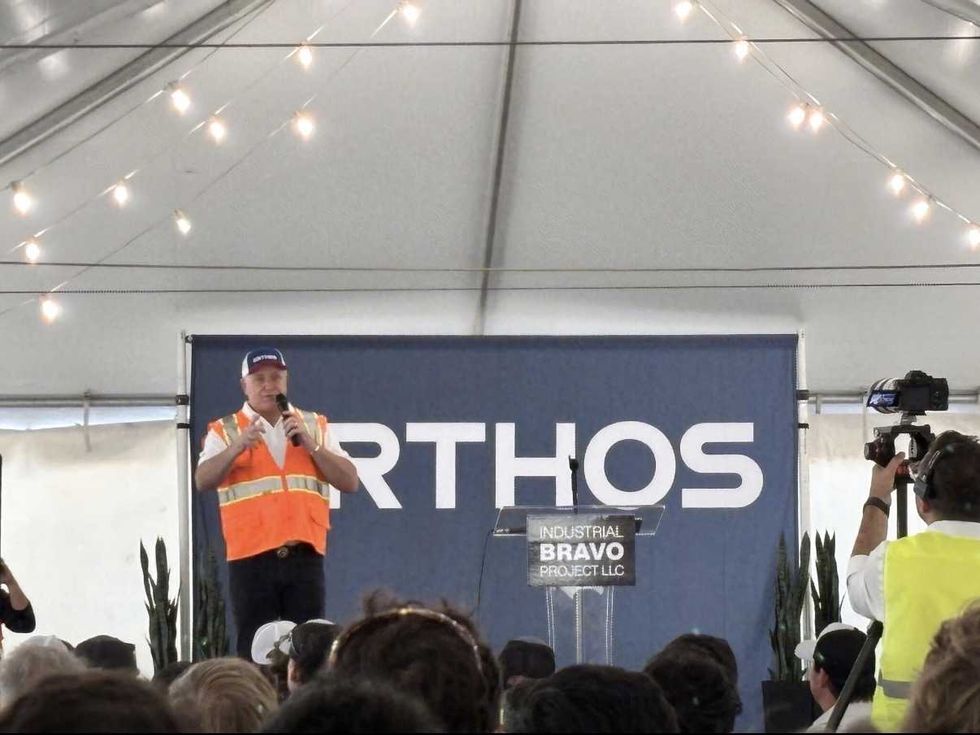 The HTX Tech Tours included a visit to the Erthos Project Bravo in Matagorda County. Photo courtesy