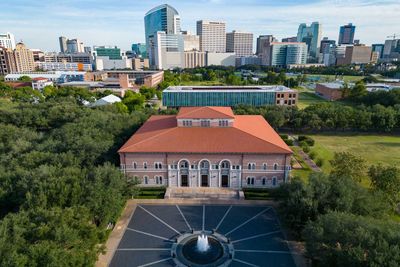
Rice's Baker Institute for Public Policy hosted delegations from Cyprus, Greece and Israel earlier this month. Photo courtesy Rice University
Representatives from three countries visited the Rice University Baker Institute for Public Policy this month to establish the Eastern Mediterranean Energy Center, a new partnership promoting energy advancement in the region.
On June 11, Baker played host to delegations from Cyprus, Greece and Israel that included Michael Damianos, Minister of Energy, Commerce and Industry of the Republic of Cyprus; Stavros Papastavrou, Minister of Environment and Energy for Greece; and Yechiel Leiter, Israeli Ambassador to the United States. U.S. Secretary of Energy Chris Wright and Rice University President Reginald DesRoches were also present to sign a declaration of intent (DOI) that officially formed the partnership first envisioned in the Eastern Mediterranean Security and Energy Partnership Act of 2019.
“This is a dynamic field,” David Satterfield, director of the Baker Institute and former U.S. ambassador to Turkey and Lebanon, said in a news release from Rice. “The East Med has enormous further potential, not just for development, for coordination of development. It is a positive thing for energy, it's a positive thing for industry, for all of the three states represented here today. It's good for the region in a geopolitical sense as well. It provides a stabilization based upon the pragmatic and integrated development and distribution of energy resources, and that is a very good thing indeed.”
The new pact will focus on improving grid stability in the region, as well as on developing U.S. liquefied natural gas (LNG) infrastructure and new technologies.
Another goal of the Eastern Mediterranean Energy Center is suppressing conflict in the region. When the Eastern Mediterranean Security and Energy Partnership Act was signed by President Joe Biden in 2019, it lifted the prohibition on arms sales to the Republic of Cyprus, authorized foreign military financing for Greece and increased intelligence gathering on Russian interests in the Mediterranean.
“We need to use commerce to suppress and surpass conflict – that is the way to bring nations together in geopolitical tensions between countries,” Wright said in the release. “You think of it as zero-sum, there's a winner and a loser, and both sides want to be the winner. Ultimately, one side will be the winner, one side will be the loser. Maybe more objectively, both sides lose, but one loses more than the other. In commerce, it's entirely different, and commerce is voluntary exchange. It only happens when there's winners on both sides. So, when you build, you develop energy and you build energy distribution infrastructure, you bring countries, you bring people together. The three founding nations here and their leadership are all friends of mine and passionate in this mission. They not only want to develop energy to bring better opportunities to their people, but they wanted to bring those three nations together, and all of their neighbors as well, and use commerce to suppress and surpass conflict. These are generational investments.”