quantum contract
Houston startup wins Space Force contract to advance quantum energy generator
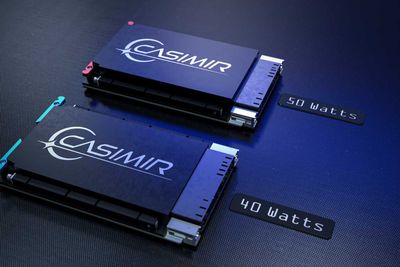
Casimir’s semiconductor chips can generate power from quantum vacuum fields without the need for batteries or charging. Photo via casimir.inc
Houston-based quantum energy technology startup Casimir Inc. has been awarded an STTR Phase I contract from the U.S. Space Force's SpaceWERX to support the development of the company's solid-state generator for potential use by the Department of the Air Force.
SpaceWERX is the innovation arm of the U.S. Space Force and a division within AFWERX, the incubator and innovation arm of the United States Department of the Air Force. The Air Force Research Laboratory and SpaceWERX, along with many other government agencies, help support innovation through the Small Business Innovation Research (SBIR) and Small Business Technology Transfer (STTR) grants and contracts.
As part of the new contract, Casimir will work to refine a fully independent generator. Casimir’s solid-state power technology could support national security missions by providing reliable power even in difficult-to-service environments.
In May, Casimir emerged from stealth, netting a $12 million seed round to commercialize its quantum energy chip. The semiconductor chips can generate power from quantum vacuum fields without the need for batteries or charging. The company aims to include the chips in large-scale energy systems that can power homes, commercial infrastructure and electric vehicles.
“This STTR funds some analysis work to address our proposed scaling approach of making our chips multi-layer to increase aggregate power,” Harold “Sonny” White, founder and CEO of Casimir, tells Energy Capital.
White adds that the company will work with Texas A&M to develop chip planarization techniques to support Casimir’s plans to scale. Additionally, White says the company is working with the U.S. Space Force to explore more applications for its technology.
“Casimir’s technology brings a new capability to the market in the form of our persistent power chips,” White adds. “This approach will be relevant to ultra-low-power electronics, and with the scaling approach we are developing, connected with the STTR work, will eventually be relevant to consumer electronics and beyond.”
Casimir has previously reported that it plans to commercialize its first-generation MicroSparc chip by 2028. The chips are expected to power devices for years without the need for replacements.
The total funding for this project has not yet been disclosed.