






The two entities will combine resources and efforts to "drive innovation, accelerate growth and empower young companies." Photo via Pexels

Two entities looking to support software-as-a-service innovation have teamed up on a new resource to meet the energy sector corporate clients' growing technology demands.

MOIC Partners, an energy enterprise software sales support solution provider founded earlier this year, and Venture Builder VC, a consulting firm, investor, and accelerator program operator led by a group of Houston innovators, have announced a new partnership. The two entities will combine resources and efforts to "drive innovation, accelerate growth and empower young companies," per a news release from the organizations.

“Throughout our careers, we’ve encountered various approaches to achieving the broader innovation objectives of Venture Builder VC and, in our judgment, this program truly stands out as a model that has the potential to introduce significant innovation to the energy sector in an abbreviated timeframe,” Dave Levitt of MOIC Partners says in the release.

MOIC Partners provides go-to-market products and services, including MOIC Sales Engine, MOIC Pipeline Grader, MOIC Pricing Engine, Virtual Dave, and MOIC Exit Engine.

Venture Builder VC recently partnered with NOV on a custom accelerator for the energy leader.

“We deliver disruptive solutions to enterprise R&D and innovation leaders by targeting growth-stage startups solving their specific problems," Billy Grandy, founder and general partner of Venture Builder VC, says in the release. "While founder-led models excel in driving change, they often struggle with scalability and change management with corporate customers. Our partnership with MOIC Partners provides essential tools to help small and mid-sized SaaS companies overcome these challenges and achieve sustainable growth.”

———

This article originally ran on InnovationMap.
Ad Placement 300x100
Ad Placement 300x600

CultureMap Emails are Awesome

Houston researchers develop compact carbon capture tech for data centers

AI emissions

Two scientists from the University of Houston have been experimenting with new carbon capture systems that fit inside a standard shipping container, which have the potential to make eliminating carbon output from industrial sites much easier.

The capture of industrial carbon is an important complement to the fight against climate change, as well as winning tax credits for businesses that use carbon capture technology.

The problem is that such systems are often measured in acres, making them expensive to build and extremely power-hungry to actually use. UH Engineering Professor Mim Rahimi and former UH Ph.D. student Ahmad Hassan (now a postdoctoral associate at Harvard) have managed to fit their new system, the Small Modular Electrochemical Container (SMECs), inside a standard 40-foot shipping crate, making them compact and modular enough to be installed almost anywhere for operations of all sizes. Their research was recently published in the journal Environmental Science & Technology.

“With a conventional system, you’re building a 130-foot-tall structure designed for a specific power plant. With our technology, we can adjust the capacity by simply turning containers on or off,” Rahimi said in a news release. “That flexibility is particularly important for data centers, where electricity can come from a combination of natural gas and renewable sources.”

Rahimi and Hassan used simulated gas models to show that under optimal conditions, the SMEC used electrochemically mediated amine regeneration (EMAR) cells developed in Rahimi’s lab to capture 90 percent of carbon under optimal conditions through 300 cycles over 50 hours.

Encouraged, the team then modeled a 360-megawatt natural gas power plant associated with OpenAI’s Stargate AI data center project in Abilene, Texas. In addition to the savings on infrastructure costs, 20 of the researchers’ shipping container systems were able to capture 98 percent of carbon from Stargate’s 875-acre campus based on the model.

The looming energy costs and subsequent carbon emissions from data centers are a real concern. Estimates from the U.S. Department of Energy hypothesize that 12 percent of America’s energy needs could be gobbled up by the centers as soon as 2028. That is a massive new source of carbon. The flexibility of the SMEC means they can be deployed wherever the centers spring up.

“We’re taking a technology that traditionally requires enormous infrastructure and finding a way to fit it inside a shipping container,” Rahimi added in the release. “That opens up entirely new possibilities for how and where carbon capture systems can be used.”

In the future, the researchers say they plan to look at ways to adapt the technology to capture carbon dioxide directly from the atmosphere.

Hertha Metals breaks ground on $100M high-purity iron factory in Conroe

coming soon

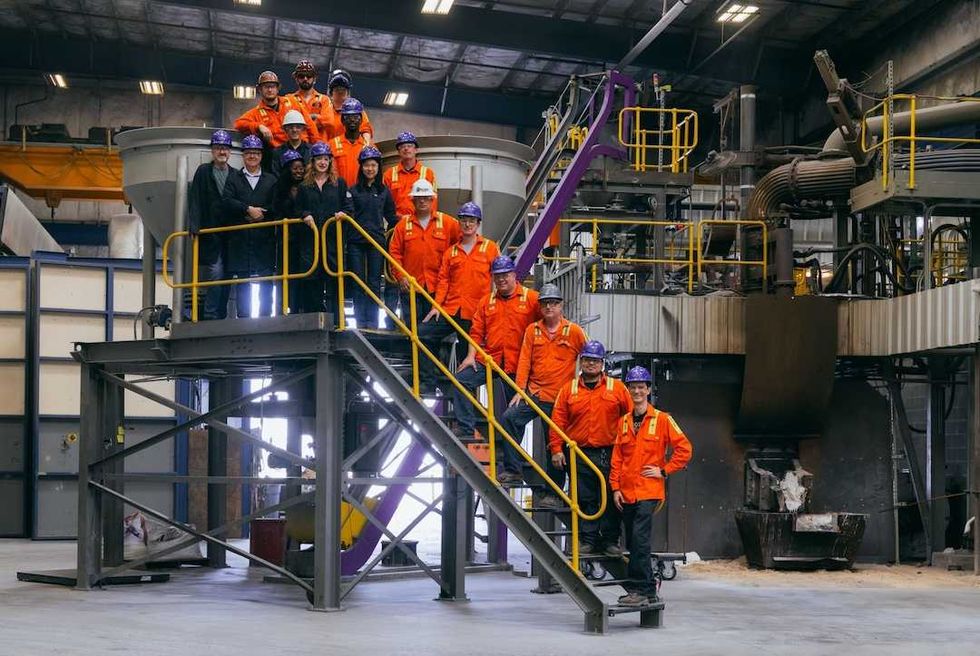
Shortly after announcing a $133.65 Series A funding round, Conroe-based Hertha Metals broke ground Oct. 8 on a $100 million factory that will produce steel-grade and magnet-grade high-purity iron.

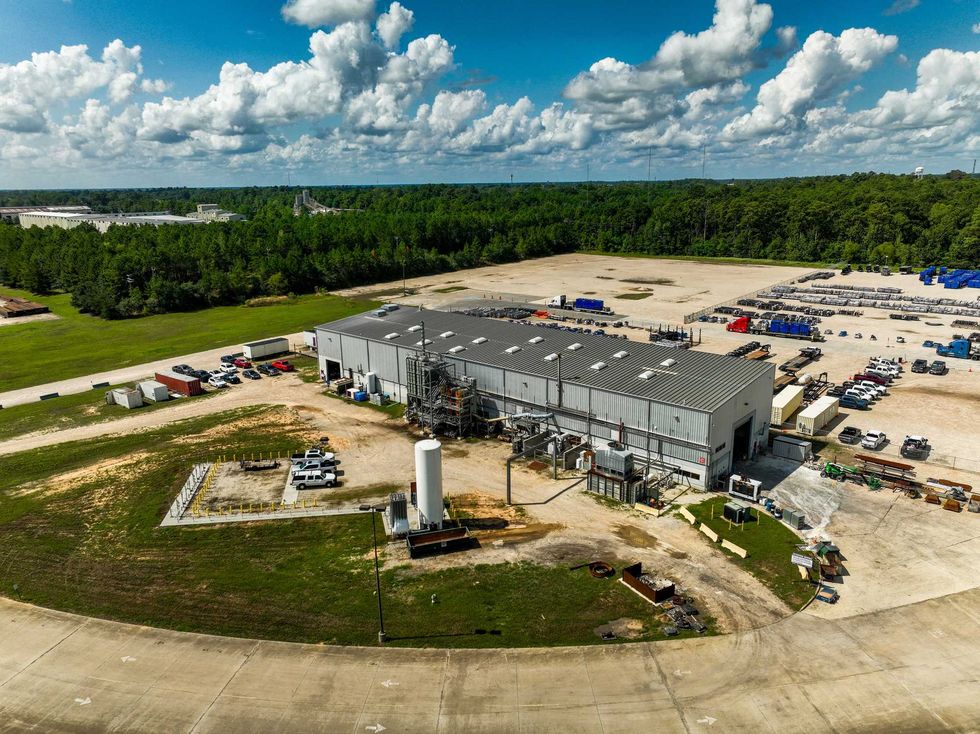
Hertha’s Chalyx plant, located in Conroe, will manufacture a total of about 10,000 metric tons per year of magnet-grade and steel-grade high-purity iron. The factory will use Hertha’s single-step process to generate high-purity iron for rare-earth-magnet and steel manufacturers in the U.S.

Hertha says Chalyx will be the first U.S. commercial plant for production of magnet-grade high-purity iron.

Chalyx is being built next to Hertha’s headquarters and its Pi100 pilot plant, which will remain in operation. Chalyx and Pi100 will form the first modern-day iron and steel “innovation complex” in the U.S., the company says.

“I founded Hertha Metals because I believed we could significantly improve how the world makes iron and steel from ore, and that an industry so fundamental to our future still had enormous room for invention,” Laureen Meroueh, founder and CEO of Hertha, said in a press release.

The 4-year-old startup says the Chalyx complex will lay the foundation for its first 500,000-ton-per-year steel mill.

Chalyx’s first priority is making high-purity iron for U.S. manufacturers of rare-earth magnets, Hertha says. These magnets are critical components for electric vehicles, data centers, wind turbines and defense systems.

China produces an estimated 94 percent of high-purity iron for rare-earth magnets, according to Hertha.

Aside from iron for rare-earth magnets, Chalyx will make iron and steel for pilot projects in the steel industry.

The plant is expected to come online in late 2027, with production of magnet-grade high-purity iron starting in early 2028.

Today, Hertha employs 32 people, the company says. Once it’s fully operating, the Chalyx plant will employ about 50 people.

Just ahead of the groundbreaking, Hertha announced the $133.65 million Series A round, co-led by Khosla Ventures and Doerr Capital. The round included a $65 million equity investment from the Pentagon.

“Iron and steel have shaped human progress for thousands of years. And I believe there is still an enormous amount left to invent,” Meroueh said at the groundbreaking ceremony.

Canada-founded energy tech company moves global HQ to Energy Corridor

houston hq

Pulsed-power technology company BlueSpark Energy will open its new global headquarters in Houston’s Energy Corridor to house its engineering, research and development, manufacturing, commercial and digital teams.

“Houston isn’t simply our new headquarters; it’s where a new BlueSpark begins,” Kahina Abdeli-Galinier, president and CEO of BlueSpark, said in a news release. ”We’re building the well health technology the industry needs to get more from existing wells, reduce intervention costs and keep wells producing for longer. Our new home brings us closer to our customers and places us at the heart of one of the most exciting markets in the industry, with the talent pool to match.”

The company, which began in Calgary, plans to grow its Houston workforce to 100 employees by the end of 2028, while the manufacturing element is expected to be operational in February 2027.

According to BlueSpark, the new facility will feature double the manufacturing floorspace of its current site, and the extra space will allow it to scale its tool manufacturing.

The headquarters is on West Sam Houston Parkway. BlueSpark's Chief Technology Officer Matt Mohajer and Chief Commercial Officer Zach Wilbur are already leading teams at the new space, according to the release.

BlueSpark develops pulsed-power technology that uses electrical energy to clean oil and gas well components, remove scale buildup and restore production without damaging equipment. Its technology helps operators reduce downtime, improve well performance and extend the productive life of existing wells.

Late last year, the company named Kahina Abdeli-Galinier as its CEO. It has since rebranded and focused on expanding its technology into new applications, including plugging and abandonment, cement removal and water services.

“We’re investing heavily in our technology, both the physics and the intelligence and delivery layer around it,” Abdeli-Galinier added in the release. “Having our engineering, manufacturing, digital, R&D and commercial teams in one place allows us to move much faster, giving our customers the tools they need to keep wells healthy and producing more for longer.”