Students from the 2023 cohort of The Energy Project showcased their innovations at the Puranik Foundation Lotus Innovation Awards. Photo courtesy of Jacob Power Photography

From the moment of arrival at the Puranik Foundation Lotus Innovation Awards, attendees engaged in an experience that stimulated the senses and excited the mind – a precise reflection of the foundation’s approach to a holistic education for future innovators.

The event, held last week at the Post Oak Hotel in Uptown, honored Houston leaders supporting the next generation of aspiring entrepreneurs and celebrated the dedication of high school students dreaming sustainability solutions into reality.

“[These students] have the potential to reach innovative places that none of us can think of because we are so set in our ways,“ says Bhakti Puranik, executive director of Puranik Foundation, just steps from where the students showcased their prototypes to secure the gala’s Fan Favorite award. “They are open-minded and creative and constantly inspired by the community that surrounds us.”

The Energy Project, launched in 2020 by the foundation, supports young minds tackling environmental challenges for sustainable development across five sectors: alternative power generation, sustainable consumption, waste management, urban design, and water sustainability.

Multiple small student teams from across the country met for design thinking lessons before creating prototypes of their own solutions at TXRX Labs. The foundation’s primary sponsor, Worldwide Oilfield Machine, provided mentors and resources to the 25 students in this year’s cohort alongside Rice University.

For the winning team, Refoam Maine, the application of mushroom mycelium in lieu of plastic for floating buoys came from the optimistic minds of Maggie Blood, Olivia Huard, Tula Bradley Prindiville, and Laura Riordan, students of Camden Hills Regional High School near Rockport, Maine.

A close-knit community, Camden Hills has collectively seen thousands of orphaned buoys pile up against their docks and beaches for years. The team plans to use their Lotus Innovation Award grant of $15,000 to get their floats in the water, and is actively working with boatyards, aquaculture farmers, and others to bring that vision to reality this summer.

Cyrus Golshan, Nathaniel Lemon, and Alexander Kristof took home the Fan Favorite Award for their solution Piezot, which harnesses energy from revolutionary piezoelectric tiles that convert pressure into energy and electricity.

The team studies at the Energy Institute High School in Houston and envisions an energy ecosystem that doesn’t rely so heavily on natural forces, but rather on human movement as a means to generate power. Placement of the tiles in high-traffic areas like airports, schools, and shopping centers could mean an exponential growth in power supply created simply by the many feet that pass through these areas every day.

Bobby Tudor, CEO and founder of Artemis Energy Partners, and recipient of the Sustainability Lotus Award from Puranik Foundation, attributes the success of the program to the convergence of expertise, a collaborative ecosystem, and global connectivity available from Houston as part of the burgeoning Energy Transition industry.

“We are the energy capital of the world because we are the intellectual capital of energy,“ says Tudor. “The knowledge, the engineering, the expertise, sits here in a more concentrated way than it sits anywhere else in the world. It is that intellectual capital that will pave the way for us to continue to be the energy capital of the world a decade from now, two decades from now, and five decades from now.”

Additionally, Paula Harris, senior vice president of the Houston Astros Community Affairs and Executive Director for the Astros Foundation, accepted the Education Lotus Award for her continued commitment to advancing STEM education across underserved communities.

For his positive impact on the mental well-being of students, Bradley H. Smith, Ph.D., Professor of Psychological, Health, and Learning Services at the University of Houston School of Psychology, Puranik Foundation honored him with Mindfulness Lotus Award.

Applications for The Energy Project are due by 1 November each fall. In addition to the team competition, next year’s cohort includes an immersive experience in India for holistic learning and leadership development.
Ad Placement 300x100
Ad Placement 300x600

CultureMap Emails are Awesome

Houston company raises $100M Series D to scale industrial decarbonization tech

fresh funding

Houston-based Utility Global has raised $100 million in an ongoing Series D round to globally deploy its decarbonization technology at an industrial scale.

The round was led by Ara Partners and APG Asset, according to a news release. Utility plans to use the funding to expand manufacturing, grow its teams and support its commercial developments and partnerships.

“This financing marks a critical step in Utility’s transition from a proven technology to full-scale global commercial execution,” Parker Meeks, CEO and president of Utility Global, said in the release. “Industrial customers are no longer looking for pilots or promises; they need deployable solutions that work within existing assets and deliver true economic industrial decarbonization today that is operationally reliable and highly scalable. Utility’s technology produces both economic clean hydrogen and capture-ready CO2 streams, and this capital enables us to scale and deploy that impact globally with speed, discipline, and rigor.”

Utility Global's H2Gen technology produces low-cost, clean hydrogen from water and industrial off-gases without requiring electricity. It's designed to integrate into existing industrial infrastructure in hard-to-abate assets in the steel, refining, petrochemical, chemical, low-carbon fuels, and upstream oil and gas sectors.

“Utility is tackling one of the most difficult challenges in the energy transition: decarbonizing hard‑to‑abate industrial sectors,” Cory Steffek, partner at Ara Partners and Utility Global board chair, said in the release. “What sets Utility apart is its ability to compete head‑to‑head with conventional fossil‑based solutions on cost and reliability, even as it materially reduces emissions. With this new funding, Utility is well-positioned for its next chapter of commercial growth while maintaining the technical excellence and capital discipline that have defined its development to date.”

Utility Global reached several major milestones in 2025. After closing a $53 million Series C, the company agreed to develop at least one decarbonization facility at an ArcelorMittal steel plant in Brazil. It also signed a strategic partnership with California-based Kyocera International Inc. to scale global manufacturing of its H2Gen electrochemical cells.

The company also partnered with Maas Energy Works, another California company, to develop a commercial project integrating Maas’ dairy biogas systems with H2Gen to produce economical, clean hydrogen.

"These projects were never intended to stand alone. They anchor a deep and growing pipeline of commercial projects now in development globally across steel, refining, chemicals, biogas and other hard-to-abate sectors worldwide, Meeks shared in a 2025 year-in-review note. He added that 2026 would be a year of "focused acceleration to scale."

Houston energy pioneer elected to National Academy of Sciences leadership

top honor

Naomi Halas, a Rice University professor and co-founder of Syzygy Plasmonics, was elected to the Council of the National Academy of Sciences this month.

The council sets priorities for the nonprofit organization, which advises the federal government on scientific and technical matters. Halas will serve a three-year term on the council, beginning July 1.

“The council’s work is focused on the academy’s national leadership and governance,” Halas said in a news release. “It plays an important role in helping set initiatives and priorities for the scientific community, and in supporting the conditions that allow science to move forward in meaningful ways.”

Halas is best known for her pioneering work in nanophotonics and plasmonics. She helped develop nanoshells, or metal-coated nanoparticles that capture light energy, which have led to innovations in renewable energy, cancer therapy and water purification.

Halas co-founded Syzygy Plasmonics with frequent collaborator and fellow Rice professor Peter Nordlander. The company is developing low-cost, light-driven, all-electric chemical reactors for the sustainable production of hydrogen fuel. It was named to Fast Company's energy innovation list last year.

Syzygy Plasmonics is developing its first commercial-scale biogas-to-sustainable aviation fuel project in Uruguay, known as NovaSAF-1. It secured a six-year offtake agreement for the entire production from the project with Singapore-based commodity company Trafigura this month.

Halas was first elected to become a member of the NAS in 2013, and was shortly after named to the National Academy of Engineering in 2014—making her one of the few scientists to hold both distinctions. She received the Benjamin Franklin Medal in Chemistry last year. Many scientists who have received the award have gone on to win Nobel prizes.

She is also the co-founder of Nanospectra Biosciences and a member of the National Academy of Inventors, the American Academy of Arts and Sciences, and the Royal Danish Academy of Science and Letters. She holds more than 25 patents, according to Rice.

Houston startup launches groundbreaking mineral hydrogen pilot

pilot project

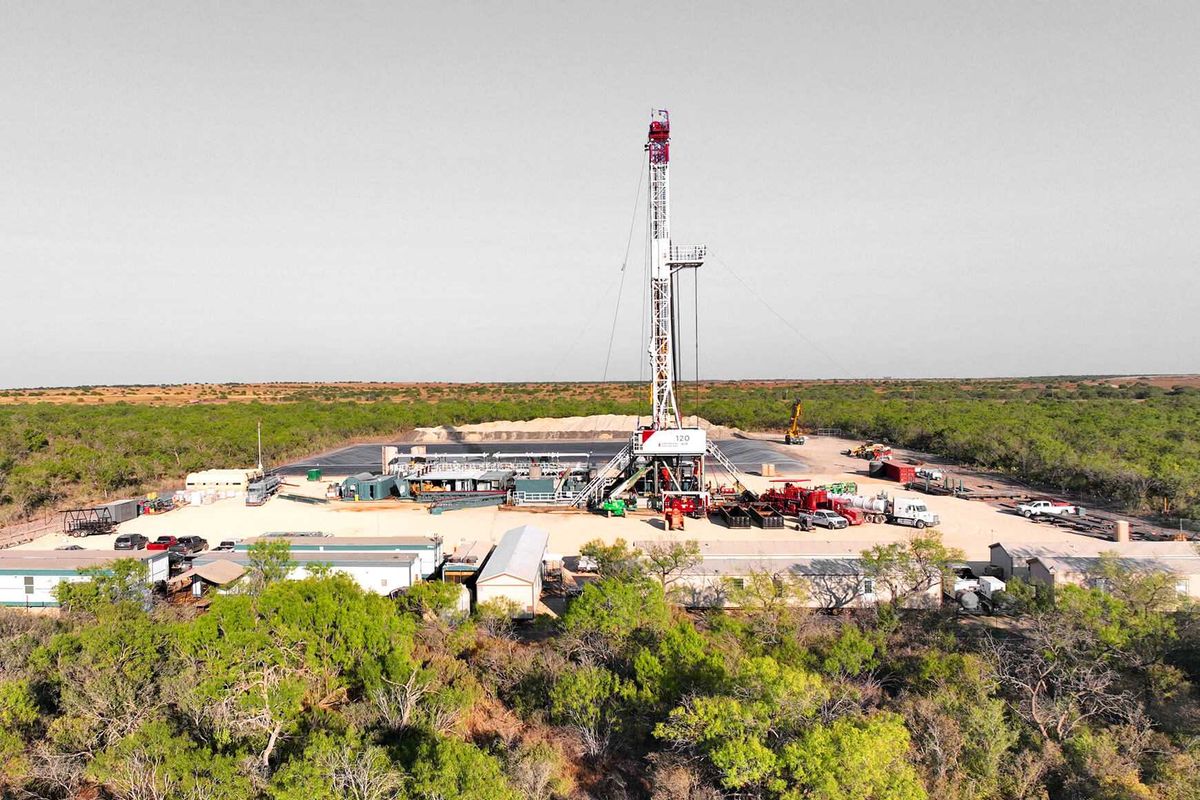
Houston climatech company Vema Hydrogen recently completed drilling its first two pilot wells in Quebec for its Engineered Mineral Hydrogen (EMH) pilot. The company says the project is the first EMH pilot of its kind.

Vema’s EMH technology produces low-cost, high-purity hydrogen from subsurface rock formations. It has the capacity to support e-fuel and clean mobility industries and the shipping and air transport markets. The pilot project is the first field deployment of the company’s technology.

“This pilot will provide the critical data needed to validate Engineered Mineral Hydrogen at commercial scale and demonstrate that Quebec can lead the world in this emerging clean energy category,” Pierre Levin, CEO of Vema Hydrogen, said in a news release.

Levin added that the sample collected thus far in the pilot is “exactly what we expected, and is very promising for hydrogen yields.”

Through the pilot, Vema will collect core samples and begin subsurface analysis to evaluate fluid movement and monitor hydrogen production from the wells. The data collected from the pilot will shape Vema's plans for commercialization and provide documentation for proof of concept in the field, according to the news release.

“Vema Hydrogen perfectly embodies the spirit of the grey to green movement: transforming mining liabilities into drivers of innovation and ecological transition,” Ludovic Beauregard, circular economy commissioner at the Thetford Region Economic Development Corporation, added in the release.

“This project demonstrates that it is possible to reconcile the revitalization of mining regions, clean energy and sustainable economic development for these areas.”

In addition to its pilot in Canada, Vema also recently signed a 10-year hydrogen purchase and sale agreement with San Francisco-based Verne Power to supply clean hydrogen for data centers across California. The company was selected as a Qualified Supplier by The First Public Hydrogen Authority, which will allow it to supply clean hydrogen at scale to California’s municipalities, transit agencies and businesses through the FPH2 network.

Vema aims to produce Engineered Mineral Hydrogen for less than $1 per kilogram. The company, founded in 2024, is working toward a gigawatt-scale hydrogen supply in North America.