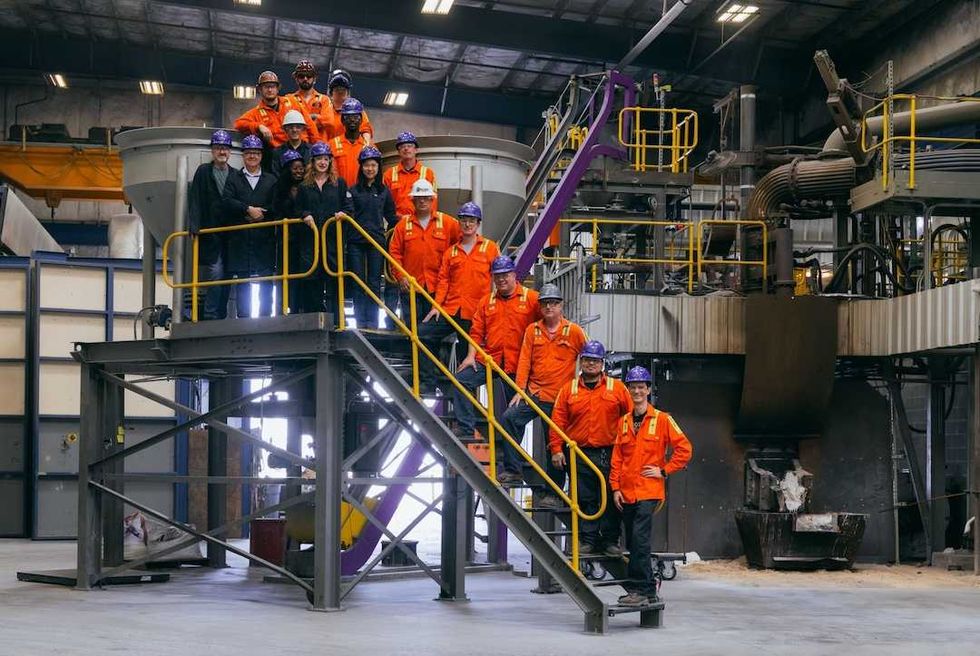
Rice University researchers have developed a new method for removing PFAS from water that works 100 times faster than traditional filters. Photo via Rice University.

Rice University researchers have teamed up with South Korean scientists to develop the first eco-friendly technology that captures and destroys toxic “forever chemicals,” or PFAS, in water.

PFAS have been linked to immune system disruption, certain cancers, liver damage and reproductive disorders. They can be found in water, soil and air, as well as in products like Teflon pans, waterproof clothing and food packaging. They do not degrade easily and are difficult to remove.

Thus far, PFAS cleanup methods have relied on adsorption, in which molecules cling to materials like activated carbon or ion-exchange resins. But these methods tend to have limited capacity, low efficiency, slow performance and can create additional waste.

The Rice-led study, published in the journal Advanced Materials, centered on a layered double hydroxide (LDH) material made from copper and aluminum that could rapidly capture PFAS and be used to destroy the chemicals.

The study was led by Rice professor Youngkun Chung, a postdoctoral fellow under the mentorship of Michael S. Wong. It was conducted in collaboration with Seoktae Kang, professor at the Korea Advanced Institute of Science and Technology, and Keon-Ham Kim, professor at Pukyung National University, who first discovered the LDH material.

The team evaluated the LDH material in river water, tap water and wastewater. And, according to Rice, that material’s unique copper-aluminum layers and charge imbalances created an ideal binding environment to capture PFAS molecules.

“To my astonishment, this LDH compound captured PFAS more than 1,000 times better than other materials,” Chung, lead author of the study and now a fellow at Rice’s WaTER (Water Technologies, Entrepreneurship and Research) Institute and Sustainability Institute, said in a news release. “It also worked incredibly fast, removing large amounts of PFAS within minutes, about 100 times faster than commercial carbon filters.”

Next, Chung, along with Rice professors Pedro Alvarez and James Tour, worked to develop an eco-friendly, sustainable method of thermally decomposing the PFAS captured on the LDH material. They heated saturated material with calcium carbonate, which eliminated more than half of the trapped PFAS without releasing toxic by-products.

The team believes the study’s results could potentially have large-scale applications in industrial cleanups and municipal water treatments.

“We are excited by the potential of this one-of-a-kind LDH-based technology to transform how PFAS-contaminated water sources are treated in the near future,” Wong added in the news release. “It’s the result of an extraordinary international collaboration and the creativity of young researchers.”

---

This article originally appeared on our sister site, InnovationMap.
Ad Placement 300x100
Ad Placement 300x600

CultureMap Emails are Awesome

Fervo taps into its hottest-ever geothermal reservoir

heat record

Things are heating up at Houston-based geothermal power company Fervo Energy.

Fervo recently drilled its hottest well so far at a new geothermal site in western Utah. Fewer than 11 days of drilling more than 11,000 feet deep at Project Blanford showed temperatures above 555 degrees Fahrenheit, which exceeds requirements for commercial viability. Fervo used proprietary AI-driven analytics for the test.

Hotter geothermal reservoirs produce more energy and improve what’s known as energy conversion efficiency, which is the ratio of useful energy output to total energy input.

“Fervo’s exploration strategy has always been underpinned by the seamless integration of cutting-edge data acquisition and advanced analytics,” Jack Norbeck, Fervo’s co-founder and chief technology officer, said in a news release. “This latest ultra-high temperature discovery highlights our team’s ability to detect and develop EGS sweet spots using AI-enhanced geophysical techniques.”

Fervo says an independent review confirms the site’s multigigawatt potential.

The company has increasingly tapped into hotter and hotter geothermal reservoirs, going from 365 degrees at Project Red to 400 degrees at Cape Station and now more than 555 degrees at Blanford.

The new site expands Fervo’s geologic footprint. The Blanford reservoir consists of sedimentary formations such as sandstones, claystones and carbonates, which can be drilled more easily and cost-effectively than more commonly targeted granite formations.

Fervo ranks among the top-funded startups in the Houston area. Since its founding in 2017, the company has raised about $1.5 billion. In January, Fervo filed for an IPO that would value the company at $2 billion to $3 billion, according to Axios Pro.

Texas claims No. 1 spot on new energy resilience report

A new report by mineral group Texas Royalty Brokers ranks Texas as the No. 1 most energy-resilient state.

The study focused on four main sources of electricity in hydroelectric dams, natural gas plants, nuclear reactors and petroleum facilities. Each state was given an Energy Resilience Score based on size and diversity of its power infrastructure, energy production and affordability for residents.

Texas earned a score of 71.3 on the report, outpacing much of the rest of the country. Pennsylvania came in at No. 2 with a score of 55.8, followed by New York (49.1) and California (48.4).

According to the report, Texas produces 11.7 percent of the country’s total energy, made possible by the state’s 141,000-megawatt power infrastructure—the largest in America.

Other key stats in the report for Texas included:

  • Per-capita consumption: 165,300 kWh per year
  • Per-capita expenditures: $5,130 annually
  • Total summer capacity: 141,200 megawatts

Despite recent failures in the ERCOT grid, including the 2021 power grid failure during Winter Storm Uri and continued power outages with climate events like 2024’s Hurricane Beryl that left 2.7 million without power, Texas still was able to land No. 1 on an energy resilience list. Texas has had the most weather-related power outages in the country in recent years, with 210 events from 2000 to 2023, according to an analysis by the nonprofit Climate Central. It's also the only state in the lower 48 with no major connections to neighboring states' power grids.

Still, the report argues that “(Texas’ infrastructure) is enough to provide energy to 140 million homes. In total, Texas operates 732 power facilities with over 3,000 generators spread across the state, so a single failure can’t knock out the entire grid here.”

The report acknowledges that a potential problem for Texas will be meeting the demands of AI data centers. Eric Winegar, managing partner at Texas Royalty Brokers, warns that these projects consume large amounts of energy and water.

According to another Texas Royalty Brokers report, Texas has 17 GPU cluster sites across the state, which is more than any other region in the United States. GPUs are specialized chips that run AI models and perform calculations.

"Energy resilience is especially important in the age of AI. The data centers that these technologies use are popping up across America, and they consume huge amounts of electricity. Some estimates even suggest that AI could account for 8% of total U.S. power consumption by 2030,” Winegar commented in the report. “We see that Texas is attracting most of these new facilities because it already has the infrastructure to support them. But we think the state needs to keep expanding capacity to meet growing demand."