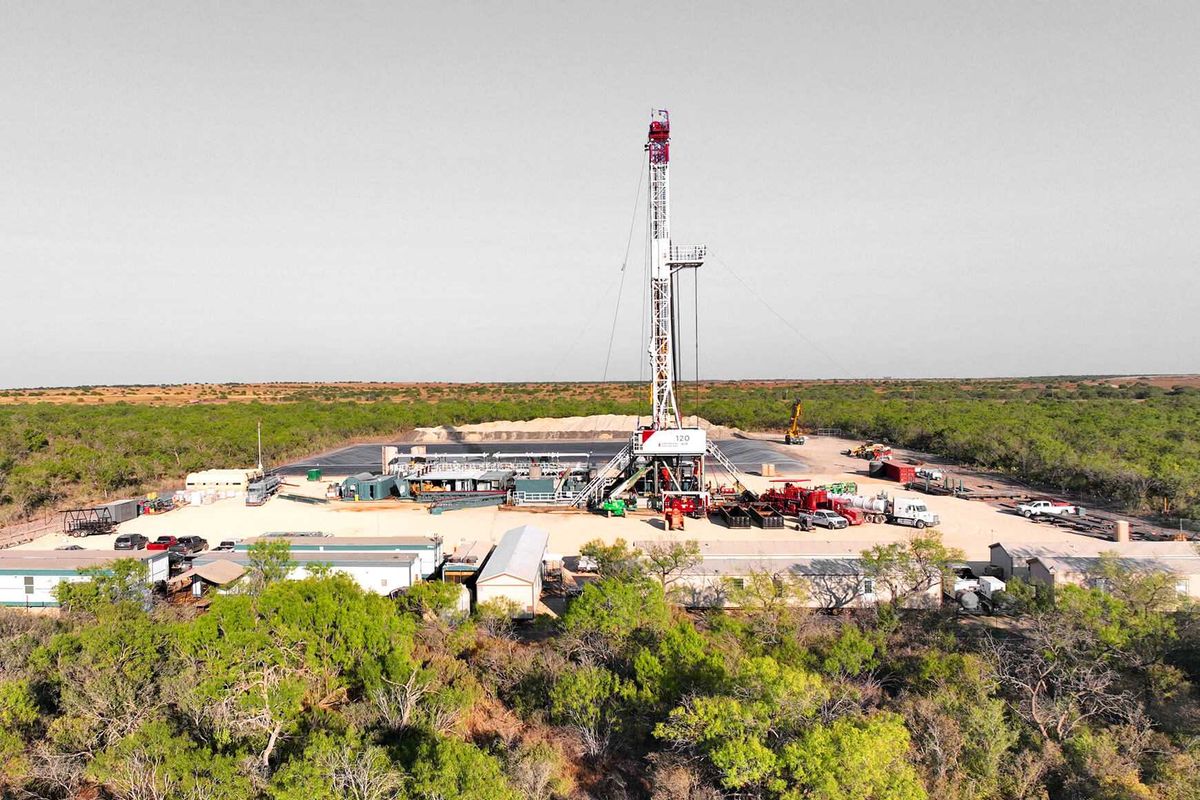
Eight Houston energy leaders appear on the global startup index. Photo via Getty Images

Eight major players in Houston’s energy industry rank among the world’s top 20 energy companies for corporate startup activity.

The inaugural Corporate Startup Activity Index 2025, published by StartupBlink, ranks global corporations by industry. The eight Houston-area employers fall into the index’s energy and environment category.

Researchers from StartupBlink, an innovation research platform, scored more than 370 companies based on three factors: corporate involvement in startup activity, startup success and ecosystem integration.

The eight Houston-area energy employers that landed in the energy and environment category’s top 20 are:

  • No. 3 BP. Score: 13.547. U.S. headquarters in Houston.
  • No. 5 Saudi Aramco. Score: 7.405. Americas headquarters in Houston.
  • No. 7 Eni. Score: 6.255. Headquarters of Eni U.S. Operating Co. in Houston.
  • No. 8 Shell. Score: 6.217. U.S. headquarters in Houston.
  • No. 11 Occidental Petroleum. Score: 5.347. Global headquarters in Houston.
  • No. 15 Engie. Score: 3.352. North American headquarters in Houston.
  • No. 17 Repsol. Score: 2.980. U.S. headquarters for oil and gas operations in The Woodlands.
  • No. 19 Chevron. Score: 2.017. Global headquarters in Houston.

“Building a startup is hard, and navigating corporate innovation can be just as complex. This ranking is a step toward making the connection between startups and corporations more transparent, enabling startups and corporations to collaborate more effectively for mutual success,” said Eli David Rokah, CEO of StartupBlink.

Salesforce topped the global index with a score of 380.090, followed by Intel, Google, Qualcomm, and Comcast.

---

This article originally appeared on InnovationMap.com.
Ad Placement 300x100
Ad Placement 300x600

CultureMap Emails are Awesome

Greentown names 5 climatech startups to manufacturing accelerator

Catalyst Cohort

Greentown Labs has named five climatech startups to its Go Make 2026 cohort, including one from Houston.

Greentown Go Make 2026 is in partnership with Shell Catalysts & Technologies and Technip Energies. Startups will be able to collaborate with leadership from Shell and Technip and have opportunities to work directly with their process engineering teams and develop potential partnerships, pilots and demonstrations, according to Greentown.

This year's manufacturing cohort focuses specifically on process technology and catalytic innovations, which, according to Greentown, have the potential to be a "critical enabler of the global energy transition." Greentown shares that 90 percent of chemical processes depend on catalysis, but traditional methods rely on fossil fuels and consume significant amounts of energy.

“Catalysis underpins the majority of industrial chemical processes, which together account for a significant share of global emissions, making it a critical lever for reducing carbon intensity while improving performance,” Georgina Campbell Flatter, CEO of Greentown, said in a news release. “Greentown Go Make 2026 is designed to close the gap between breakthrough innovation and industrial deployment. By connecting startups with Shell and Technip Energies’ technical expertise and global scale, we’re helping accelerate solutions that improve efficiency and drive industrial decarbonization.”

The five Greentown Go Make 2026 companies include:

  • Houston-based Biosimo, which makes scalable biochemicals from ethanol
  • Missouri-based Catalyxx, which transforms bioethanol into drop-in, cost-competitive, carbon-negative chemicals
  • Sydney, Australia-based HydGene Renewables, which produces low-carbon hydrogen and industrial chemicals from waste biomass
  • Switzerland-based TreaTech, which turns waste into renewable gas, water and minerals through catalytic hydrothermal gasification
  • California-based Unifuel, which has developed a chemical technology platform to make sustainable aviation fuel, renewable gasoline and other renewable chemicals

The cohort will be celebrated at a kickoff event in Houston at The Ion on June 9.

In addition to Greentown Go Make, Greentown also runs its Go Move (transportation), Go Energize (energy and electricity), Go Build (buildings), and Go Grow (food and agriculture) cohort-based programs. The climatech incubator announced its Go Build 2026 cohort in March. Read more here.

Houston developer launches AI-powered water platform to boost efficiency

eyes on AI

Houston real estate company McCord Development has launched an artificial-Intelligence-run water management platform, MizuWatch.

MizuWatch aims to help operators, districts, and municipalities detect leaks faster, reduce water loss and improve efficiency, according to the company. MizuWatch pulls data from supply sources, smart meters, historical usage and maintenance records, and combines them into a single platform. The AI system also uses visual mapping and digital twin technology to deliver near-real-time system insights.

“MizuWatch brings the right data together daily, so teams can see what’s happening now, intervene earlier and focus their resources where they have the greatest impact,” Jerzy Wielgus, chief product officer for MizuWatch, said in a news release.

MizuWatch was built to “scale across geographies and system sizes to help assist with water scarcity, aging infrastructure, and operational complexity,” according to the company. It was developed at Houston’s Generation Park, McCord’s 4,300-acre master planned commercial district. McCord was able to pilot the platform onsite to help manage its complex, real-world water systems at scale.

“Resilient infrastructure is a key factor for the companies choosing Generation Park,” Ryan McCord, CEO of McCord Development and Founder & CEO of MizuWatch, added in the release. “We made the decision to deploy smart meters, but no one knew how to use the data they generate. This is an opportunity across all infrastructure where sensors are deployed. What started as an internal solution has become a platform we believe can help stakeholders everywhere be more efficient in their operations, investment, and compliance.”

Last fall, Eli Lilly and Co. selected Generation Park for its $6.5 billion manufacturing plant. More than 300 locations in the U.S. competed for the factory. Bristol Myers Squibb Co., another pharmaceutical giant, also announced it is considering Generation Park for a new manufacturing hub earlier this month.

Oil giant BP ousts new chairman over serious conduct concerns

Sudden Exit

BP has ousted its chairman over what it called serious concerns related to “important governance standards, oversight and conduct.”

The departure was abrupt and unexpected, with Albert Manifold having been appointed to the position late last year.

“Albert has helped bring a welcome focus and pace to BP’s transformation," Amanda Blanc, senior independent director, said in a statement Tuesday, May 26. "However, the board has been surprised and disappointed to learn of governance oversight and conduct issues it deems unacceptable and has taken decisive action.”

BP's board named Ian Tyler as interim chair, effective immediately.

BP, based in London and with North American headquarters in Houston, is a “supermajor,” one of the five largest oil production and exploration companies in the world when measured by revenue and profit.

Manifold, who had been the top executive at Dublin-based global building materials company CRH for 10 years, became the chair at BP in October. BP was looking for someone to revamp the oil giant and went with an industry outsider in Manifold, who had made major strategic changes at CRH.

After a new focus on renewable energy at BP in 2020, by 2025 the company was seeking a return to its roots. BP's hard reset was criticized by environmentalists, as well as some shareholders.

CEO Murray Auchincloss said last year that optimism over opportunities in renewable energy was misplaced, with the company moving “too far and too fast.”

Changes in leadership at BP in recent years has been tumultuous.

CEO Bernard Looney resigned in late 2023 after BP determined that he had misled the company over his past relationships with colleagues.

Auchincloss stepped down in December, and the company named Meg O'Neill as his successor.

Manifold’s was challenged almost immediately when shareholders defeated company resolutions this spring that would have allowed BP to reduce climate reporting requirements and move its annual meetings fully online. Some 18% of shareholders voted against Manifold’s election as chairman, a high level of opposition for an appointment that is generally rubber stamped by investors.

Legal & General, one of Britain’s largest insurers and investment companies, said at the time that Manifold was responsible for resolutions that would have had “a negative impact on shareholders’ insight into how the company is addressing financially material long-term risks, and seizing long-term value creation opportunities, associated with the energy transition,” the Times of London reported on April 23.

Glass Lewis, an influential shareholder advisor, urged investors to vote against Manifold’s election. It held that BP took “unprecedented action” by refusing to consider a resolution from a group of climate activists and pension funds hoping to force the board to create an alternative strategy should demand for fossil fuels decline, the Times reported.

Like other big oil companies, BP has struggled with falling demand in recent years.

BP’s 2025 earnings fell 16% from a year earlier to $7.49 billion as the price of Brent crude, a benchmark for international oil prices, dropped 16.9%. The company’s preferred measure of earnings is underlying replacement cost profit, which adjusts for one-time items and fluctuations in the market value of inventories. Net income plunged 86% to $55 million.

Last year there were media reports that British oil giant Shell was in talks to buy rival BP. Shell denied the reports at the time.

The search for a new chair is underway, BP said Tuesday. Shares of BP Plc slid nearly 5% in midday trading on the NYSE.