







Houston Mayor Sylvester Turner celebrated the opening of the renovated City Hall basement that was damaged in Hurricane Harvey. Photo via houstontx.gov

Where some might see just a basement, Mayor Sylvester Turner sees an opportunity to tell a story of Houston's resiliency and dedication to sustainability.

When Hurricane Harvey hit Houston, it left 18 to 20 inches of floodwaters in the basement of Houston City Hall. The city received funding from FEMA to support the $4.4 million renovation project that commenced in 2020. After facing challenges — including a defaulted contractor — the city revealed the new space this week, which was completed by contractor Dunhill Construction.

The basement includes 18 works of art that each are an "ode to Houston." Photo via houstontx.gov

"The City Hall Basement renovation is a testament to the resilient spirit of Houston," says Turner in the news release. "We encountered some challenges, but we've revitalized this space while preserving our history and embracing innovation. This space truly embodies our commitment to a sustainable future."

The new basement holds conference rooms, training facilities, and a wellness center that was donated by Cigna. The project was focused on implementing sustainability and efficiency and included replacing aging air handling units with more efficient technology, LED lighting equipped with sensors to avoid energy waste, and a sliding floodgate to prevent history from repeating itself should another storm hit Houston.

The new space includes training facilities.Photo via houstontx.gov

The project also incorporated 18 pieces of Houston-focused art by artists including Mark Chen, Syd Moen, Nancy Newberry, and David Reinfeld. The 49 Houston mayor portraits, which were rescued by a staffer during the storm, were conserved, reframed, and rehung.

The space will also be the home to Houston's first walk-in 311 center, per the release, and the 311’s Continuity of Operations Plan, or COOP, and will be a secondary location in case the main call center fails.

With the completion of the project, the city has a few more upgrades — including additional training facilities, the mayor's dining room, and kitchen — coming soon and set to be completed in November.
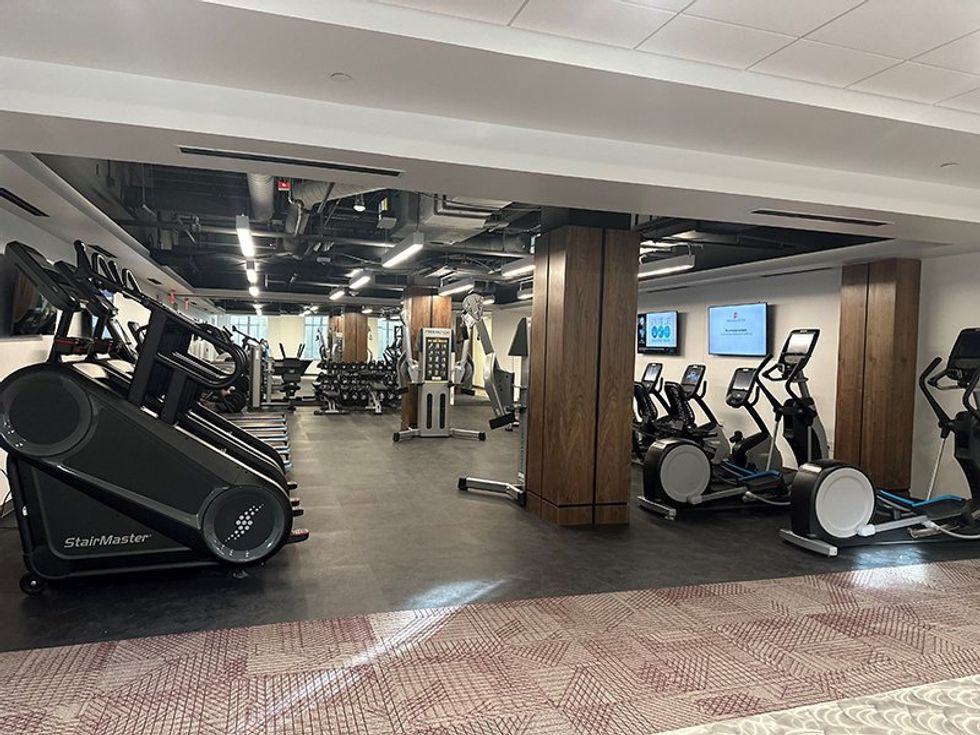
Cigna donated a wellness center as a part of the renovation. Photo via houstontx.gov

Ad Placement 300x100
Ad Placement 300x600

CultureMap Emails are Awesome

Texas could topple Virginia as biggest data-center market by 2030, JLL report says

data analysis

Everything’s bigger in Texas, they say—and that phrase now applies to the state’s growing data-center presence.

A new report from commercial real estate services provider JLL says Texas could overtake Northern Virginia as the world’s largest data-center market by 2030. Northern Virginia is a longtime holder of that title.

What’s driving Texas’ increasingly larger role in the data-center market? The key factor is artificial intelligence.

Companies like Google and Microsoft need more energy-hungry data centers to power AI innovations. In a 2023 article, Forbes explained that AI models consume a lot of energy because of the massive amount of data used to train them, as well as the complexity of those models and the rising volume of tasks assigned to AI.

“The data-center sector has officially entered hyperdrive,” Andy Cvengros, executive managing director at JLL and co-leader of its U.S. data-center business, said in the report. “Record-low vacancy sustained over two consecutive years provides compelling evidence against bubble concerns, especially when nearly all our massive construction pipeline is already pre-committed by investment-grade tenants.”

Dallas-Fort Worth has long dominated the Texas data-center market. But in recent years, West Texas has emerged as a popular territory for building data-center campuses, thanks in large part to an abundance of land and energy. Nearly two-thirds of data-center construction underway now is happening in “frontier markets” like West Texas, Ohio, Tennessee and Wisconsin, the JLL report says.

Northern Virginia, the current data-center champ in the U.S., boasted a data-center market with 6,315 megawatts of capacity at the end of 2025, the report says. That compares with 2,423 megawatts in Dallas-Fort Worth, 1,700 megawatts in the Austin-San Antonio corridor, 200 megawatts in West Texas, and 164 megawatts in Houston.

Fervo taps into its hottest-ever geothermal reservoir

heat record

Things are heating up at Houston-based geothermal power company Fervo Energy.

Fervo recently drilled its hottest well so far at a new geothermal site in western Utah. Fewer than 11 days of drilling more than 11,000 feet deep at Project Blanford showed temperatures above 555 degrees Fahrenheit, which exceeds requirements for commercial viability. Fervo used proprietary AI-driven analytics for the test.

Hotter geothermal reservoirs produce more energy and improve what’s known as energy conversion efficiency, which is the ratio of useful energy output to total energy input.

“Fervo’s exploration strategy has always been underpinned by the seamless integration of cutting-edge data acquisition and advanced analytics,” Jack Norbeck, Fervo’s co-founder and chief technology officer, said in a news release. “This latest ultra-high temperature discovery highlights our team’s ability to detect and develop EGS sweet spots using AI-enhanced geophysical techniques.”

Fervo says an independent review confirms the site’s multigigawatt potential.

The company has increasingly tapped into hotter and hotter geothermal reservoirs, going from 365 degrees at Project Red to 400 degrees at Cape Station and now more than 555 degrees at Blanford.

The new site expands Fervo’s geologic footprint. The Blanford reservoir consists of sedimentary formations such as sandstones, claystones and carbonates, which can be drilled more easily and cost-effectively than more commonly targeted granite formations.

Fervo ranks among the top-funded startups in the Houston area. Since its founding in 2017, the company has raised about $1.5 billion. In January, Fervo filed for an IPO that would value the company at $2 billion to $3 billion, according to Axios Pro.