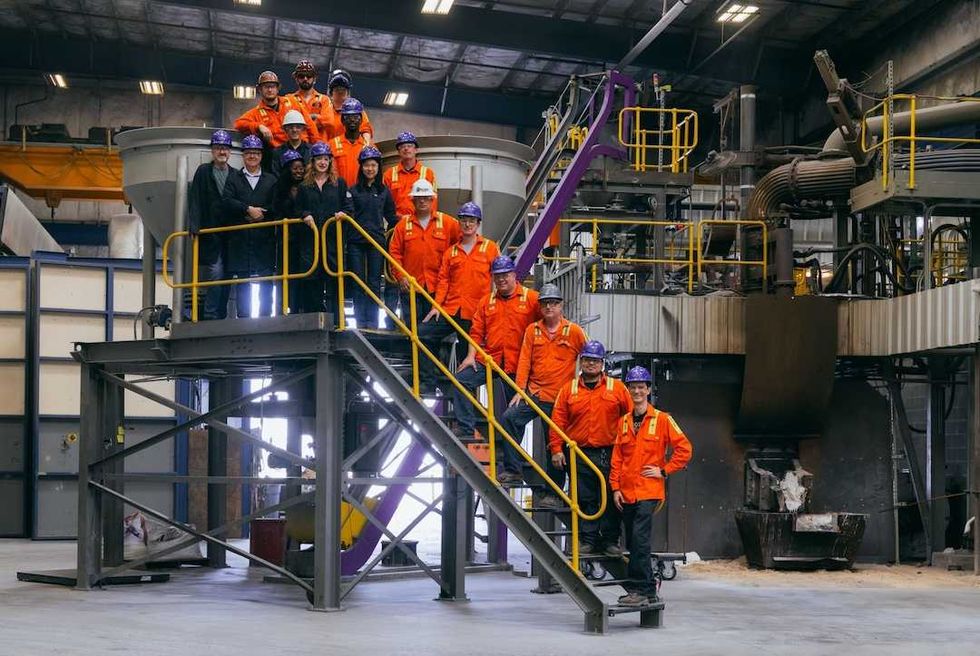
The process permanently stores some CO2 underground, reducing carbon emissions and carbon intensity. Photo courtesy UH

A new report from the University of Houston estimates that a method known as carbon dioxide-enhanced oil recovery (CO2-EOR) could recover roughly 137 billion barrels of U.S. oil—with Texas and the Gulf Coast poised to play a major role.

A UH Energy-produced white paper, titled “Revitalization of Mature Oil Fields: Opportunities and Challenges of CO2-EOR,” looks at how CO2-EOR could increase U.S. energy supply, reduce carbon emissions and lower the carbon intensity of oil production.

CO2-EOR injects pressurized carbon dioxide into mature oil wells to loosen and push oil trapped underground toward the production wells, allowing operators to extract oil typically left behind. The process permanently stores some CO2 underground, reducing carbon emissions and carbon intensity.

“Injected CO2 works to revitalize mature oil fields by reducing oil viscosity, improving sweep efficiency and restoring reservoir pressure, resulting in incremental oil production beyond primary and secondary recovery,” the report reads. “CO2-EOR also supports permanent carbon storage and by virtue of this will produce uniquely low-carbon intensity oil for global markets.”

Authored by Charles McConnell, executive director of UH's Center for Carbon Management in Energy, and Zhiyuan Li, a UH petroleum engineering doctoral candidate, the paper says that much of the opportunity lies right under the feet of Texas oil companies.

Texas and the Gulf Coast, including its offshore resources, have half of the nation's oil resources considered favorable for the CO2-EOR technology, the report says. According to UH, conventional U.S. oil reservoirs contain 624 billion barrels, with 434 billion barrels still underground, including about 20 billion barrels of proven reserves.

Still, the paper argues that the economics behind CO2-EOR need to be considered. The process’ success depends on a number of factors, including costs of carbon capture, field redevelopment, operations, monitoring, transportation and available tax incentives, according to UH.

Logistically, developing CO2-EOR operations out of older wells and infrastructure presents pros and cons. While using older wells can be more economical, aging infrastructure may require more frequent monitoring, inspection, repair or re-plugging, according to UH.

Ultimately, the report recommends focusing CO2-EOR development on mature oil fields with existing infrastructure, well-understood geology and reliable CO2 supplies. This approach, UH says, could help extend the productive life of existing oil fields while supporting “lower carbon intensity oil for global markets and a significant contribution to energy security.”

Read the full report here.
Ad Placement 300x100
Ad Placement 300x600

CultureMap Emails are Awesome

Amazon's EV robotaxi service Zook is set to arrive in Houston

EV News

Amazon-owned electric robotaxi ride-hailing service Zoox is zooming into Houston in September.

Initially, self-driving retrofitted SUVs with safety drivers on board will serve downtown Houston, centrally located tourist hotspots, and certain residential neighborhoods. The SUVs will test Houston roads before Zoox rolls out autonomous robotaxis, the company says.

Zoox takes Houston for a test drive

At the outset, Zoox says, a limited number of vehicles will be driven by people to gather data about Houston roads.

“This helps create a detailed picture of each street, from road geometry to traffic lights,” the company says. “Once we have mapped out an area, we will test autonomous driving capabilities. Safety and operational readiness govern the pace of our rollout.”

Zoox says its robotaxi differs from vehicles operated by other ride-hailing services.

The all-electric robotaxi “is purpose-built for autonomous ride-hailing and designed for riders from day one,” the company says. “It has no traditional driving controls and instead has carriage-style seating, sliding glass doors, and features that let the rider personalize their journey.”

To help manage the fleet, Zoox plans to open a depot in Houston for vehicle charging and maintenance, a representative says via email.

Along with Houston, Zoox is launching this month in San Diego. The ride-hailing service already operates in Austin, Dallas, Atlanta, Las Vegas, Los Angeles, Miami, Phoenix, the San Francisco Bay Area, Seattle, and Washington, D.C.

Zoox breaks into “sprawling” Houston market

Zoox describes Houston as its “most sprawling market to date.”

“Driving here means navigating complex service-road networks, unique merging scenarios, and challenging environmental conditions, including severe heat, heavy rain, and urban flooding,” the company says. “It’s a rigorous test of our technology across geography and terrain.”

Zoox will join two other autonomous ride-hailing services in Houston:

  • Waymo began rolling in Houston in February. Alphabet, the parent company of Google, owns Waymo.
  • Electric vehicle manufacturer Tesla began offering robotaxi services earlier this year.

A third Zoox competitor is arriving within the next year. A partnership comprising rideshare provider Uber, EV manufacturer Lucid, and autonomous technology company Nuro plans to launch a robotaxi service in Houston by mid-2027.

---

This article originally appeared on CultureMap.com.

San Antonio company breaks ground on 347MW solar project outside of Houston

coming soon

Crews have broken ground on the forthcoming 347-megawatt direct-current SunRoper Solar project in Wharton County, Texas, that will add capacity to the ERCOT grid.

The solar project, which is slated to begin operations in December 2027, will provide electricity to an undisclosed Fortune 100 company under a long-term power purchase agreement, according to a news release.

San Antonio’s OCI Energy and Israel's Arava Power are developing the project. It's being financed by ING Capital and constructed by Louisiana-based WHC Inc. The project received $394 million in construction financing in February.

"SunRoper demonstrates how strategic partnerships can help meet Texas' growing demand for electricity through investments in critical energy infrastructure," Sabah Bayatli, president of OCI Energy, said in the release.

Project partners, landowners and company executives attended a groundbreaking event for SunRoper on Sept. 1 at the site outside of the Houston metro area. The companies say they are advancing this energy project to strengthen grid reliability and to help deliver affordable power to one of the highest-demand areas in the state.

“WHC is proud to serve as EPC contractor on the SunRoper Solar project, bringing our construction expertise to bear on a facility that will deliver meaningful power to the Houston region,” Randel Badeaux, president of power North America for WHC, added in the news release. “This groundbreaking reflects months of careful planning and coordination with OCI Energy, Arava Power and our project partners, and we look forward to executing a safe, high-quality build through to completion in 2027.”

OCI Energy currently operates several utility-scale solar and battery energy storage system projects outside of the San Antonio area, and has five other projects under construction outside of San Antonio and Waco, with more than 30 under development in Arkansas, Mississippi, Georgia, Colorado and Alberta, Canada. The company also has existing projects in New Jersey and Georgia.

In $2 billion deal, NVIDIA takes 20% stake in Woodlands-based Lancium

power play

With an initial investment of $2 billion, AI chip manufacturer NVIDIA just acquired a 20 percent stake in The Woodlands-based Lancium, which develops large-scale campuses that combine AI data centers and onsite power supplies.

Lancium recently announced the investment but didn’t disclose the dollar amount. The Information news website reported NVIDIA’s investment totaled $2 billion, with the possibility of an additional $1 billion if Lancium achieves certain milestones.

Dealroom.co calls NVIDIA’s investment a “form of supply-chain insurance.”

NVIDIA “is gaining exposure to the scarce physical assets that determine whether its chips can be deployed,” Dealroom.co says. “The move makes Nvidia look less like a pure chip company and more like an allocator of infrastructure capacity.”

Investment precedes possible IPO in 2027

Thanks to NVIDIA’s cash infusion, Lancium and its portfolio of land and power connections carry an enterprise value of about $10 billion, according to The Information.

The investment should enable Lancium to expand as it explores a potential IPO next year, The Information reported.

Neither Lancium nor NVIDIA is responding to requests for comment about the deal.

Lancium’s marquee project is a 1,000-acre data center and power generation campus in West Texas for the $500 billion Stargate initiative. Stargate, a joint venture comprising MGX, OpenAI, Oracle and SoftBank, is building data centers equipped to handle AI-level workloads.

“Epicenter of energy and AI infrastructure”

Founded in 2017, Lancium has 4 gigawatts of leased capacity and a more than 15-gigawatt development pipeline. In 2024, Blackstone Energy Transition Partners invested about $500 million in Lancium, giving Blackstone a roughly 50 percent stake.

“This partnership with NVIDIA is a strong testament to Lancium’s position at the epicenter of energy and AI infrastructure … . We look forward to continuing to partner with these leading companies to help power the next generation of AI innovation,” Bilal Khan, senior managing director at Blackstone, said in a release.

Through the NVIDIA partnership, Lancium’s data center and power generation campuses will use the tech company’s “AI factory” platform, including software, computing, and networking capabilities. This will give NVIDIA customers and partners access to power capacity that supports heavy AI workloads.

“We have spent years assembling the power, the land, and the infrastructure expertise needed to deliver AI data center capacity at a scale the world has never seen,” Michael McNamara, co-founder and CEO of Lancium, said in the release.

“Partnering with NVIDIA — the definitive technology platform for AI computing — ensures that every campus in our portfolio will be deployed with the industry’s most advanced technology and that NVIDIA’s customers will have access to the capacity they need to compete and lead in the AI era.”