fresh funding
Texas A&M wins $5.4M DOE grant for advanced nuclear fuel research
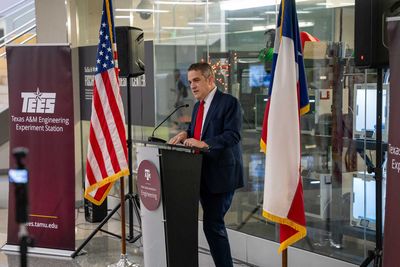
U.S. Deputy Secretary of Energy James P. Danly awarded the grant to Texas A&M Engineering Experiment Station on Oct. 29. Photo by Danny Palomba/Texas A&M University College of Engineering
The U.S. Department of Energy has awarded Texas A&M Engineering Experiment Station (TEES) a $5.4 million grant to research ways to turn nuclear waste into fuel.
The goal of the project, “Turning Nuclear Waste into Fuel with a Thorium Molten Salt Reactor,” is to develop innovative reactor fuel technology that could help transform long-lived nuclear waste into a valuable energy resource while advancing the future of nuclear power, according to Texas A&M.
Lin Shao, a Texas A&M professor of nuclear engineering, will lead the project and unite researchers from TEES, Savannah River National Laboratory and Abilene, Texas-based nuclear power company Natura Resources. The team will use experimental testing, fuel preparation, reactor design and computational modeling in their work.
“Texas A&M Engineering is honored to receive this support from the Department of Energy to advance groundbreaking nuclear energy technologies,” Robert H. Bishop, vice chancellor and dean of Texas A&M Engineering and director of TEES, said in a news release. “This research aligns directly with our mission to solve the nation’s most pressing engineering challenges through innovation and collaboration. We have an opportunity to develop solutions that reduce nuclear waste, improve energy reliability and help maintain American leadership in advanced nuclear technologies.”
Texas A&M’s award is part of the DOE's Advanced Research Projects Agency-Energy (ARPA-E) $50 million advancement for next-generation nuclear fuels through the High-performance Optimized Recycled Nuclear Isotopes for Gen IV reactors (HORNIG) program. Texas A&M was one of eight projects selected as part of the ARPA-E efforts.
“America’s energy future depends on bold innovation and strong partnerships between the federal government, national laboratories, universities and industry,” U.S. Deputy Secretary of Energy James P. Danly said when he awarded the grant on campus Oct. 29. “This project demonstrates how we can address long-term nuclear waste challenges while advancing technologies that strengthen our nation’s energy security. The Department of Energy is proud to support research that has the potential to unlock new value from existing nuclear materials and accelerate the deployment of advanced reactor systems.”